 Add to Chrome
 Add to Firefox
 Add to Edge
GALACTIC: Global and Local Agnostic Counterfactuals for Time-series Clustering
Mar 05, 2026
Time-series clustering is a fundamental tool for pattern discovery, yet existing explainability methods, primarily based on feature attribution or metadata, fail to identify the transitions that move an instance across cluster boundaries. While Counterfactual Explanations (CEs) identify the minimal temporal perturbations required to alter the prediction of a model, they have been mostly confined to supervised settings. This paper introduces GALACTIC, the first unified framework to bridge local and global counterfactual explainability for unsupervised time-series clustering. At instance level (local), GALACTIC generates perturbations via a cluster-aware optimization objective that respects the target and underlying cluster assignments. At cluster level (global), to mitigate cognitive load and enhance interpretability, we formulate a representative CE selection problem. We propose a Minimum Description Length (MDL) objective to extract a non-redundant summary of global explanations that characterize the transitions between clusters. We prove that our MDL objective is supermodular, which allows the corresponding MDL reduction to be framed as a monotone submodular set function. This enables an efficient greedy selection algorithm with provable $(1-1/e)$ approximation guarantees. Extensive experimental evaluation on the UCR Archive demonstrates that GALACTIC produces significantly sparser local CEs and more concise global summaries than state-of-the-art baselines adapted for our problem, offering the first unified approach for interpreting clustered time-series through counterfactuals.

UGCE: User-Guided Incremental Counterfactual Exploration
May 27, 2025Counterfactual explanations (CFEs) are a popular approach for interpreting machine learning predictions by identifying minimal feature changes that alter model outputs. However, in real-world settings, users often refine feasibility constraints over time, requiring counterfactual generation to adapt dynamically. Existing methods fail to support such iterative updates, instead recomputing explanations from scratch with each change, an inefficient and rigid approach. We propose User-Guided Incremental Counterfactual Exploration (UGCE), a genetic algorithm-based framework that incrementally updates counterfactuals in response to evolving user constraints. Experimental results across five benchmark datasets demonstrate that UGCE significantly improves computational efficiency while maintaining high-quality solutions compared to a static, non-incremental approach. Our evaluation further shows that UGCE supports stable performance under varying constraint sequences, benefits from an efficient warm-start strategy, and reveals how different constraint types may affect search behavior.
FGCE: Feasible Group Counterfactual Explanations for Auditing Fairness
Oct 29, 2024

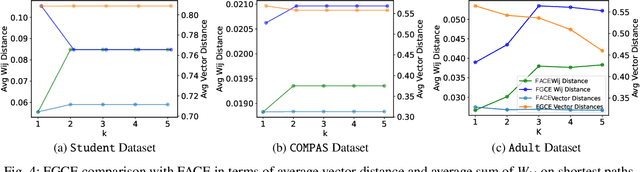
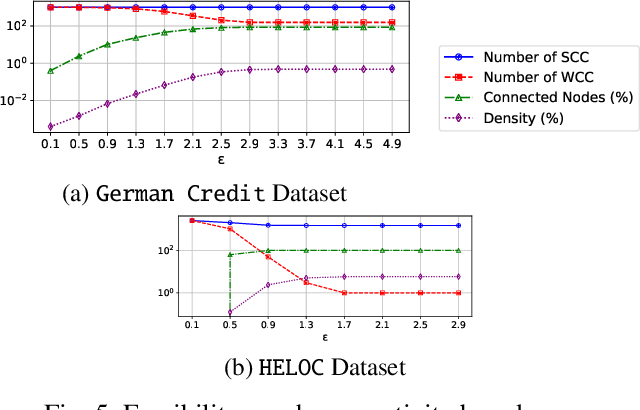
This paper introduces the first graph-based framework for generating group counterfactual explanations to audit model fairness, a crucial aspect of trustworthy machine learning. Counterfactual explanations are instrumental in understanding and mitigating unfairness by revealing how inputs should change to achieve a desired outcome. Our framework, named Feasible Group Counterfactual Explanations (FGCEs), captures real-world feasibility constraints and constructs subgroups with similar counterfactuals, setting it apart from existing methods. It also addresses key trade-offs in counterfactual generation, including the balance between the number of counterfactuals, their associated costs, and the breadth of coverage achieved. To evaluate these trade-offs and assess fairness, we propose measures tailored to group counterfactual generation. Our experimental results on benchmark datasets demonstrate the effectiveness of our approach in managing feasibility constraints and trade-offs, as well as the potential of our proposed metrics in identifying and quantifying fairness issues.
On Explaining Unfairness: An Overview
Feb 16, 2024Algorithmic fairness and explainability are foundational elements for achieving responsible AI. In this paper, we focus on their interplay, a research area that is recently receiving increasing attention. To this end, we first present two comprehensive taxonomies, each representing one of the two complementary fields of study: fairness and explanations. Then, we categorize explanations for fairness into three types: (a) Explanations to enhance fairness metrics, (b) Explanations to help us understand the causes of (un)fairness, and (c) Explanations to assist us in designing methods for mitigating unfairness. Finally, based on our fairness and explanation taxonomies, we present undiscovered literature paths revealing gaps that can serve as valuable insights for future research.