 Add to Chrome
 Add to Firefox
 Add to Edge
3D Blood Pulsation Maps
Dec 11, 2025
We present Pulse3DFace, the first dataset of its kind for estimating 3D blood pulsation maps. These maps can be used to develop models of dynamic facial blood pulsation, enabling the creation of synthetic video data to improve and validate remote pulse estimation methods via photoplethysmography imaging. Additionally, the dataset facilitates research into novel multi-view-based approaches for mitigating illumination effects in blood pulsation analysis. Pulse3DFace consists of raw videos from 15 subjects recorded at 30 Hz with an RGB camera from 23 viewpoints, blood pulse reference measurements, and facial 3D scans generated using monocular structure-from-motion techniques. It also includes processed 3D pulsation maps compatible with the texture space of the 3D head model FLAME. These maps provide signal-to-noise ratio, local pulse amplitude, phase information, and supplementary data. We offer a comprehensive evaluation of the dataset's illumination conditions, map consistency, and its ability to capture physiologically meaningful features in the facial and neck skin regions.

Federated Learning with Heterogeneous Data Handling for Robust Vehicular Object Detection
May 02, 2024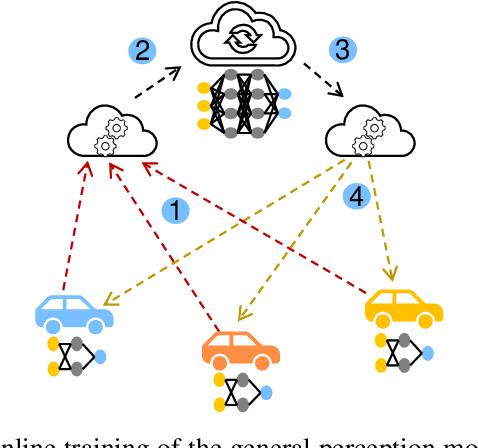
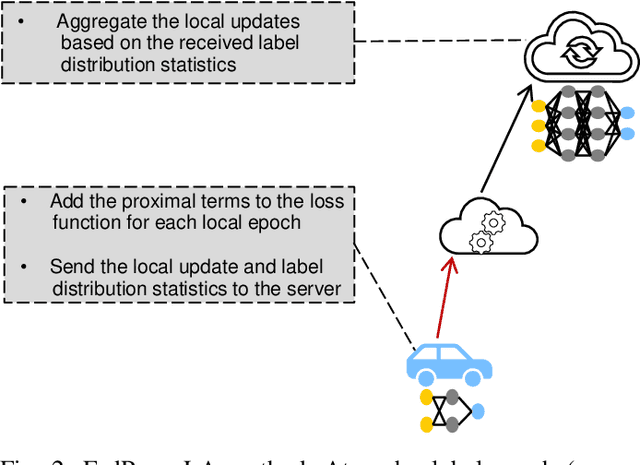
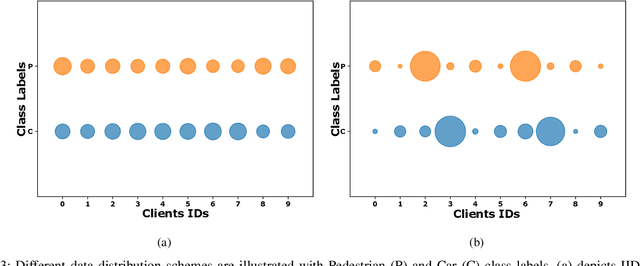
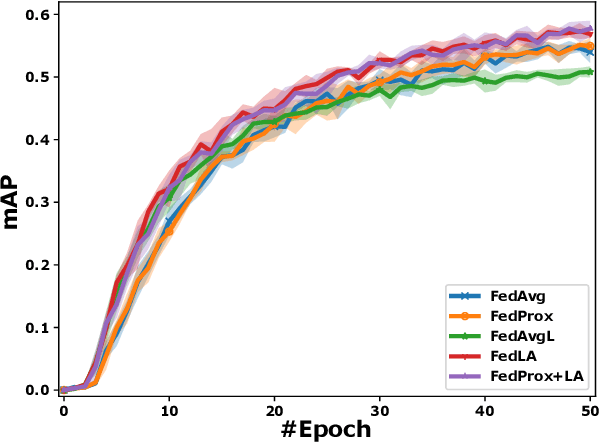
In the pursuit of refining precise perception models for fully autonomous driving, continual online model training becomes essential. Federated Learning (FL) within vehicular networks offers an efficient mechanism for model training while preserving raw sensory data integrity. Yet, FL struggles with non-identically distributed data (e.g., quantity skew), leading to suboptimal convergence rates during model training. In previous work, we introduced FedLA, an innovative Label-Aware aggregation method addressing data heterogeneity in FL for generic scenarios. In this paper, we introduce FedProx+LA, a novel FL method building upon the state-of-the-art FedProx and FedLA to tackle data heterogeneity, which is specifically tailored for vehicular networks. We evaluate the efficacy of FedProx+LA in continuous online object detection model training. Through a comparative analysis against conventional and state-of-the-art methods, our findings reveal the superior convergence rate of FedProx+LA. Notably, if the label distribution is very heterogeneous, our FedProx+LA approach shows substantial improvements in detection performance compared to baseline methods, also outperforming our previous FedLA approach. Moreover, both FedLA and FedProx+LA increase convergence speed by 30% compared to baseline methods.