 Add to Chrome
 Add to Firefox
 Add to Edge
Cross-Sample Augmented Test-Time Adaptation for Personalized Intraoperative Hypotension Prediction
Dec 12, 2025
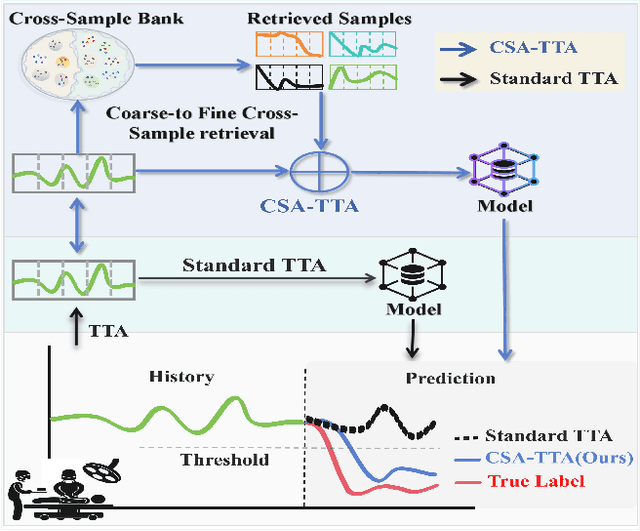
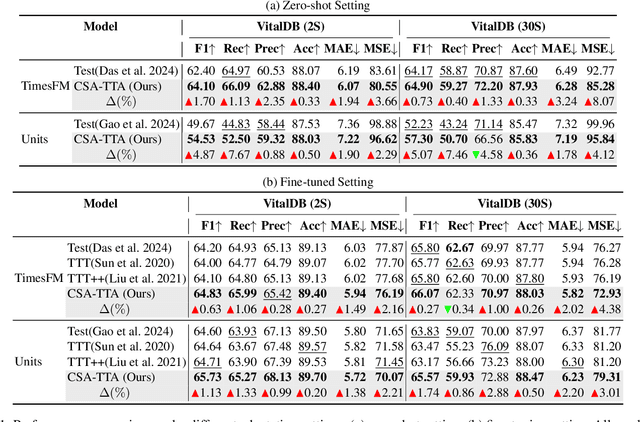

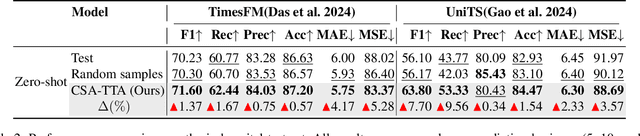
Intraoperative hypotension (IOH) poses significant surgical risks, but accurate prediction remains challenging due to patient-specific variability. While test-time adaptation (TTA) offers a promising approach for personalized prediction, the rarity of IOH events often leads to unreliable test-time training. To address this, we propose CSA-TTA, a novel Cross-Sample Augmented Test-Time Adaptation framework that enhances training by incorporating hypotension events from other individuals. Specifically, we first construct a cross-sample bank by segmenting historical data into hypotensive and non-hypotensive samples. Then, we introduce a coarse-to-fine retrieval strategy for building test-time training data: we initially apply K-Shape clustering to identify representative cluster centers and subsequently retrieve the top-K semantically similar samples based on the current patient signal. Additionally, we integrate both self-supervised masked reconstruction and retrospective sequence forecasting signals during training to enhance model adaptability to rapid and subtle intraoperative dynamics. We evaluate the proposed CSA-TTA on both the VitalDB dataset and a real-world in-hospital dataset by integrating it with state-of-the-art time series forecasting models, including TimesFM and UniTS. CSA-TTA consistently enhances performance across settings-for instance, on VitalDB, it improves Recall and F1 scores by +1.33% and +1.13%, respectively, under fine-tuning, and by +7.46% and +5.07% in zero-shot scenarios-demonstrating strong robustness and generalization.

MultiEYE: Dataset and Benchmark for OCT-Enhanced Retinal Disease Recognition from Fundus Images
Dec 12, 2024


Existing multi-modal learning methods on fundus and OCT images mostly require both modalities to be available and strictly paired for training and testing, which appears less practical in clinical scenarios. To expand the scope of clinical applications, we formulate a novel setting, "OCT-enhanced disease recognition from fundus images", that allows for the use of unpaired multi-modal data during the training phase and relies on the widespread fundus photographs for testing. To benchmark this setting, we present the first large multi-modal multi-class dataset for eye disease diagnosis, MultiEYE, and propose an OCT-assisted Conceptual Distillation Approach (OCT-CoDA), which employs semantically rich concepts to extract disease-related knowledge from OCT images and leverage them into the fundus model. Specifically, we regard the image-concept relation as a link to distill useful knowledge from the OCT teacher model to the fundus student model, which considerably improves the diagnostic performance based on fundus images and formulates the cross-modal knowledge transfer into an explainable process. Through extensive experiments on the multi-disease classification task, our proposed OCT-CoDA demonstrates remarkable results and interpretability, showing great potential for clinical application. Our dataset and code are available at https://github.com/xmed-lab/MultiEYE.