 Add to Chrome
 Add to Firefox
 Add to Edge
Cross-Sample Augmented Test-Time Adaptation for Personalized Intraoperative Hypotension Prediction
Dec 12, 2025
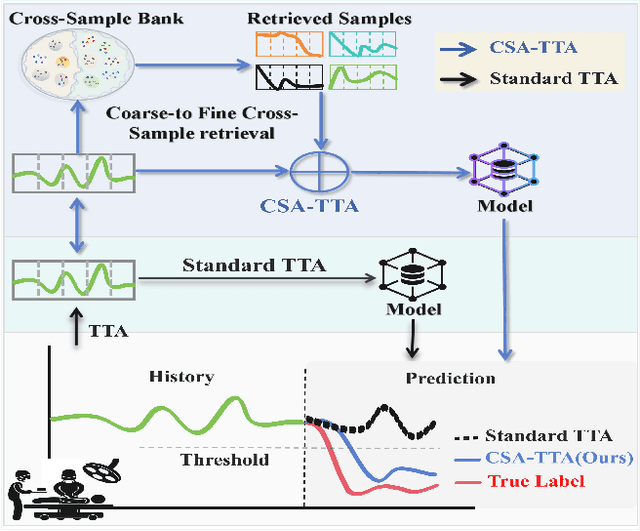
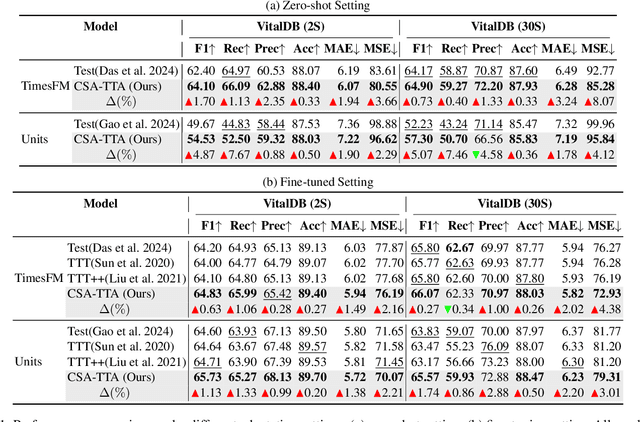

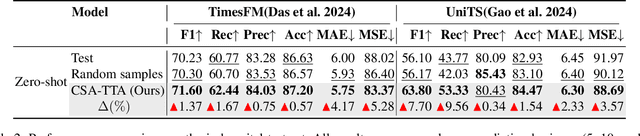
Intraoperative hypotension (IOH) poses significant surgical risks, but accurate prediction remains challenging due to patient-specific variability. While test-time adaptation (TTA) offers a promising approach for personalized prediction, the rarity of IOH events often leads to unreliable test-time training. To address this, we propose CSA-TTA, a novel Cross-Sample Augmented Test-Time Adaptation framework that enhances training by incorporating hypotension events from other individuals. Specifically, we first construct a cross-sample bank by segmenting historical data into hypotensive and non-hypotensive samples. Then, we introduce a coarse-to-fine retrieval strategy for building test-time training data: we initially apply K-Shape clustering to identify representative cluster centers and subsequently retrieve the top-K semantically similar samples based on the current patient signal. Additionally, we integrate both self-supervised masked reconstruction and retrospective sequence forecasting signals during training to enhance model adaptability to rapid and subtle intraoperative dynamics. We evaluate the proposed CSA-TTA on both the VitalDB dataset and a real-world in-hospital dataset by integrating it with state-of-the-art time series forecasting models, including TimesFM and UniTS. CSA-TTA consistently enhances performance across settings-for instance, on VitalDB, it improves Recall and F1 scores by +1.33% and +1.13%, respectively, under fine-tuning, and by +7.46% and +5.07% in zero-shot scenarios-demonstrating strong robustness and generalization.

Embodied Multi-Modal Agent trained by an LLM from a Parallel TextWorld
Nov 28, 2023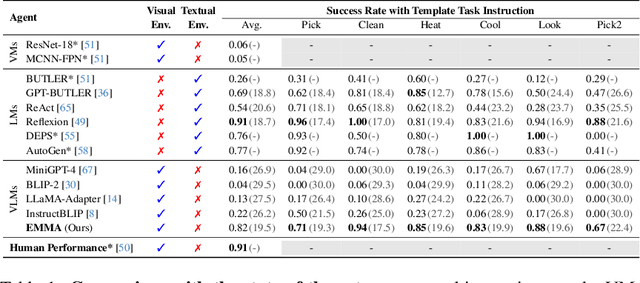
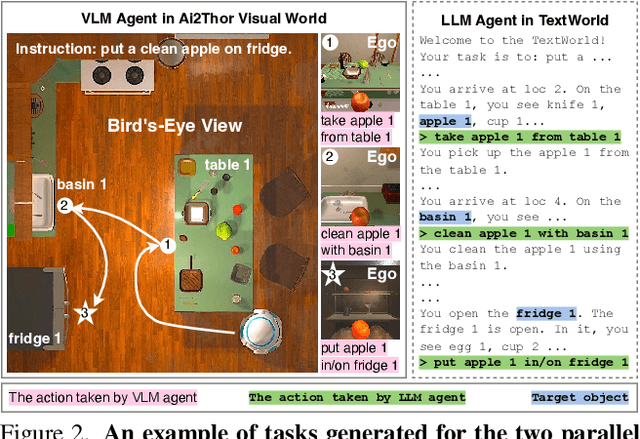
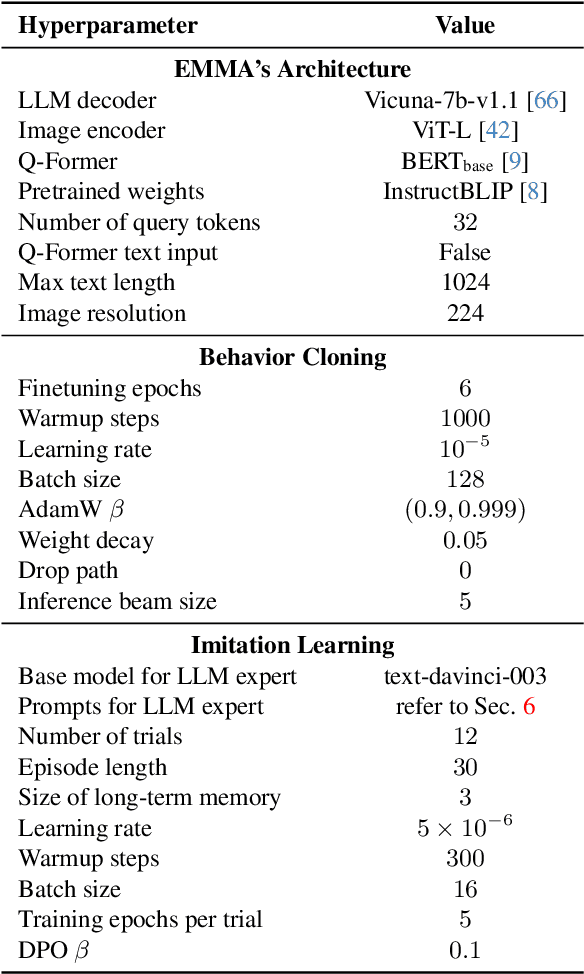
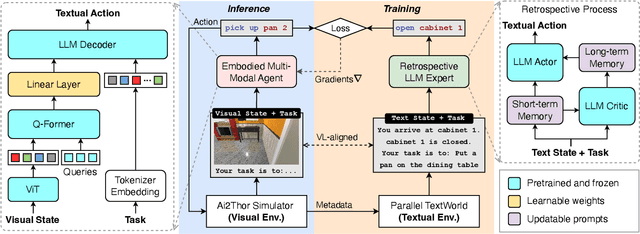
While large language models (LLMs) excel in a simulated world of texts, they struggle to interact with the more realistic world without perceptions of other modalities such as visual or audio signals. Although vision-language models (VLMs) integrate LLM modules (1) aligned with static image features, and (2) may possess prior knowledge of world dynamics (as demonstrated in the text world), they have not been trained in an embodied visual world and thus cannot align with its dynamics. On the other hand, training an embodied agent in a noisy visual world without expert guidance is often challenging and inefficient. In this paper, we train a VLM agent living in a visual world using an LLM agent excelling in a parallel text world (but inapplicable to the visual world). Specifically, we distill LLM's reflection outcomes (improved actions by analyzing mistakes) in a text world's tasks to finetune the VLM on the same tasks of the visual world, resulting in an Embodied Multi-Modal Agent (EMMA) quickly adapting to the visual world dynamics. Such cross-modality imitation learning between the two parallel worlds enables EMMA to generalize to a broad scope of new tasks without any further guidance from the LLM expert. Extensive evaluations on the ALFWorld benchmark highlight EMMA's superior performance to SOTA VLM-based agents across diverse tasks, e.g., 20%-70% improvement in the success rate.