 Add to Chrome
 Add to Firefox
 Add to Edge
MyoSem: Aligning Electromyography to Natural-Language Action Semantics for Hand Action Understanding
May 29, 2026
Electromyography (EMG) directly reflects muscle activation and is a key sensing modality for gesture recognition, prosthetic control, and wearable interaction. Existing EMG methods, however, commonly formulate hand action understanding as classification over fixed labels, making it difficult to support querying, retrieval, and generalization based on action descriptions. We present MyoSem, an EMG--action semantic alignment framework that maps low-level EMG signals into a shared semantic space constructed from multi-view action descriptions. MyoSem combines multi-view action-semantic construction, activation-aware EMG encoding, and semantic query alignment, enabling bidirectional retrieval between EMG signals and text descriptions. We systematically evaluate MyoSem on EMG2Pose and NinaPro-series datasets. Results show that MyoSem performs well on EMG--text bidirectional retrieval, generally outperforms most baselines, and shows favorable generalization to unseen users, held-out action classes, and amputee-user transfer scenarios. Ablations and visualizations further validate the effectiveness of each module. Overall, MyoSem advances EMG-based hand action understanding from fixed-label recognition toward queryable bidirectional semantic retrieval, providing a new modeling paradigm for language-mediated EMG action understanding.

Collaborative Medical Triage under Uncertainty: A Multi-Agent Dynamic Matching Approach
Jul 30, 2025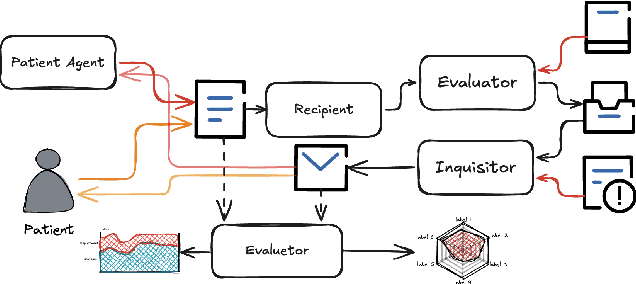
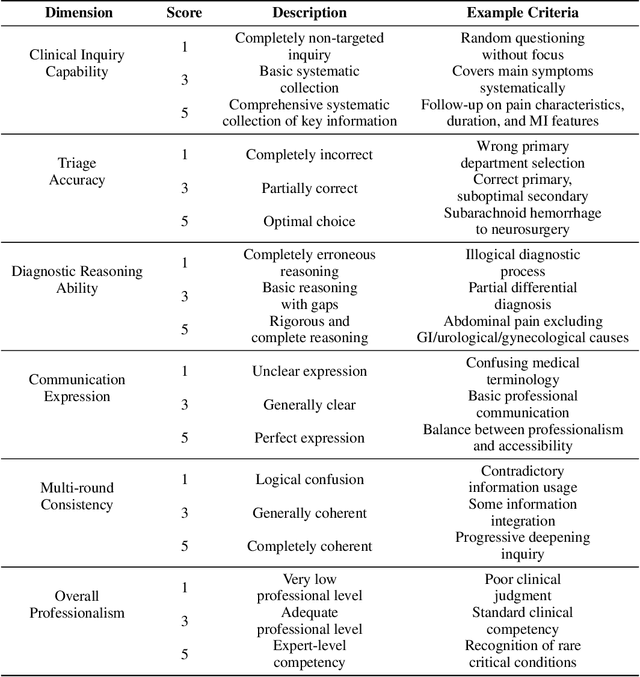
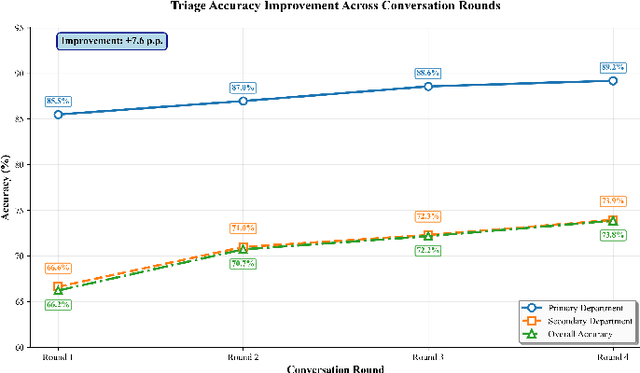
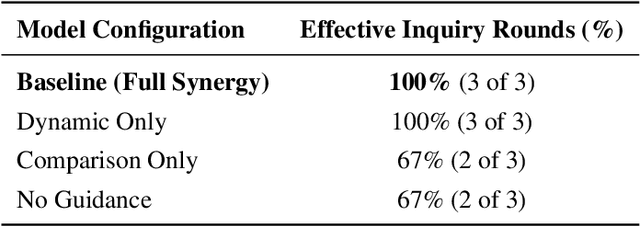
The post-pandemic surge in healthcare demand, coupled with critical nursing shortages, has placed unprecedented pressure on emergency department triage systems, necessitating innovative AI-driven solutions. We present a multi-agent interactive intelligent system for medical triage that addresses three fundamental challenges in current AI-based triage systems: insufficient medical specialization leading to hallucination-induced misclassifications, heterogeneous department structures across healthcare institutions, and inefficient detail-oriented questioning that impedes rapid triage decisions. Our system employs three specialized agents - RecipientAgent, InquirerAgent, and DepartmentAgent - that collaborate through structured inquiry mechanisms and department-specific guidance rules to transform unstructured patient symptoms into accurate department recommendations. To ensure robust evaluation, we constructed a comprehensive Chinese medical triage dataset from a medical website, comprising 3,360 real-world cases spanning 9 primary departments and 62 secondary departments. Through systematic data imputation using large language models, we address the prevalent issue of incomplete medical records in real-world data. Experimental results demonstrate that our multi-agent system achieves 89.2% accuracy in primary department classification and 73.9% accuracy in secondary department classification after four rounds of patient interaction. The system's pattern-matching-based guidance mechanisms enable efficient adaptation to diverse hospital configurations while maintaining high triage accuracy. Our work provides a scalable framework for deploying AI-assisted triage systems that can accommodate the organizational heterogeneity of healthcare institutions while ensuring clinically sound decision-making.