 Add to Chrome
 Add to Firefox
 Add to Edge
TactiDex: A Real-World Tactile-Guided Benchmark for Human-Like Dexterous Manipulation
Jul 10, 2026
Tactile feedback is fundamental to Hand-Object Interaction (HOI), governing contact formation, force regulation, and stable manipulation, making it essential for achieving true human-like dexterous manipulation. Yet, current human-to-robot dexterous transfer pipelines primarily rely on kinematic trajectories, resulting in motion imitation without physically grounded interaction. To address this, we introduce TactiDex, a real-world tactile-guided benchmark specifically designed to move dexterous manipulation beyond kinematic mimicry toward contact-level human-likeness. TactiDex provides a comprehensive dataset that elegantly aligns whole-hand tactile signals with multi-granularity kinematic and object states, coupled with standardized evaluation metrics. Building upon this data paradigm, we propose a tactile-driven transfer framework that effectively translates human demonstrations into physically plausible robotic execution. We introduce TactiSkill, a framework built upon a novel tri-component tactile reward that innovatively uses tactile signals as structured supervision. This reward unifies guidance, human-like alignment, and contact constraints into a single objective. Through comprehensive experiments on both single and bimanual tasks, we demonstrate that TactiSkill achieves superior performance in manipulation success and physical realism. This work lays a crucial foundation for advancing tactile-aware dexterous manipulation. Our project page at https://tactidex.github.io/.

One Policy but Many Worlds: A Scalable Unified Policy for Versatile Humanoid Locomotion
May 24, 2025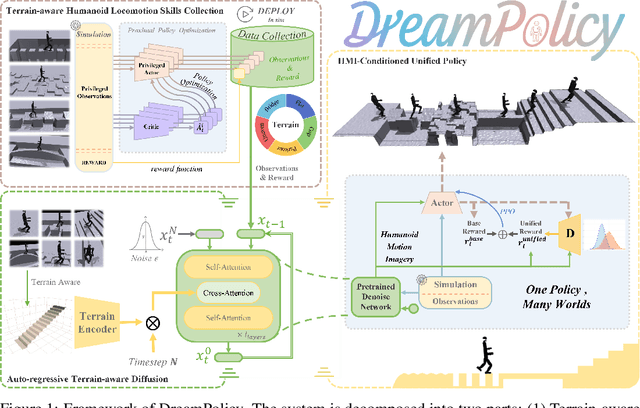
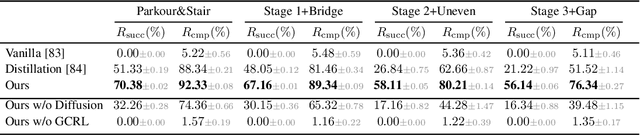
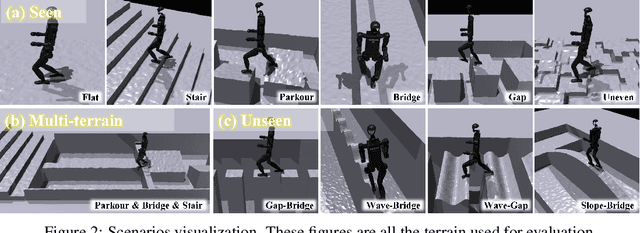
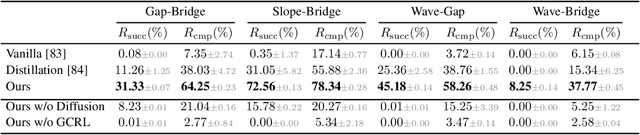
Humanoid locomotion faces a critical scalability challenge: traditional reinforcement learning (RL) methods require task-specific rewards and struggle to leverage growing datasets, even as more training terrains are introduced. We propose DreamPolicy, a unified framework that enables a single policy to master diverse terrains and generalize zero-shot to unseen scenarios by systematically integrating offline data and diffusion-driven motion synthesis. At its core, DreamPolicy introduces Humanoid Motion Imagery (HMI) - future state predictions synthesized through an autoregressive terrain-aware diffusion planner curated by aggregating rollouts from specialized policies across various distinct terrains. Unlike human motion datasets requiring laborious retargeting, our data directly captures humanoid kinematics, enabling the diffusion planner to synthesize "dreamed" trajectories that encode terrain-specific physical constraints. These trajectories act as dynamic objectives for our HMI-conditioned policy, bypassing manual reward engineering and enabling cross-terrain generalization. DreamPolicy addresses the scalability limitations of prior methods: while traditional RL fails to exploit growing datasets, our framework scales seamlessly with more offline data. As the dataset expands, the diffusion prior learns richer locomotion skills, which the policy leverages to master new terrains without retraining. Experiments demonstrate that DreamPolicy achieves average 90% success rates in training environments and an average of 20% higher success on unseen terrains than the prevalent method. It also generalizes to perturbed and composite scenarios where prior approaches collapse. By unifying offline data, diffusion-based trajectory synthesis, and policy optimization, DreamPolicy overcomes the "one task, one policy" bottleneck, establishing a paradigm for scalable, data-driven humanoid control.