 Add to Chrome
 Add to Firefox
 Add to Edge
Zhinv: Real-time hub-height wind field reconstruction using only local sparse observations
Jul 28, 2026
The high proportion of wind power connected to the grid places higher demands on fine-grained knowledge of regional wind fields. Since the wind information directly obtainable in actual operations is mostly sparse, discrete, and irregularly distributed local observations, it is difficult to directly meet the needs of tasks such as wind power regulation, wind resource assessment, and low-altitude environmental perception of continuous regional wind fields. Therefore, we propose Zhinv, an end-to-end reconstruction framework that directly weaves sparse and irregular observations into a fine-grid wind field at hub-height. Experiments in Northeast China, Europe, and Southeast Asia demonstrate that Zhinv can accurately, robustly, and efficiently reconstruct fine-grid wind fields from sparse observations, reducing the error by about 66% compared with Kriging. With local wind-power observations as input, Zhinv enables wind power centers to bypass NWP and complex assimilation processes, supporting direct and real-time wind resource assessment from locally available data.

Meta-Inverse Physics-Informed Neural Networks for High-Dimensional Ordinary Differential Equations
May 05, 2026Solving inverse problems in dynamical systems governed by high-dimensional coupled ordinary differential equations (ODEs) is a ubiquitous challenge in scientific machine learning. In many real-world applications, researchers seek to uncover unknown parameters or model unknown dynamics even as the underlying physics is only partially characterized, and observations are sparse and limited to specific measurable channels. While physics-informed neural networks (PINNs) are ideal for inverse inference under partial observability, existing PINNs typically rely on task-specific joint optimization, which suffers from optimization difficulties and poor generalization. In this paper, we propose a meta-inverse physics-informed neural network (MI-PINN) that reformulates inverse modeling as a two-stage meta-learning problem. MI-PINN first learns a physics-aware representation across multiple tasks, and then performs inverse modeling by optimizing task-specific unknowns while keeping the learned representation fixed. This two-stage formulation significantly reduces the parameter search dimension, thereby improving sample efficiency and enabling accurate inference. To handle multi-scale dynamics common in these high-dimensional ODE systems, we further introduce an adaptive clustering-based multi-branch learning scheme. We demonstrate the effectiveness of MI-PINN on whole-body physiologically based pharmacokinetic (PBPK) models with up to 33 coupled ODEs, using paracetamol and theophylline under intravenous and oral dosing scenarios. Experimental results show that MI-PINN enables accurate recovery of masked kinetic parameters and reconstruction of missing mechanistic terms despite limited clinical observations.
Transferable Physics-Informed Representations via Closed-Form Head Adaptation
Apr 23, 2026Physics-informed neural networks (PINNs) have garnered significant interest for their potential in solving partial differential equations (PDEs) that govern a wide range of physical phenomena. By incorporating physical laws into the learning process, PINN models have demonstrated the ability to learn physical outcomes reasonably well. However, current PINN approaches struggle to predict or solve new PDEs effectively when there is a lack of training examples, indicating they do not generalize well to unseen problem instances. In this paper, we present a transferable learning approach for PINNs premised on a fast Pseudoinverse PINN framework (Pi-PINN). Pi-PINN learns a transferable physics-informed representation in a shared embedding space and enables rapid solving of both known and unknown PDE instances via closed-form head adaptation using a least-squares-optimal pseudoinverse under PDE constraints. We further investigate the synergies between data-driven multi-task learning loss and physics-informed loss, providing insights into the design of more performant PINNs. We demonstrate the effectiveness of Pi-PINN on various PDE problems, including Poisson's equation, Helmholtz equation, and Burgers' equation, achieving fast and accurate physics-informed solutions without requiring any data for unseen instances. Pi-PINN can produce predictions 100-1000 times faster than a typical PINN, while producing predictions with 10-100 times lower relative error than a typical data-driven model even with only two training samples. Overall, our findings highlight the potential of transferable representations with closed-form head adaptation to enhance the efficiency and generalization of PINNs across PDE families and scientific and engineering applications.
Scale-PINN: Learning Efficient Physics-Informed Neural Networks Through Sequential Correction
Feb 23, 2026Physics-informed neural networks (PINNs) have emerged as a promising mesh-free paradigm for solving partial differential equations, yet adoption in science and engineering is limited by slow training and modest accuracy relative to modern numerical solvers. We introduce the Sequential Correction Algorithm for Learning Efficient PINN (Scale-PINN), a learning strategy that bridges modern physics-informed learning with numerical algorithms. Scale-PINN incorporates the iterative residual-correction principle, a cornerstone of numerical solvers, directly into the loss formulation, marking a paradigm shift in how PINN losses can be conceived and constructed. This integration enables Scale-PINN to achieve unprecedented convergence speed across PDE problems from different physics domain, including reducing training time on a challenging fluid-dynamics problem for state-of-the-art PINN from hours to sub-2 minutes while maintaining superior accuracy, and enabling application to representative problems in aerodynamics and urban science. By uniting the rigor of numerical methods with the flexibility of deep learning, Scale-PINN marks a significant leap toward the practical adoption of PINNs in science and engineering through scalable, physics-informed learning. Codes are available at https://github.com/chiuph/SCALE-PINN.
Out-of-Distribution Generalization for Neural Physics Solvers
Jan 27, 2026Neural physics solvers are increasingly used in scientific discovery, given their potential for rapid in silico insights into physical, materials, or biological systems and their long-time evolution. However, poor generalization beyond their training support limits exploration of novel designs and long-time horizon predictions. We introduce NOVA, a route to generalizable neural physics solvers that can provide rapid, accurate solutions to scenarios even under distributional shifts in partial differential equation parameters, geometries and initial conditions. By learning physics-aligned representations from an initial sparse set of scenarios, NOVA consistently achieves 1-2 orders of magnitude lower out-of-distribution errors than data-driven baselines across complex, nonlinear problems including heat transfer, diffusion-reaction and fluid flow. We further showcase NOVA's dual impact on stabilizing long-time dynamical rollouts and improving generative design through application to the simulation of nonlinear Turing systems and fluidic chip optimization. Unlike neural physics solvers that are constrained to retrieval and/or emulation within an a priori space, NOVA enables reliable extrapolation beyond known regimes, a key capability given the need for exploration of novel hypothesis spaces in scientific discovery
Physics-Informed Uncertainty Enables Reliable AI-driven Design
Jan 26, 2026Inverse design is a central goal in much of science and engineering, including frequency-selective surfaces (FSS) that are critical to microelectronics for telecommunications and optical metamaterials. Traditional surrogate-assisted optimization methods using deep learning can accelerate the design process but do not usually incorporate uncertainty quantification, leading to poorer optimization performance due to erroneous predictions in data-sparse regions. Here, we introduce and validate a fundamentally different paradigm of Physics-Informed Uncertainty, where the degree to which a model's prediction violates fundamental physical laws serves as a computationally-cheap and effective proxy for predictive uncertainty. By integrating physics-informed uncertainty into a multi-fidelity uncertainty-aware optimization workflow to design complex frequency-selective surfaces within the 20 - 30 GHz range, we increase the success rate of finding performant solutions from less than 10% to over 50%, while simultaneously reducing computational cost by an order of magnitude compared to the sole use of a high-fidelity solver. These results highlight the necessity of incorporating uncertainty quantification in machine-learning-driven inverse design for high-dimensional problems, and establish physics-informed uncertainty as a viable alternative to quantifying uncertainty in surrogate models for physical systems, thereby setting the stage for autonomous scientific discovery systems that can efficiently and robustly explore and evaluate candidate designs.
Parametric Expensive Multi-Objective Optimization via Generative Solution Modeling
Nov 17, 2025Many real-world applications require solving families of expensive multi-objective optimization problems~(EMOPs) under varying operational conditions. This gives rise to parametric expensive multi-objective optimization problems (P-EMOPs) where each task parameter defines a distinct optimization instance. Current multi-objective Bayesian optimization methods have been widely used for finding finite sets of Pareto optimal solutions for individual tasks. However, P-EMOPs present a fundamental challenge: the continuous task parameter space can contain infinite distinct problems, each requiring separate expensive evaluations. This demands learning an inverse model that can directly predict optimized solutions for any task-preference query without expensive re-evaluation. This paper introduces the first parametric multi-objective Bayesian optimizer that learns this inverse model by alternating between (1) acquisition-driven search leveraging inter-task synergies and (2) generative solution sampling via conditional generative models. This approach enables efficient optimization across related tasks and finally achieves direct solution prediction for unseen parameterized EMOPs without additional expensive evaluations. We theoretically justify the faster convergence by leveraging inter-task synergies through task-aware Gaussian processes. Meanwhile, empirical studies in synthetic and real-world benchmarks further verify the effectiveness of our alternating framework.
Physics-Informed Neuro-Evolution (PINE): A Survey and Prospects
Jan 11, 2025Deep learning models trained on finite data lack a complete understanding of the physical world. On the other hand, physics-informed neural networks (PINNs) are infused with such knowledge through the incorporation of mathematically expressible laws of nature into their training loss function. By complying with physical laws, PINNs provide advantages over purely data-driven models in limited-data regimes. This feature has propelled them to the forefront of scientific machine learning, a domain characterized by scarce and costly data. However, the vision of accurate physics-informed learning comes with significant challenges. This review examines PINNs for the first time in terms of model optimization and generalization, shedding light on the need for new algorithmic advances to overcome issues pertaining to the training speed, precision, and generalizability of today's PINN models. Of particular interest are the gradient-free methods of neuroevolution for optimizing the uniquely complex loss landscapes arising in PINN training. Methods synergizing gradient descent and neuroevolution for discovering bespoke neural architectures and balancing multiple conflicting terms in physics-informed learning objectives are positioned as important avenues for future research. Yet another exciting track is to cast neuroevolution as a meta-learner of generalizable PINN models.
Generalizable Neural Physics Solvers by Baldwinian Evolution
Dec 06, 2023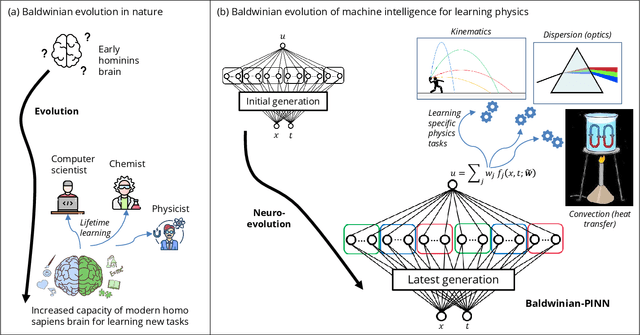
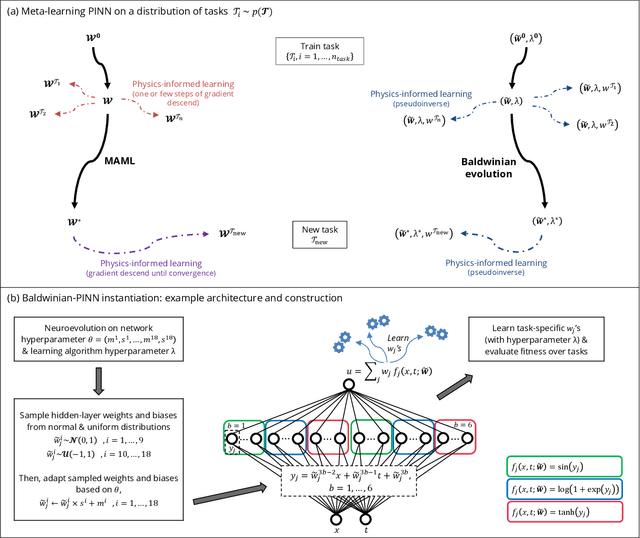
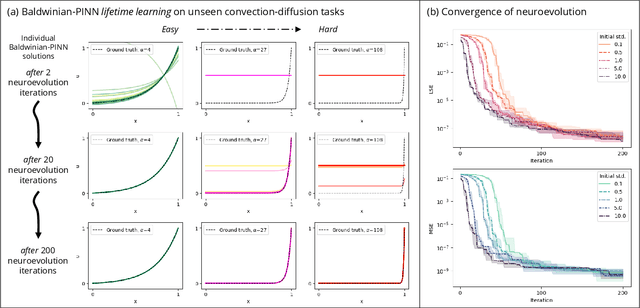
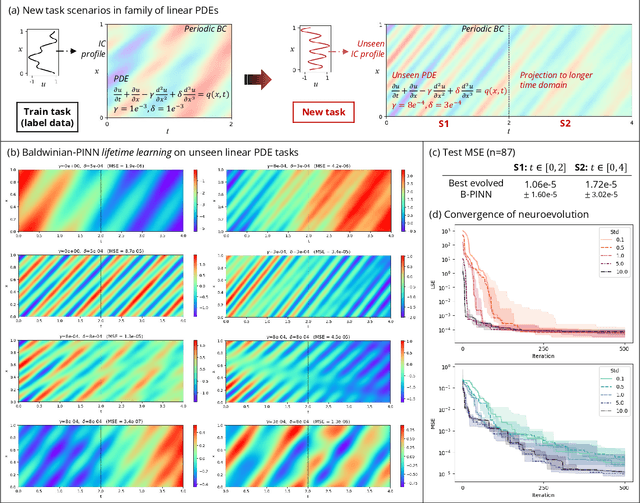
Physics-informed neural networks (PINNs) are at the forefront of scientific machine learning, making possible the creation of machine intelligence that is cognizant of physical laws and able to accurately simulate them. In this paper, the potential of discovering PINNs that generalize over an entire family of physics tasks is studied, for the first time, through a biological lens of the Baldwin effect. Drawing inspiration from the neurodevelopment of precocial species that have evolved to learn, predict and react quickly to their environment, we envision PINNs that are pre-wired with connection strengths inducing strong biases towards efficient learning of physics. To this end, evolutionary selection pressure (guided by proficiency over a family of tasks) is coupled with lifetime learning (to specialize on a smaller subset of those tasks) to produce PINNs that demonstrate fast and physics-compliant prediction capabilities across a range of empirically challenging problem instances. The Baldwinian approach achieves an order of magnitude improvement in prediction accuracy at a fraction of the computation cost compared to state-of-the-art results with PINNs meta-learned by gradient descent. This paper marks a leap forward in the meta-learning of PINNs as generalizable physics solvers.
Graph Neural Network Based Surrogate Model of Physics Simulations for Geometry Design
Feb 01, 2023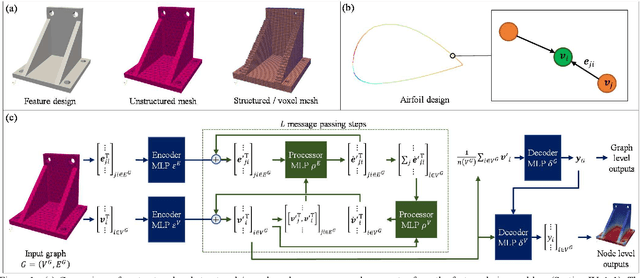
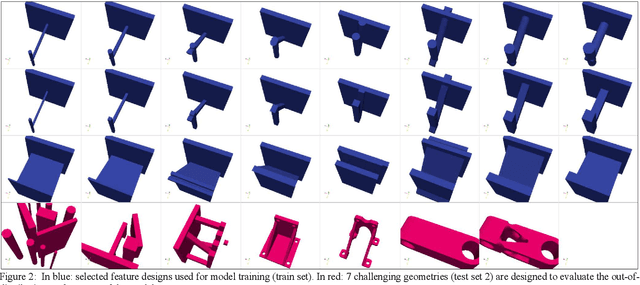
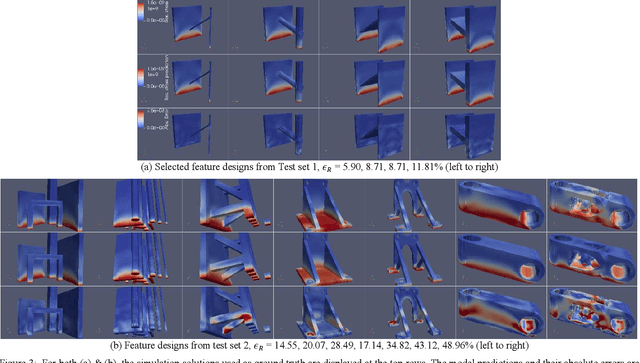

Computational Intelligence (CI) techniques have shown great potential as a surrogate model of expensive physics simulation, with demonstrated ability to make fast predictions, albeit at the expense of accuracy in some cases. For many scientific and engineering problems involving geometrical design, it is desirable for the surrogate models to precisely describe the change in geometry and predict the consequences. In that context, we develop graph neural networks (GNNs) as fast surrogate models for physics simulation, which allow us to directly train the models on 2/3D geometry designs that are represented by an unstructured mesh or point cloud, without the need for any explicit or hand-crafted parameterization. We utilize an encoder-processor-decoder-type architecture which can flexibly make prediction at both node level and graph level. The performance of our proposed GNN-based surrogate model is demonstrated on 2 example applications: feature designs in the domain of additive engineering and airfoil design in the domain of aerodynamics. The models show good accuracy in their predictions on a separate set of test geometries after training, with almost instant prediction speeds, as compared to O(hour) for the high-fidelity simulations required otherwise.