 Add to Chrome
 Add to Firefox
 Add to Edge
MathDoc: Benchmarking Structured Extraction and Active Refusal on Noisy Mathematics Exam Papers
Jan 15, 2026
The automated extraction of structured questions from paper-based mathematics exams is fundamental to intelligent education, yet remains challenging in real-world settings due to severe visual noise. Existing benchmarks mainly focus on clean documents or generic layout analysis, overlooking both the structural integrity of mathematical problems and the ability of models to actively reject incomplete inputs. We introduce MathDoc, the first benchmark for document-level information extraction from authentic high school mathematics exam papers. MathDoc contains \textbf{3,609} carefully curated questions with real-world artifacts and explicitly includes unrecognizable samples to evaluate active refusal behavior. We propose a multi-dimensional evaluation framework covering stem accuracy, visual similarity, and refusal capability. Experiments on SOTA MLLMs, including Qwen3-VL and Gemini-2.5-Pro, show that although end-to-end models achieve strong extraction performance, they consistently fail to refuse illegible inputs, instead producing confident but invalid outputs. These results highlight a critical gap in current MLLMs and establish MathDoc as a benchmark for assessing model reliability under degraded document conditions. Our project repository is available at \href{https://github.com/winnk123/papers/tree/master}{GitHub repository}

Geometric Prior-Guided Federated Prompt Calibration
Dec 08, 2025Federated Prompt Learning (FPL) offers a parameter-efficient solution for collaboratively training large models, but its performance is severely hindered by data heterogeneity, which causes locally trained prompts to become biased. Existing methods, focusing on aggregation or regularization, fail to address this root cause of local training bias. To this end, we propose Geometry-Guided Text Prompt Calibration (GGTPC), a novel framework that directly corrects this bias by providing clients with a global geometric prior. This prior, representing the shape of the global data distribution derived from the covariance matrix, is reconstructed on the server in a privacy-preserving manner. Clients then use a novel Geometry-Prior Calibration Layer (GPCL) to align their local feature distributions with this global prior during training. Extensive experiments show GGTPC's effectiveness. On the label-skewed CIFAR-100 dataset ($β$=0.1), it outperforms the state-of-the-art by 2.15\%. Under extreme skew ($β$=0.01), it improves upon the baseline by 9.17\%. Furthermore, as a plug-and-play module on the domain-skewed Office-Home dataset, it boosts FedAvg's performance by 4.60\%. These results demonstrate that GGTPC effectively mitigates data heterogeneity by correcting the fundamental local training bias, serving as a versatile module to enhance various FL algorithms.
TextMine: LLM-Powered Knowledge Extraction for Humanitarian Mine Action
Sep 18, 2025Humanitarian Mine Action has generated extensive best-practice knowledge, but much remains locked in unstructured reports. We introduce TextMine, an ontology-guided pipeline that uses Large Language Models to extract knowledge triples from HMA texts. TextMine integrates document chunking, domain-aware prompting, triple extraction, and both reference-based and LLM-as-a-Judge evaluation. We also create the first HMA ontology and a curated dataset of real-world demining reports. Experiments show ontology-aligned prompts boost extraction accuracy by 44.2%, cut hallucinations by 22.5%, and improve format conformance by 20.9% over baselines. While validated on Cambodian reports, TextMine can adapt to global demining efforts or other domains, transforming unstructured data into structured knowledge.
Plausible-Parrots @ MSP2023: Enhancing Semantic Plausibility Modeling using Entity and Event Knowledge
Aug 29, 2024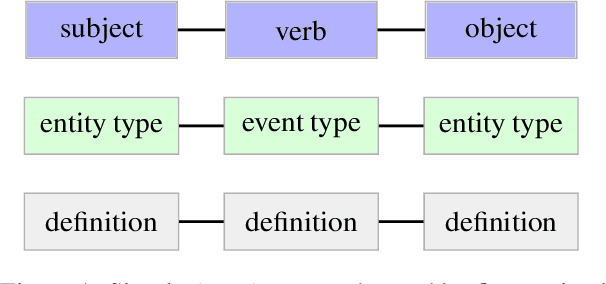
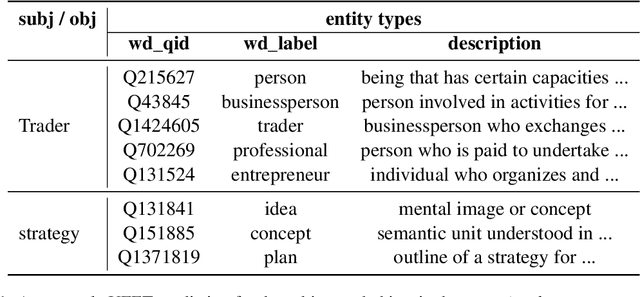
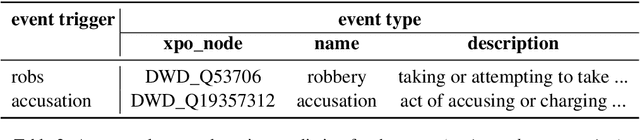
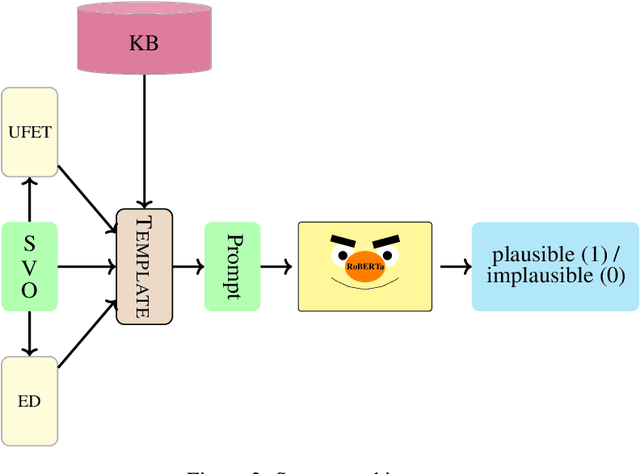
In this work, we investigate the effectiveness of injecting external knowledge to a large language model (LLM) to identify semantic plausibility of simple events. Specifically, we enhance the LLM with fine-grained entity types, event types and their definitions extracted from an external knowledge base. These knowledge are injected into our system via designed templates. We also augment the data to balance the label distribution and adapt the task setting to real world scenarios in which event mentions are expressed as natural language sentences. The experimental results show the effectiveness of the injected knowledge on modeling semantic plausibility of events. An error analysis further emphasizes the importance of identifying non-trivial entity and event types.