 Add to Chrome
 Add to Firefox
 Add to Edge
SubtleTalk: Generating Controllable Weakly-correlated Facial Dynamics for 3D Talking Heads via Residual Flow Matching
Aug 03, 2026
Audio-driven 3D facial animation aims to synthesize realistic and temporally coherent motions from speech. Despite notable progress in lip synchronization, weakly correlated dynamics, including eyebrow movements, eye blinks, and head motion, which are essential to photorealistic facial animation, remain difficult to model faithfully and often appear static or unnaturally repetitive. We attribute this limitation to three factors: (a) insufficient conditioning for weakly correlated dynamics; (b) the limited ability of deterministic regression to capture diverse motion patterns; (c) data bottlenecks from unreliable upper-face pseudo-labels and limited dataset diversity. To address these issues, we propose SubtleTalk, a framework for generating natural and controllable weakly correlated facial dynamics via multi-condition modeling and residual flow matching. First, to compensate for the limited guidance of speech alone, we introduce interpretable controls, including prosody, regional intensity, and Valence-Arousal signals, to explicitly capture the timing, magnitude, and affective variation of weakly correlated dynamics. Second, to overcome the limited expressiveness of deterministic regression, we build residual flow matching based on a stable speech-driven motion prior, allowing the model to capture stochastic deviations beyond deterministic prediction. Third, to alleviate the data bottleneck, we construct SubtleTalk-Face, a large-scale 3D facial animation dataset comprising about 3,900 identities and 74 hours of data, built via a simple and scalable pseudo-labeling pipeline and featuring improved upper-face tracking and frame-level VA annotations. Extensive experiments demonstrate that our method significantly improves the realism and diversity of weakly correlated facial dynamics while preserving accurate lip synchronization.

MEDTalk: Multimodal Controlled 3D Facial Animation with Dynamic Emotions by Disentangled Embedding
Jul 08, 2025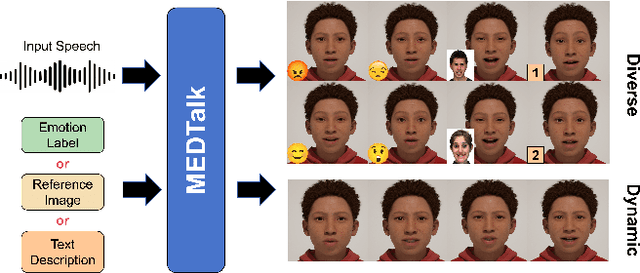
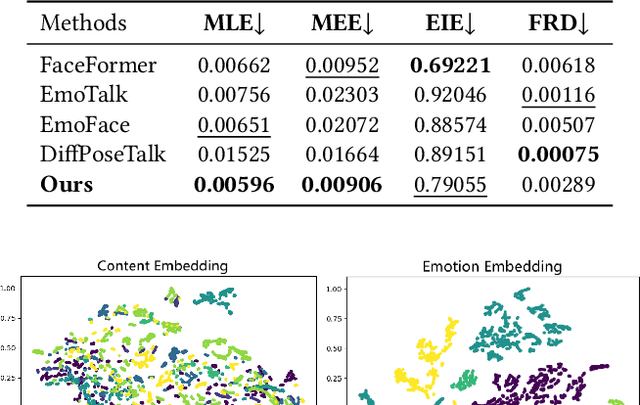
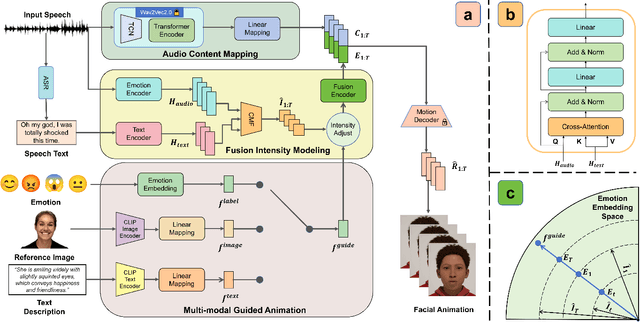
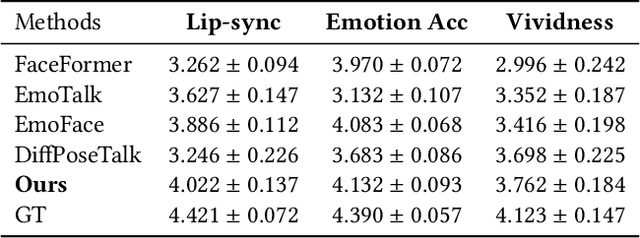
Audio-driven emotional 3D facial animation aims to generate synchronized lip movements and vivid facial expressions. However, most existing approaches focus on static and predefined emotion labels, limiting their diversity and naturalness. To address these challenges, we propose MEDTalk, a novel framework for fine-grained and dynamic emotional talking head generation. Our approach first disentangles content and emotion embedding spaces from motion sequences using a carefully designed cross-reconstruction process, enabling independent control over lip movements and facial expressions. Beyond conventional audio-driven lip synchronization, we integrate audio and speech text, predicting frame-wise intensity variations and dynamically adjusting static emotion features to generate realistic emotional expressions. Furthermore, to enhance control and personalization, we incorporate multimodal inputs-including text descriptions and reference expression images-to guide the generation of user-specified facial expressions. With MetaHuman as the priority, our generated results can be conveniently integrated into the industrial production pipeline.