 Add to Chrome
 Add to Firefox
 Add to Edge
SLIDER: Sparse History-Guided Aerial Robot Target Search using Sliding Local Maps
Jul 12, 2026
Efficient exploration and target search in large-scale unknown environments remain challenging for aerial robots due to the demands of broad spatial coverage, fine-grained perception, and real-time decision-making. This paper presents SLIDER, a lightweight and memory-efficient framework that avoids reliance on globally dense maps by combining a local sliding map with sparse global history information. A novel observation quality evaluation method is proposed, leveraging historical poses and sensor models to assess point cloud data in real-time, enabling efficient frontier detection. To support scalable and responsive planning, an incremental viewpoint clustering strategy dynamically adapts to local updates, significantly reducing the number of candidate targets and decreasing computational load. A sparse global topological map is incrementally maintained to assist global planning and cost evaluation. Extensive simulations and real-world experiments demonstrate that the proposed system outperforms state-of-the-art methods in memory usage, decision latency, and search efficiency.

Explore the Capacity of Near Field Channel using Gaussian Beams
Mar 22, 2026Channel capacity lies at the core of wireless communication, yet determining it typically requires detailed channel information between the transmitter and receiver. For near field MIMO systems, obtaining the detailed native channel is often difficult or expensive. This paper develops a scheme to approximate the near field channel in a Gaussian beam domain. Hermite Gaussian (HG) modes are used to approximate the channel between a pair of square antenna arrays in a free space line of sight (LOS) environment. We show that HG modes efficiently represent the dominant singular modes of the native channel, enabling accurate channel estimation and capacity computation in the HG beam space. An iterative algorithm is proposed to approach the maximal channel capacity by gradually expanding the beam space dimension. Simulation results demonstrate that the method converges rapidly and significantly reduces channel estimation overhead.
Near field transmission using Hermite-Gaussian modes
May 16, 2025RF transmission in line-of-sight near field based on Hermite-Gaussian (HG) modes is developed. Multiple HG modes are transmitted and received using rectangular antenna arrays to form the basic modes and dimensions for MIMO transmission. Beam steering can be achieved by manipulating the antenna arrays with 3D rotation in the desired EM field. The beam parameters are optimized to minimize the size of the antennas. Simulation is performed for a 300GHz system with free space channel model. Spectrum efficiency up to 294.3bps/Hz can be achieved with 36 HG modes and cross-polarization.
On the Capacity of Reconfigurable Intelligence Surface: the Sparse Channel Case
Oct 12, 2023Reconfigurable intelligent surface (RIS) is an important candidate technology for 6G. We provide an analysis of RIS-assisted MIMO communication in sparse channel typically found in the mmW or THz range. By exploring the sparse property, we maximize the capacity in the singular space of the channel and developed efficient algorithms for SU-MIMO or DL MU-MIMO. We also proved it is more difficult to support high rank transmission in the RIS reflection channel than in the traditional MIMO channel.
A Re-ranking Model for Dependency Parser with Recursive Convolutional Neural Network
May 21, 2015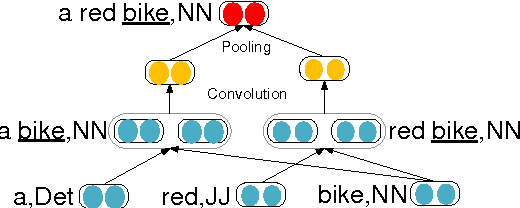
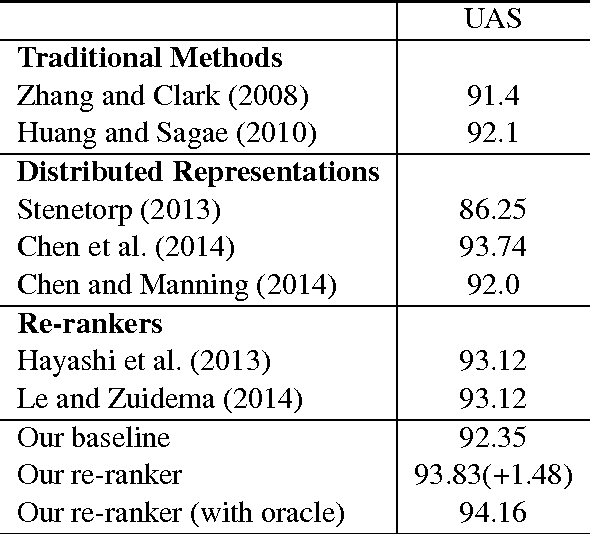
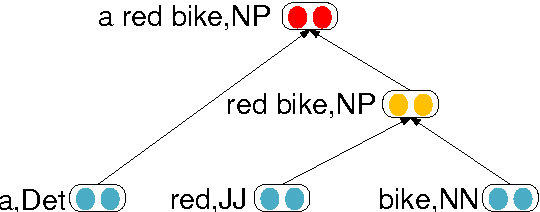
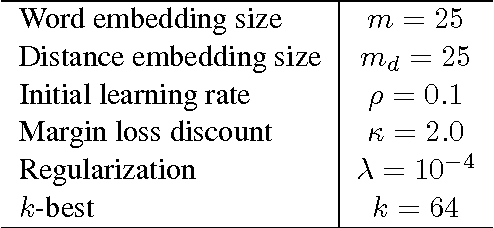
In this work, we address the problem to model all the nodes (words or phrases) in a dependency tree with the dense representations. We propose a recursive convolutional neural network (RCNN) architecture to capture syntactic and compositional-semantic representations of phrases and words in a dependency tree. Different with the original recursive neural network, we introduce the convolution and pooling layers, which can model a variety of compositions by the feature maps and choose the most informative compositions by the pooling layers. Based on RCNN, we use a discriminative model to re-rank a $k$-best list of candidate dependency parsing trees. The experiments show that RCNN is very effective to improve the state-of-the-art dependency parsing on both English and Chinese datasets.