 Add to Chrome
 Add to Firefox
 Add to Edge
Probing Outcome-Level Resemblance and Mechanism-Level Alignment in LLM Risk Decisions: Evidence from the St. Petersburg Game
Jun 03, 2026
LLMs can appear cautious in risk decision-making tasks, yet cautious-looking outputs do not necessarily indicate alignment with human decision-making mechanisms. We investigate this distinction using the St. Petersburg game as a controlled testbed, a classical paradox in which the expected payoff is infinite, yet humans typically report low, finite willingness to pay. We evaluate 28 LLMs with a structured prompt suite that includes the original game; controlled decision variants that perturb truncation, repeated play, numeric endowment, and occupational identity; a human-perspective prompt that asks models to reason as human decision makers; and paired comparisons between base models and their instruction-tuned counterparts. In the original game, most models generate finite bids, creating the appearance of human-like risk behavior. However, this outcome-level resemblance masks substantial mechanism-level differences. The controlled variants reveal that rather than maintaining human-like behavior seen in the original game, models often shift to conditionally and computationally rational behavior. Human-cue prompting and instruction tuning often lower bids and reduce some visible pathologies, but most mechanism-level response patterns remain largely unchanged. These findings show that behavioral alignment in risk decision-making can be surface-level: LLMs may produce human-like risk decisions without exhibiting human-consistent mechanisms. High-stakes evaluations of LLM decision-making should therefore move beyond outcome similarity and examine whether the alignment is supported by mechanism-level consistency.

INS-MMBench: A Comprehensive Benchmark for Evaluating LVLMs' Performance in Insurance
Jun 13, 2024Large Vision-Language Models (LVLMs) have demonstrated outstanding performance in various general multimodal applications such as image recognition and visual reasoning, and have also shown promising potential in specialized domains. However, the application potential of LVLMs in the insurance domain-characterized by rich application scenarios and abundant multimodal data-has not been effectively explored. There is no systematic review of multimodal tasks in the insurance domain, nor a benchmark specifically designed to evaluate the capabilities of LVLMs in insurance. This gap hinders the development of LVLMs within the insurance domain. In this paper, we systematically review and distill multimodal tasks for four representative types of insurance: auto insurance, property insurance, health insurance, and agricultural insurance. We propose INS-MMBench, the first comprehensive LVLMs benchmark tailored for the insurance domain. INS-MMBench comprises a total of 2.2K thoroughly designed multiple-choice questions, covering 12 meta-tasks and 22 fundamental tasks. Furthermore, we evaluate multiple representative LVLMs, including closed-source models such as GPT-4o and open-source models like BLIP-2. This evaluation not only validates the effectiveness of our benchmark but also provides an in-depth performance analysis of current LVLMs on various multimodal tasks in the insurance domain. We hope that INS-MMBench will facilitate the further application of LVLMs in the insurance domain and inspire interdisciplinary development. Our dataset and evaluation code are available at https://github.com/FDU-INS/INS-MMBench.
Harnessing GPT-4V for Insurance: A Preliminary Exploration
Apr 15, 2024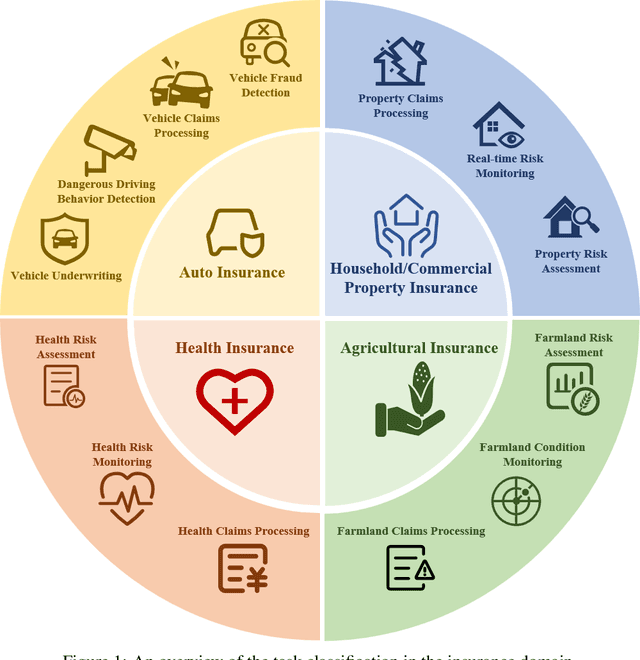
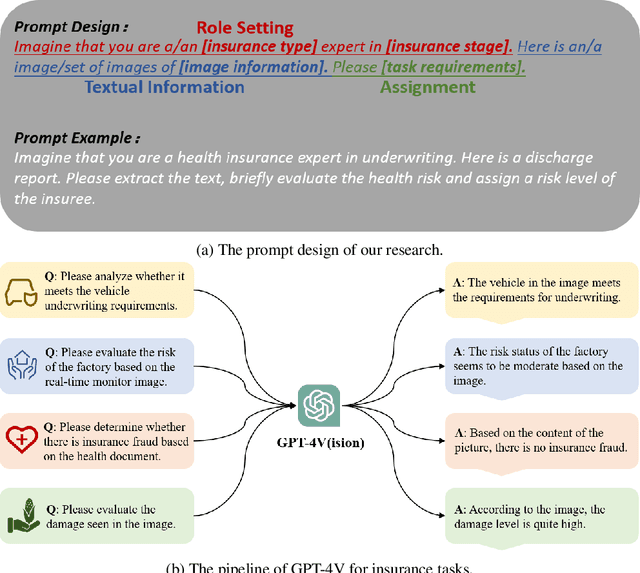


The emergence of Large Multimodal Models (LMMs) marks a significant milestone in the development of artificial intelligence. Insurance, as a vast and complex discipline, involves a wide variety of data forms in its operational processes, including text, images, and videos, thereby giving rise to diverse multimodal tasks. Despite this, there has been limited systematic exploration of multimodal tasks specific to insurance, nor a thorough investigation into how LMMs can address these challenges. In this paper, we explore GPT-4V's capabilities in the insurance domain. We categorize multimodal tasks by focusing primarily on visual aspects based on types of insurance (e.g., auto, household/commercial property, health, and agricultural insurance) and insurance stages (e.g., risk assessment, risk monitoring, and claims processing). Our experiment reveals that GPT-4V exhibits remarkable abilities in insurance-related tasks, demonstrating not only a robust understanding of multimodal content in the insurance domain but also a comprehensive knowledge of insurance scenarios. However, there are notable shortcomings: GPT-4V struggles with detailed risk rating and loss assessment, suffers from hallucination in image understanding, and shows variable support for different languages. Through this work, we aim to bridge the insurance domain with cutting-edge LMM technology, facilitate interdisciplinary exchange and development, and provide a foundation for the continued advancement and evolution of future research endeavors.