 Add to Chrome
 Add to Firefox
 Add to Edge
TCAndon-Router: Adaptive Reasoning Router for Multi-Agent Collaboration
Jan 08, 2026
Multi-Agent Systems(MAS) have become a powerful paradigm for building high performance intelligent applications. Within these systems, the router responsible for determining which expert agents should handle a given query plays a crucial role in overall performance. Existing routing strategies generally fall into two categories: performance routing, which balances latency and cost across models of different sizes, and task routing, which assigns queries to domain-specific experts to improve accuracy. In real-world enterprise applications, task routing is more suitable; however, most existing approaches rely on static single-label decisions, which introduce two major limitations: (i) difficulty in seamlessly integrating new agents as business domains expand, and (ii) routing conflicts caused by overlapping agent capabilities, ultimately degrading accuracy and robustness.To address these challenges, we propose TCAndon-Router(TCAR): an adaptive reasoning router for multi-agent collaboration. Unlike traditional routers, TCAR supports dynamic agent onboarding and first generates a natural-language reasoning chain before predicting a set of candidate agents capable of handling the query. In addition, we design a collaborative execution pipeline in which selected agents independently produce responses, which are then aggregated and refined into a single high-quality response by a dedicated Refining Agent.Experiments on public datasets and real enterprise data demonstrate that TCAR significantly improves routing accuracy, reduces routing conflicts, and remains robust in ambiguous scenarios. We have released TCAR at https://huggingface.co/tencent/TCAndon-Router to support future research on explainable and collaborative multi-agent routing.

Hyperbolic Hypergraph Neural Networks for Multi-Relational Knowledge Hypergraph Representation
Dec 11, 2024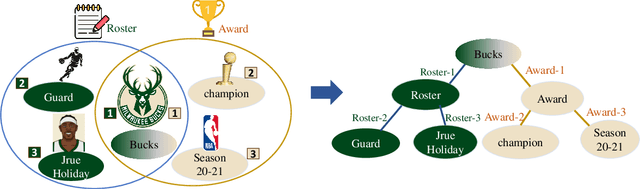
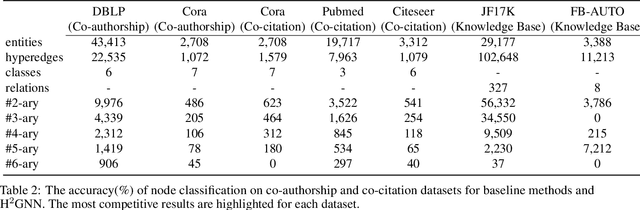
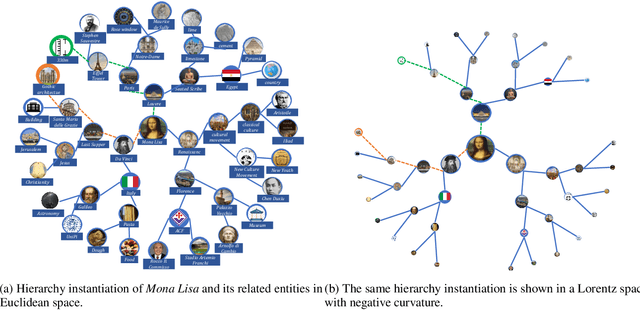
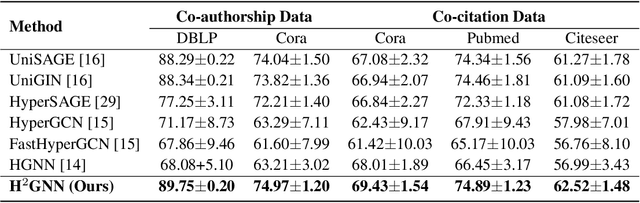
Knowledge hypergraphs generalize knowledge graphs using hyperedges to connect multiple entities and depict complicated relations. Existing methods either transform hyperedges into an easier-to-handle set of binary relations or view hyperedges as isolated and ignore their adjacencies. Both approaches have information loss and may potentially lead to the creation of sub-optimal models. To fix these issues, we propose the Hyperbolic Hypergraph Neural Network (H2GNN), whose essential component is the hyper-star message passing, a novel scheme motivated by a lossless expansion of hyperedges into hierarchies. It implements a direct embedding that consciously incorporates adjacent entities, hyper-relations, and entity position-aware information. As the name suggests, H2GNN operates in the hyperbolic space, which is more adept at capturing the tree-like hierarchy. We compare H2GNN with 15 baselines on knowledge hypergraphs, and it outperforms state-of-the-art approaches in both node classification and link prediction tasks.