 Add to Chrome
 Add to Firefox
 Add to Edge
Opti-Agent-Bench: Benchmarking End-to-End Optimization R&D Agents on Real-World Business Problems
Jul 12, 2026
LLM-based agents are increasingly deployed to solve optimization problems, yet existing benchmarks evaluate them on pre-structured mathematical formulations that bypass the most critical challenge: translating complex business requirements into correct models and solve efficiently. We introduce Opti-Agent-Bench, an end-to-end benchmark that evaluates Large Language Models (LLMs) across the complete optimization R&D pipeline, from understanding business-language descriptions through mathematical modeling, algorithm selection, and code implementation, to solution report generation. Our design rests on three pillars: (1) businesssemantic authenticity with anti-template traps that defeat pattern matching; (2) modular evaluation with cross-module consistency checking across Problem Understanding, Formal Modeling, Implementation, and Reporting; and (3) the ORAC bi-level validity framework that simultaneously ensures task quality and scoring integrity. Across several industrialscale tasks spanning integer programming, robust optimization, stochastic programming, and non-convex optimization, we expose critical failure modes of current models, including constraint omission, model-code inconsistency, and report-implementation divergence, that remain invisible under conventional single-metric evaluation.

Genetic Auto-prompt Learning for Pre-trained Code Intelligence Language Models
Mar 20, 2024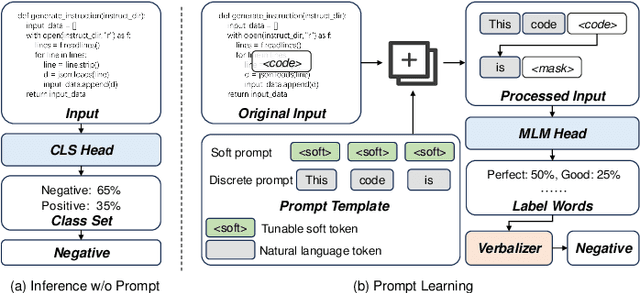
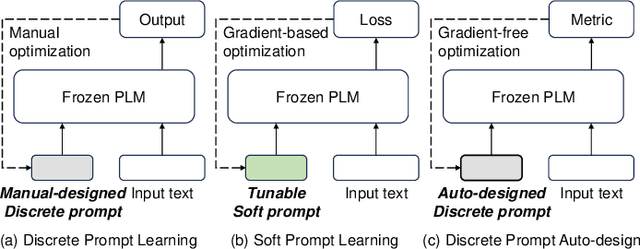
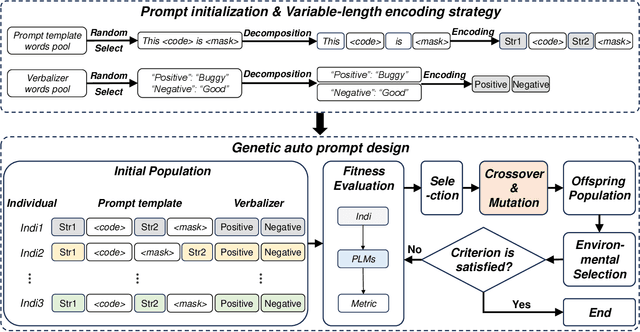
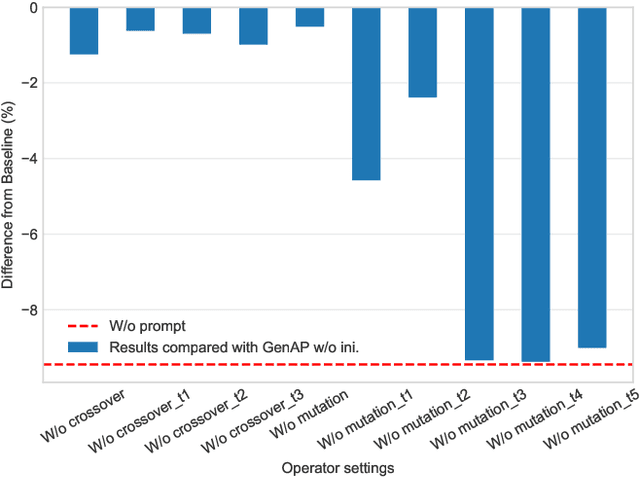
As Pre-trained Language Models (PLMs), a popular approach for code intelligence, continue to grow in size, the computational cost of their usage has become prohibitively expensive. Prompt learning, a recent development in the field of natural language processing, emerges as a potential solution to address this challenge. In this paper, we investigate the effectiveness of prompt learning in code intelligence tasks. We unveil its reliance on manually designed prompts, which often require significant human effort and expertise. Moreover, we discover existing automatic prompt design methods are very limited to code intelligence tasks due to factors including gradient dependence, high computational demands, and limited applicability. To effectively address both issues, we propose Genetic Auto Prompt (GenAP), which utilizes an elaborate genetic algorithm to automatically design prompts. With GenAP, non-experts can effortlessly generate superior prompts compared to meticulously manual-designed ones. GenAP operates without the need for gradients or additional computational costs, rendering it gradient-free and cost-effective. Moreover, GenAP supports both understanding and generation types of code intelligence tasks, exhibiting great applicability. We conduct GenAP on three popular code intelligence PLMs with three canonical code intelligence tasks including defect prediction, code summarization, and code translation. The results suggest that GenAP can effectively automate the process of designing prompts. Specifically, GenAP outperforms all other methods across all three tasks (e.g., improving accuracy by an average of 2.13% for defect prediction). To the best of our knowledge, GenAP is the first work to automatically design prompts for code intelligence PLMs.