 Add to Chrome
 Add to Firefox
 Add to Edge
EdgeBench: Unveiling Scaling Laws of Learning from Real-World Environments
Jul 06, 2026
Pretraining scaling laws reveal that model capability improves predictably with data and compute. But learning from real world environments after deployment remains far less understood. Analyzing roughly 38,000 hours of agent interaction with the environment across 134 real world tasks, we find, to the best of our knowledge, the first evidence that overall performance during environment learning follows a log-sigmoid scaling law with remarkably high precision, reaching R^2 = 0.998. Across model generations, we also find that agent learning speed roughly doubles every three months. This discovery stems from EdgeBench, a suite of 134 real world tasks with ultra-long horizons, spanning scientific discovery, software engineering, combinatorial optimization, professional knowledge work, formal mathematics, and interactive games. Each task sustains at least 12 hours of continuous agent operation under rich, multilevel feedback, and is built through substantial expert effort. We publicly release 51 tasks and our full evaluation framework to accelerate the study of how agents learn from real world experience.

Using Geometrical information to Measure the Vibration of A Swaying Millimeter-wave Radar
Jun 19, 2024This paper presents two new, simple yet effective approaches to measure the vibration of a swaying millimeter-wave radar (mmRadar) utilizing geometrical information. Specifically, for the planar vibrations, we firstly establish an equation based on the area difference between the swaying mmRadar and the reference objects at different moments, which enables the quantification of planar displacement. Secondly, volume differences are also utilized with the same idea, achieving the self-vibration measurement of a swaying mmRadar for spatial vibrations. Experimental results confirm the effectiveness of our methods, demonstrating its capability to estimate both the amplitude and a crude direction of the mmRadar's self-vibration.
BERT: Accelerating Vital Signs Measurement for Bioradar with An Efficient Recursive Technique
Apr 20, 2024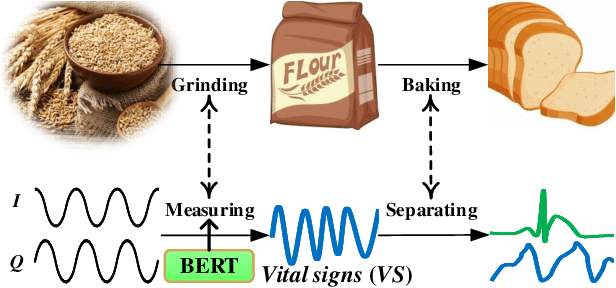
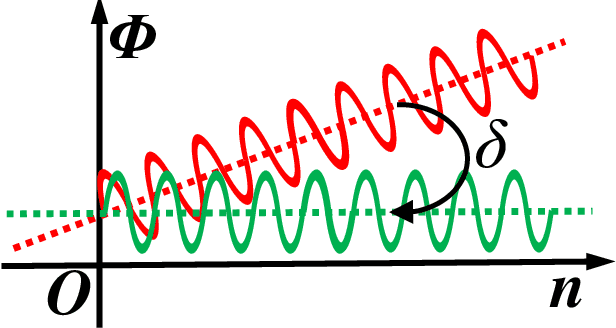
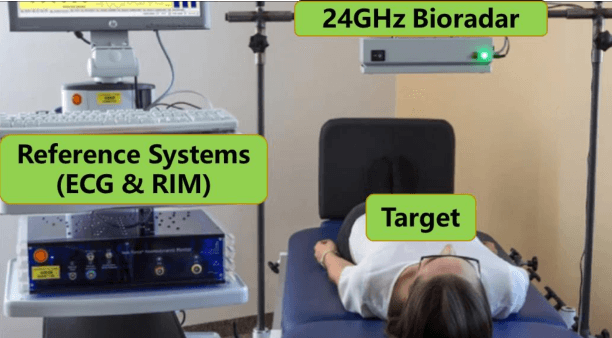
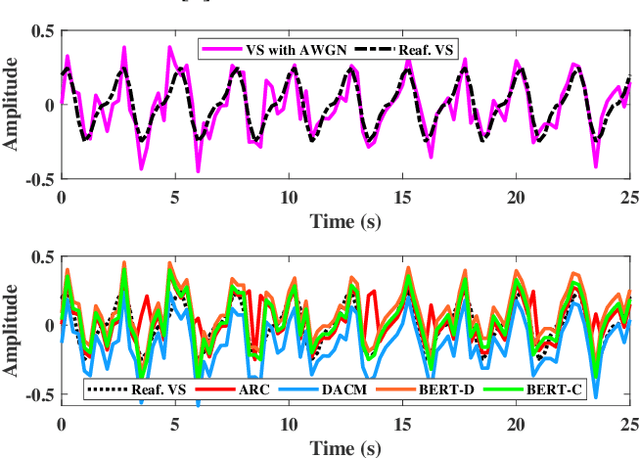
Recent years have witnessed the great advance of bioradar system in smart sensing of vital signs (VS) for human healthcare monitoring. As an important part of VS sensing process, VS measurement aims to capture the chest wall micromotion induced by the human respiratory and cardiac activities. Unfortunately, the existing VS measurement methods using bioradar have encountered bottlenecks in making a trade-off between time cost and measurement accuracy. To break this bottleneck, this letter proposes an efficient recursive technique (BERT) heuristically, based on the observation that the features of bioradar VS meet the conditions of Markov model. Extensive experimental results validate that BERT measurement yields lower time costs, competitive estimates of heart rate, breathing rate, and heart rate variability. Our BERT method is promising us a new and superior option to measure VS for bioradar. This work seeks not only to solve the current issue of how to accelerate VS measurement with an acceptable accuracy, but also to inspire creative new ideas that spur further advances in this promising field in the future.