 Add to Chrome
 Add to Firefox
 Add to Edge
From Knowledge to Action: Outcomes of the 2025 Large Language Model (LLM) Hackathon for Applications in Materials Science and Chemistry
May 04, 2026
Large language models (LLMs) are rapidly changing how researchers in materials science and chemistry discover, organize, and act on scientific knowledge. This paper analyzes a broad set of community-developed LLM applications in an effort to identify emerging patterns in how these systems can be used across the scientific research lifecycle. We organize the projects into two complementary categories: Knowledge Infrastructure, systems that structure, retrieve, synthesize, and validate scientific information; and Action Systems, systems that execute, coordinate, or automate scientific work across computational and experimental environments. The submissions reveal a shift from single-purpose LLM tools toward integrated, multi-agent workflows that combine retrieval, reasoning, tool use, and domain-specific validation. Prominent themes include retrieval-augmented generation as grounding infrastructure, persistent structured knowledge representations, multimodal and multilingual scientific inputs, and early progress toward laboratory-integrated closed-loop systems. Together, these results suggest that LLMs are evolving from general-purpose assistants into composable infrastructure for scientific reasoning and action. This work provides a community snapshot of that transition and a practical taxonomy for understanding emerging LLM-enabled workflows in materials science and chemistry.

CALA: A Class-Aware Logit Adapter for Few-Shot Class-Incremental Learning
Dec 17, 2024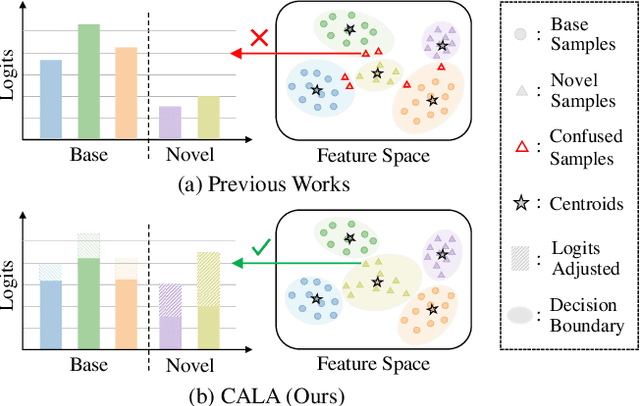
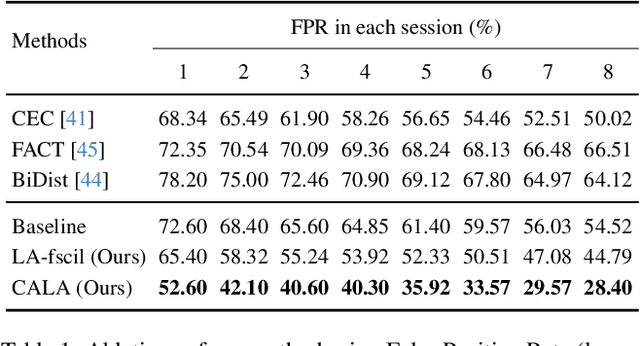
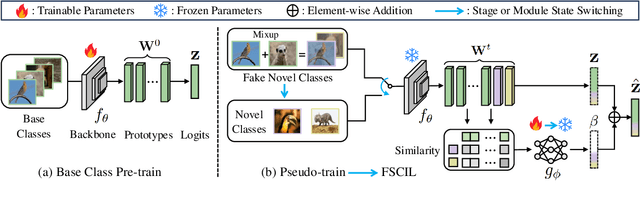
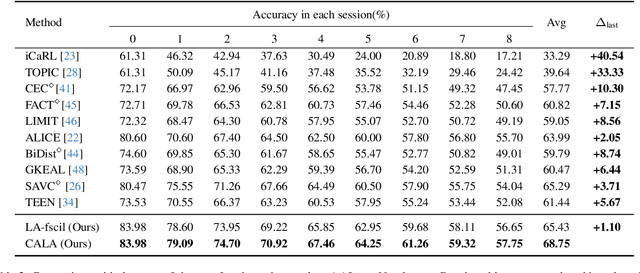
Few-Shot Class-Incremental Learning (FSCIL) defines a practical but challenging task where models are required to continuously learn novel concepts with only a few training samples. Due to data scarcity, existing FSCIL methods resort to training a backbone with abundant base data and then keeping it frozen afterward. However, the above operation often causes the backbone to overfit to base classes while overlooking the novel ones, leading to severe confusion between them. To address this issue, we propose Class-Aware Logit Adapter (CALA). Our method involves a lightweight adapter that learns to rectify biased predictions through a pseudo-incremental learning paradigm. In the real FSCIL process, we use the learned adapter to dynamically generate robust balancing factors. These factors can adjust confused novel instances back to their true label space based on their similarity to base classes. Specifically, when confusion is more likely to occur in novel instances that closely resemble base classes, greater rectification is required. Notably, CALA operates on the classifier level, preserving the original feature space, thus it can be flexibly plugged into most of the existing FSCIL works for improved performance. Experiments on three benchmark datasets consistently validate the effectiveness and flexibility of CALA. Codes will be available upon acceptance.