 Add to Chrome
 Add to Firefox
 Add to Edge
CangjieBench: Benchmarking LLMs on a Low-Resource General-Purpose Programming Language
Mar 15, 2026
Large Language Models excel in high-resource programming languages but struggle with low-resource ones. Existing research related to low-resource programming languages primarily focuses on Domain-Specific Languages (DSLs), leaving general-purpose languages that suffer from data scarcity underexplored. To address this gap, we introduce CangjieBench, a contamination-free benchmark for Cangjie, a representative low-resource general-purpose language. The benchmark comprises 248 high-quality samples manually translated from HumanEval and ClassEval, covering both Text-to-Code and Code-to-Code tasks. We conduct a systematic evaluation of diverse LLMs under four settings: Direct Generation, Syntax-Constrained Generation, Retrieval-Augmented Generation (RAG), and Agent. Experiments reveal that Direct Generation performs poorly, whereas Syntax-Constrained Generation offers the best trade-off between accuracy and computational cost. Agent achieve state-of-the-art accuracy but incur high token consumption. Furthermore, we observe that Code-to-Code translation often underperforms Text-to-Code generation, suggesting a negative transfer phenomenon where models overfit to the source language patterns. We hope that our work will offer valuable insights into LLM generalization to unseen and low-resource programming languages. Our code and data are available at https://github.com/cjhCoder7/CangjieBench.

CCUP: A Controllable Synthetic Data Generation Pipeline for Pretraining Cloth-Changing Person Re-Identification Models
Oct 17, 2024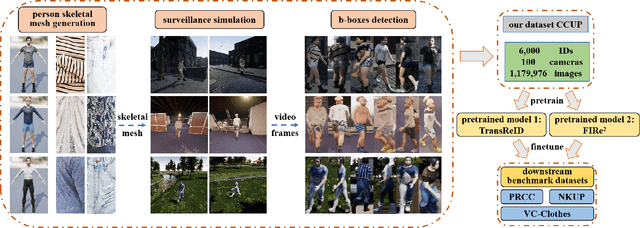


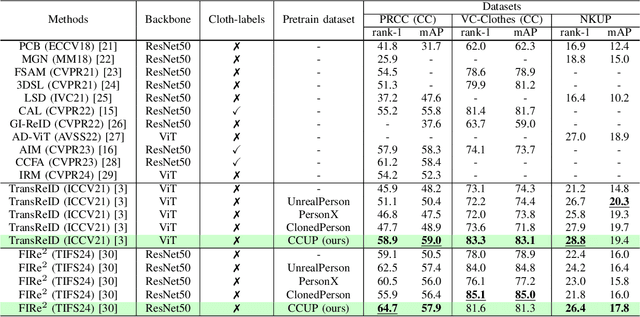
Cloth-changing person re-identification (CC-ReID), also known as Long-Term Person Re-Identification (LT-ReID) is a critical and challenging research topic in computer vision that has recently garnered significant attention. However, due to the high cost of constructing CC-ReID data, the existing data-driven models are hard to train efficiently on limited data, causing overfitting issue. To address this challenge, we propose a low-cost and efficient pipeline for generating controllable and high-quality synthetic data simulating the surveillance of real scenarios specific to the CC-ReID task. Particularly, we construct a new self-annotated CC-ReID dataset named Cloth-Changing Unreal Person (CCUP), containing 6,000 IDs, 1,179,976 images, 100 cameras, and 26.5 outfits per individual. Based on this large-scale dataset, we introduce an effective and scalable pretrain-finetune framework for enhancing the generalization capabilities of the traditional CC-ReID models. The extensive experiments demonstrate that two typical models namely TransReID and FIRe^2, when integrated into our framework, outperform other state-of-the-art models after pretraining on CCUP and finetuning on the benchmarks such as PRCC, VC-Clothes and NKUP. The CCUP is available at: https://github.com/yjzhao1019/CCUP.