 Add to Chrome
 Add to Firefox
 Add to Edge
Multi-Resolution Voxelized Map-Based Stereo Visual-Inertial Odometry
Jul 19, 2026
Incorporating prior maps significantly enhances the accuracy and robustness of pose estimation in visual-inertial odometry (VIO). However, the large data volume of such maps, combined with limited transmission bandwidth, makes it impractical to continuously load local maps onto an edge device. In this paper, we propose a multi-resolution prior map construction method and a corresponding map-based VIO system. The prior map is voxelized at multiple resolutions, with each voxel retaining only a single map point. During online VIO operation, a cone-shaped indexing strategy associates 2D features on the edge device with 3D map points. The cone's intercept is determined by the distance from the current position to the 3D points, enabling the selection of the appropriate resolution level and the retrieval of the unique map point within the corresponding voxel via a 3D digital differential analyzer (DDA) algorithm. This approach minimizes both the volume of data required for transmission and the computational load during data association. Extensive experiments on two public datasets demonstrate that our system achieves accurate pose estimation while requiring minimal data transmission.

Citadel: Protecting Data Privacy and Model Confidentiality for Collaborative Learning with SGX
May 04, 2021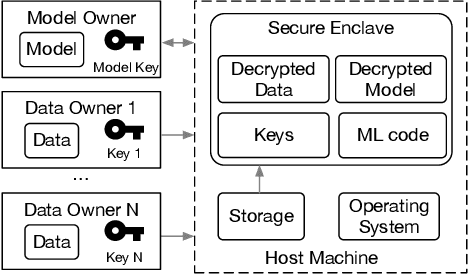
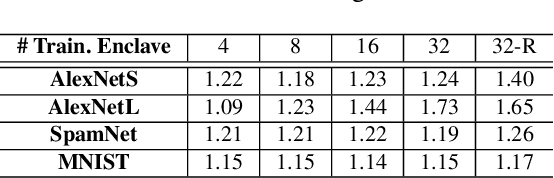
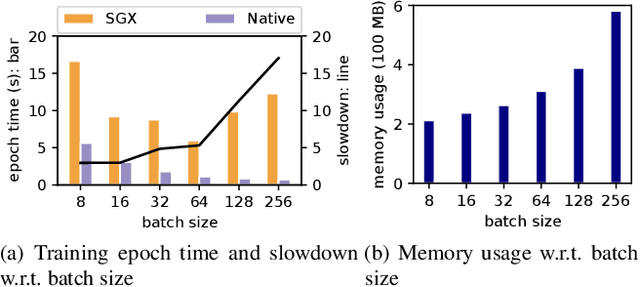
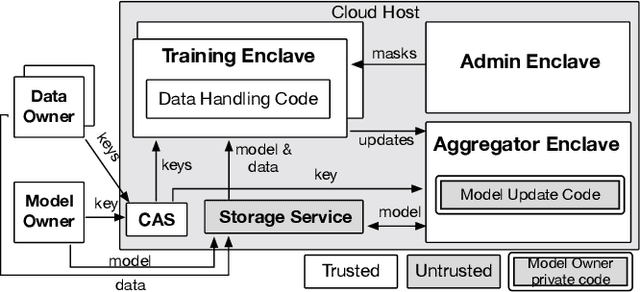
With the advancement of machine learning (ML) and its growing awareness, many organizations who own data but not ML expertise (data owner) would like to pool their data and collaborate with those who have expertise but need data from diverse sources to train truly generalizable models (model owner). In such collaborative ML, the data owner wants to protect the privacy of its training data, while the model owner desires the confidentiality of the model and the training method which may contain intellectual properties. However, existing private ML solutions, such as federated learning and split learning, cannot meet the privacy requirements of both data and model owners at the same time. This paper presents Citadel, a scalable collaborative ML system that protects the privacy of both data owner and model owner in untrusted infrastructures with the help of Intel SGX. Citadel performs distributed training across multiple training enclaves running on behalf of data owners and an aggregator enclave on behalf of the model owner. Citadel further establishes a strong information barrier between these enclaves by means of zero-sum masking and hierarchical aggregation to prevent data/model leakage during collaborative training. Compared with the existing SGX-protected training systems, Citadel enables better scalability and stronger privacy guarantees for collaborative ML. Cloud deployment with various ML models shows that Citadel scales to a large number of enclaves with less than 1.73X slowdown caused by SGX.