 Add to Chrome
 Add to Firefox
 Add to Edge
MATCH: Modulating Attention via In-Context Retrieval for Long-Context Transformers
Jun 29, 2026
The quadratic computational cost of traditional attention mechanisms poses a major bottleneck to the scalability and practical deployment of large language models (LLMs), particularly in long-context scenarios. To improve efficiency, existing approaches often enforce rigid structural constraints such as local attention windows. However, these strategies typically lead to substantial performance degradation on tasks requiring precise long-range recall. In this work, we propose MATCH, a scalable and efficient framework that augments sparsified attention mechanisms with dynamically integrated in-context information through an efficient retrieval system. Empirical results show that MATCH significantly improves the performance of sparse-attention models on both synthetic and real-world natural-language tasks. These findings highlight the versatility of MATCH as a general approach for enhancing in-context retrieval capabilities while maintaining the efficiency benefits of sparse attention architectures.

EFPC: Towards Efficient and Flexible Prompt Compression
Mar 11, 2025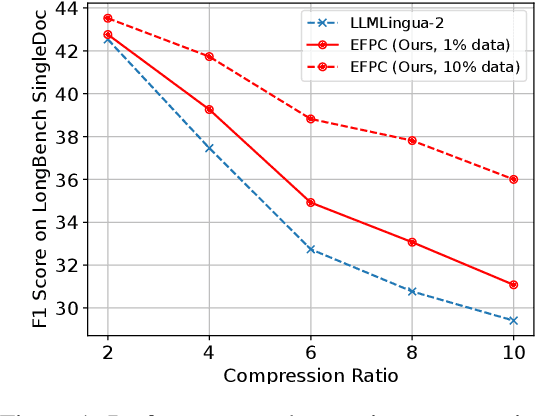
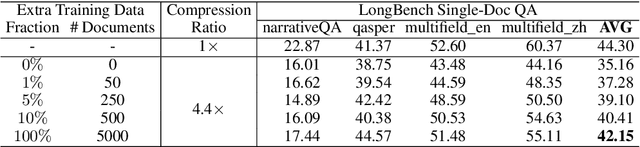
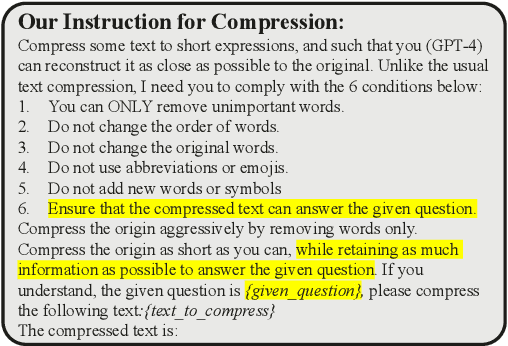
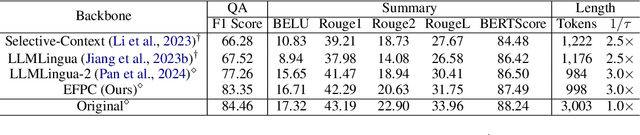
The emergence of large language models (LLMs) like GPT-4 has revolutionized natural language processing (NLP), enabling diverse, complex tasks. However, extensive token counts lead to high computational and financial burdens. To address this, we propose Efficient and Flexible Prompt Compression (EFPC), a novel method unifying task-aware and task-agnostic compression for a favorable accuracy-efficiency trade-off. EFPC uses GPT-4 to generate compressed prompts and integrates them with original prompts for training. During training and inference, we selectively prepend user instructions and compress prompts based on predicted probabilities. EFPC is highly data-efficient, achieving significant performance with minimal data. Compared to the state-of-the-art method LLMLingua-2, EFPC achieves a 4.8% relative improvement in F1-score with 1% additional data at a 4x compression rate, and an 11.4% gain with 10% additional data on the LongBench single-doc QA benchmark. EFPC's unified framework supports broad applicability and enhances performance across various models, tasks, and domains, offering a practical advancement in NLP.