 Add to Chrome
 Add to Firefox
 Add to Edge
PILOT: Privileged Imitation Learning for End-to-End Motion Planning of Autonomous UAVs under Partial Observability
Aug 14, 2026
Autonomous navigation in cluttered environments is hampered by partial observability and dynamic constraints. This paper presents PILOT, a constraint-aware privileged imitation learning framework for vision-based end-to-end UAV motion planning under partial observability. The framework distills planning strategies from a computationally intensive optimal control expert into a student policy regularized toward safety and dynamic requirements via a dual-objective loss function. To mitigate partial observability, a spatiotemporal perception fusion module using a Temporal Convolutional Network (TCN) is developed to integrate historical depth images and odometry. This module infers task-relevant latent context from historical observations, enhancing spatial awareness beyond the instantaneous FOV without maintaining persistent map memory. A trajectory parameterization layer mapping network outputs to a structured trajectory, while enabling explicit continuity, dynamic-consistency, and obstacle soft penalties during training, encouraging constraint satisfaction for unseen observations without formal guarantees. Simulations on quadrotor and fixed-wing aircraft demonstrate that PILOT achieves performance comparable to the privileged expert while reducing computational overhead by over 80\%. Successful indoor and outdoor zero-shot deployment confirms the practical feasibility and cross-domain generalization of the planner.

MindClaw: Closed-Loop Embodied Mental-State Reasoning for Precision Intervention
May 31, 2026Theory of Mind (ToM) enables an agent to reason about another actor's beliefs, goals, and intentions, which is essential for human-centered embodied assistance. Existing ToM benchmarks have advanced text and multimodal mental-state recognition, but they mostly evaluate offline question answering or final action prediction. They do not fully test whether an embodied agent can stay connected to a changing environment, update actor-specific beliefs, decide when reasoning is needed, and intervene only when help is useful. Building on MindPower, we extend robot-centric ToM reasoning to a real-time closed-loop setting and introduce MindClaw, a framework for embodied mental-state reasoning with precision intervention. MindClaw connects multi-source inputs, belief memory, an embodied cognitive trigger skill, mental reasoning, and action generation, allowing the agent to output helpful actions at the right time while remaining silent when intervention is unnecessary. Experiments show that direct VLM baselines struggle with task awareness and intervention calibration, while MindClaw achieves the best overall performance, demonstrating the importance of trigger-skill optimization for closed-loop embodied ToM assistance.
GRF-based Predictive Flocking Control with Dynamic Pattern Formation
Mar 13, 2024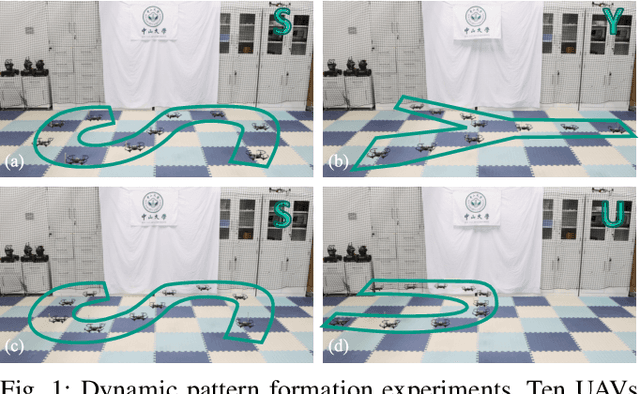
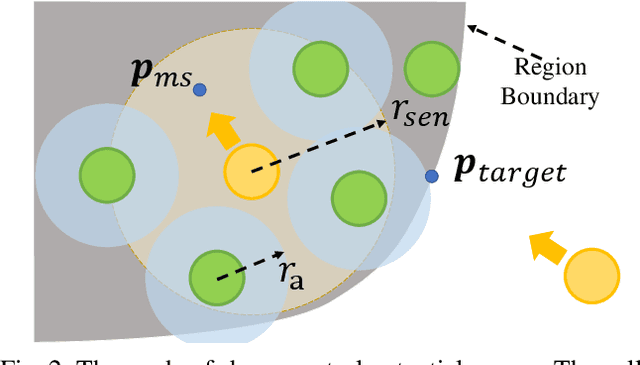
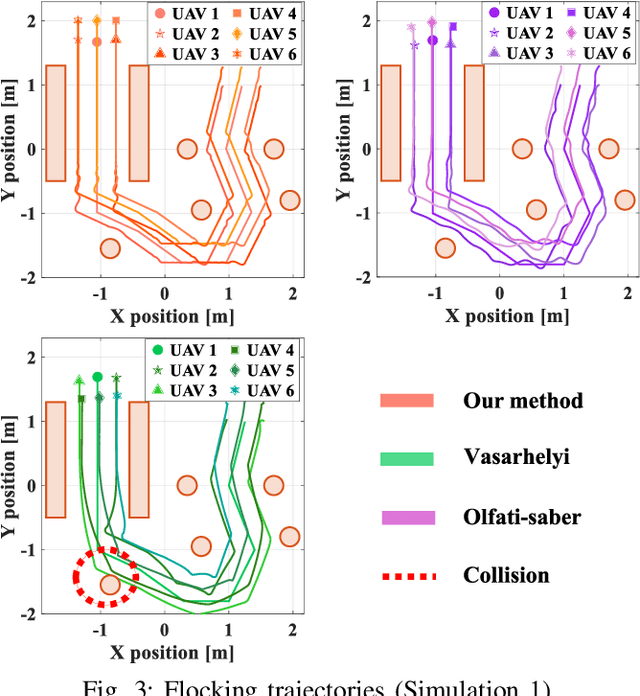
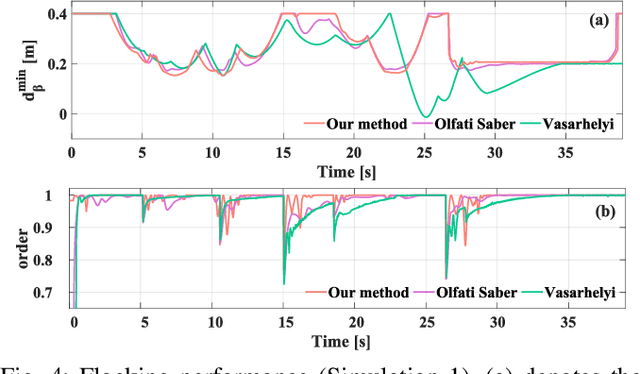
It is promising but challenging to design flocking control for a robot swarm to autonomously follow changing patterns or shapes in a optimal distributed manner. The optimal flocking control with dynamic pattern formation is, therefore, investigated in this paper. A predictive flocking control algorithm is proposed based on a Gibbs random field (GRF), where bio-inspired potential energies are used to charaterize ``robot-robot'' and ``robot-environment'' interactions. Specialized performance-related energies, e.g., motion smoothness, are introduced in the proposed design to improve the flocking behaviors. The optimal control is obtained by maximizing a posterior distribution of a GRF. A region-based shape control is accomplished for pattern formation in light of a mean shift technique. The proposed algorithm is evaluated via the comparison with two state-of-the-art flocking control methods in an environment with obstacles. Both numerical simulations and real-world experiments are conducted to demonstrate the efficiency of the proposed design.