 Add to Chrome
 Add to Firefox
 Add to Edge
WST: Weakly Supervised Transducer for Automatic Speech Recognition
Nov 06, 2025
The Recurrent Neural Network-Transducer (RNN-T) is widely adopted in end-to-end (E2E) automatic speech recognition (ASR) tasks but depends heavily on large-scale, high-quality annotated data, which are often costly and difficult to obtain. To mitigate this reliance, we propose a Weakly Supervised Transducer (WST), which integrates a flexible training graph designed to robustly handle errors in the transcripts without requiring additional confidence estimation or auxiliary pre-trained models. Empirical evaluations on synthetic and industrial datasets reveal that WST effectively maintains performance even with transcription error rates of up to 70%, consistently outperforming existing Connectionist Temporal Classification (CTC)-based weakly supervised approaches, such as Bypass Temporal Classification (BTC) and Omni-Temporal Classification (OTC). These results demonstrate the practical utility and robustness of WST in realistic ASR settings. The implementation will be publicly available.

Detecting Separation in Robotic and Sensor Networks
Feb 16, 2011
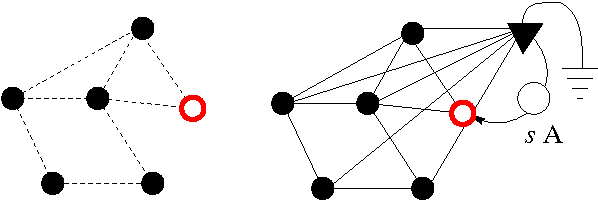
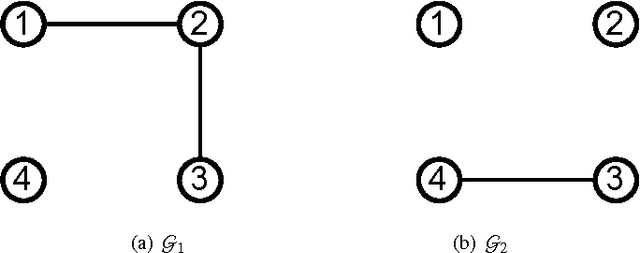
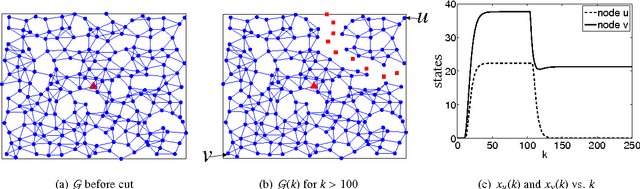
In this paper we consider the problem of monitoring detecting separation of agents from a base station in robotic and sensor networks. Such separation can be caused by mobility and/or failure of the agents. While separation/cut detection may be performed by passing messages between a node and the base in static networks, such a solution is impractical for networks with high mobility, since routes are constantly changing. We propose a distributed algorithm to detect separation from the base station. The algorithm consists of an averaging scheme in which every node updates a scalar state by communicating with its current neighbors. We prove that if a node is permanently disconnected from the base station, its state converges to $0$. If a node is connected to the base station in an average sense, even if not connected in any instant, then we show that the expected value of its state converges to a positive number. Therefore, a node can detect if it has been separated from the base station by monitoring its state. The effectiveness of the proposed algorithm is demonstrated through simulations, a real system implementation and experiments involving both static as well as mobile networks.