 Add to Chrome
 Add to Firefox
 Add to Edge
CDGC-Net: 3D Medical Image Segmentation with Cooperative Dual-Scale Self-Attention and Grouped Channel Modeling
Aug 09, 2026
Accurate 3D medical image segmentation requires the integration of long-range anatomical context with fine boundary detail. Existing methods often model global and local features in separate modules or feature levels and perform channel recalibration independently. This may cause semantic mismatch between global context and local boundaries, insufficient channel relationship modeling, weak spatial-channel interaction, and redundant representations. We propose CDGC-Net, a 3D medical image segmentation network that combines cooperative dual-scale spatial attention with grouped hierarchical channel modeling. With-in each CDGC block, Cooperative Dual-Scale Self-Attention (CDSA) assigns attention heads to parallel local-window and global-sparse branches. The two branches capture fine spatial details and long-range anatomical context at the same feature level. Their outputs are concatenated into an $N\times C$ spatial representation and directly passed to Grouped Hierarchical Channel Attention (GHCA). GHCA organizes the channels into $r$ groups and models both within-group and cross-group dependencies. CDSA and GHCA reuse a shared key projection to maintain a consistent feature reference. Residual feature alignment subsequently integrates the refined features with the original representation. On the Synapse, ACDC, BraTS, and LA datasets, CDGC-Net achieved mean DSC values of 86.96\%, 92.91\%, 82.56\%, and 93.52\%, respectively, exceeding the next-highest reported values by 0.39, 0.47, 0.17, and 0.32 percentage points. CDGC-Net contains 25.83M parameters and 28.62G FLOPs for an input size of $64\times128\times128$, reducing these quantities by 39.87\% and 40.30\%, respectively, relative to UNETR++. These results indicate a favorable trade-off between segmentation accuracy and computational complexity.

Robust and Efficient Motion Reasoning for Privacy-Aware Classroom Incident Recognition
Aug 05, 2026Can computer vision help make classrooms safer? In this pilot study, we investigate privacy-aware and computationally efficient classroom incident recognition from CCTV-style observations. This setting remains underexplored, with limited benchmarks and few methods designed for the privacy, efficiency, and generalization demands of real-world deployment. We introduce a novel hybrid benchmark combining generative CCTV-style videos with real-world classroom pose data, and propose a lightweight, but robust motion-reasoning framework motivated by the observation that many incidents differ more in motion direction, speed, acceleration, and intensity than in pose alone. To that end, our method first constructs hierarchical kinematic representations of human actions. Our method then distills hierarchical, multi-order kinematic reasoning from a large teacher into a much smaller single-order student, enabling efficient per-person inference while preserving expressive motion understanding. Experiments show that our model outperforms substantially larger baselines at less than one-tenth of their computational cost, while also demonstrating stronger out-of-domain motion reasoning and zero-shot synthetic-to-real generalization. We will publicly release the benchmark, codebase, and supporting tools to facilitate further research in privacy-aware classroom safety.
OFD-Net: Teacher-Free Reliable Semi-supervised Medical Image Segmentation with Orthogonal Feature Disentanglement Net of Foreground-Background
Jul 18, 2026Semi-supervised learning (SSL) is an effective solution for medical image segmentation with limited annotations. Existing SSL methods mainly rely on pseudo-labels generated by teacher-student supervision or cross-network consistency. However, these methods lack an explicit structural reference for judging pseudo-label quality. Low-quality pseudo-labels may lead to unreliable training, error accumulation and confirmation bias when processing unlabeled data with substantial appearance variations. To address this issue, we proposed OFD-Net, a teacher-free single-network framework for reliable semi-supervised medical image segmentation. OFD-Net employs an Orthogonal Feature Disentanglement Module (OFDM) to capture OFD features for reliable SSL by disentangling unlabeled data into background and foreground representations with a reliable structural distribution, thereby effectively reducing error accumulation and alleviating confirmation bias among unlabeled data. Specifically, OFD-Net explicitly employs a Disentanglement Guidance Module (DGM) to inject the resulting structural priors of foreground-background into the decoder by deformable convolution processing, and outputs predictions with clearer foreground representations. Based on DGM and the OFDM, we further develop a reliability-aware pseudo-label learning mechanism that evaluates unlabeled supervision according to the structural consistency between the main prediction and the disentangled foreground-background responses, and then down-weights unreliable regions during training. Extensive experiments on four public medical image segmentation benchmarks, namely ISIC-2016, Kvasir-SEG, Synapse, and ACDC, validate the effectiveness of OFD-Net. These results confirm that orthogonal foreground-background disentanglement enables OFD-Net to establish an efficient and reliable training paradigm within a teacher-free single-network framework.
A Global-Local Cross-Attention Network for Ultra-high Resolution Remote Sensing Image Semantic Segmentation
Jun 24, 2025With the rapid development of ultra-high resolution (UHR) remote sensing technology, the demand for accurate and efficient semantic segmentation has increased significantly. However, existing methods face challenges in computational efficiency and multi-scale feature fusion. To address these issues, we propose GLCANet (Global-Local Cross-Attention Network), a lightweight segmentation framework designed for UHR remote sensing imagery.GLCANet employs a dual-stream architecture to efficiently fuse global semantics and local details while minimizing GPU usage. A self-attention mechanism enhances long-range dependencies, refines global features, and preserves local details for better semantic consistency. A masked cross-attention mechanism also adaptively fuses global-local features, selectively enhancing fine-grained details while exploiting global context to improve segmentation accuracy. Experimental results show that GLCANet outperforms state-of-the-art methods regarding accuracy and computational efficiency. The model effectively processes large, high-resolution images with a small memory footprint, providing a promising solution for real-world remote sensing applications.
Fast-StrucTexT: An Efficient Hourglass Transformer with Modality-guided Dynamic Token Merge for Document Understanding
May 19, 2023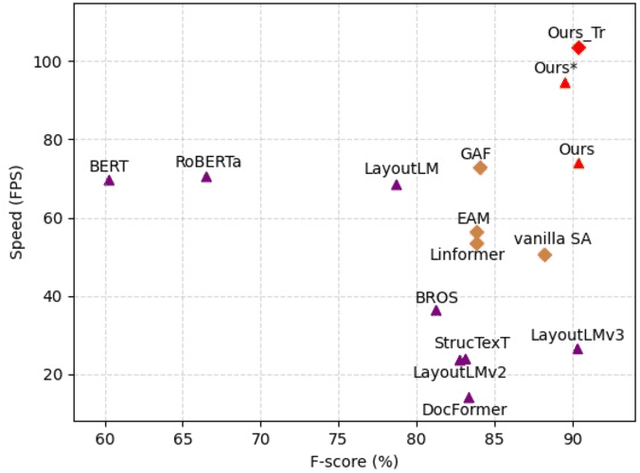
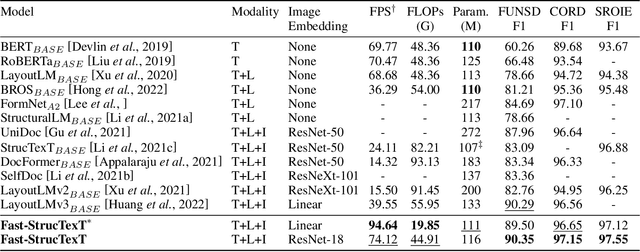
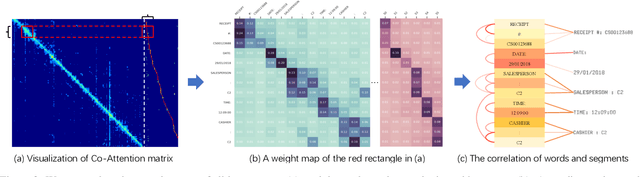

Transformers achieve promising performance in document understanding because of their high effectiveness and still suffer from quadratic computational complexity dependency on the sequence length. General efficient transformers are challenging to be directly adapted to model document. They are unable to handle the layout representation in documents, e.g. word, line and paragraph, on different granularity levels and seem hard to achieve a good trade-off between efficiency and performance. To tackle the concerns, we propose Fast-StrucTexT, an efficient multi-modal framework based on the StrucTexT algorithm with an hourglass transformer architecture, for visual document understanding. Specifically, we design a modality-guided dynamic token merging block to make the model learn multi-granularity representation and prunes redundant tokens. Additionally, we present a multi-modal interaction module called Symmetry Cross Attention (SCA) to consider multi-modal fusion and efficiently guide the token mergence. The SCA allows one modality input as query to calculate cross attention with another modality in a dual phase. Extensive experiments on FUNSD, SROIE, and CORD datasets demonstrate that our model achieves the state-of-the-art performance and almost 1.9X faster inference time than the state-of-the-art methods.
Latency Aware Semi-synchronous Client Selection and Model Aggregation for Wireless Federated Learning
Oct 19, 2022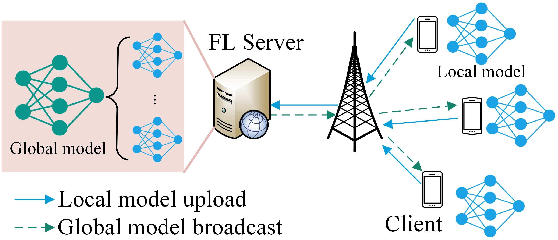
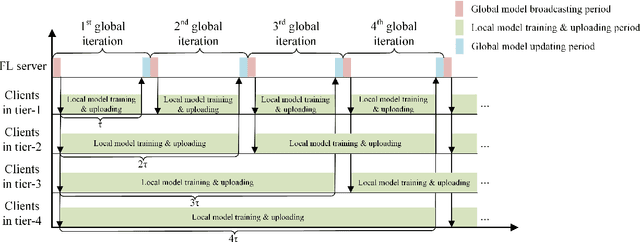
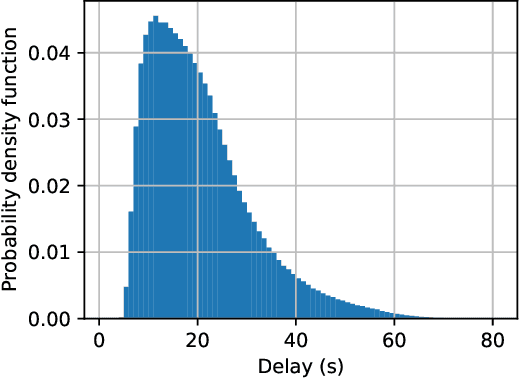
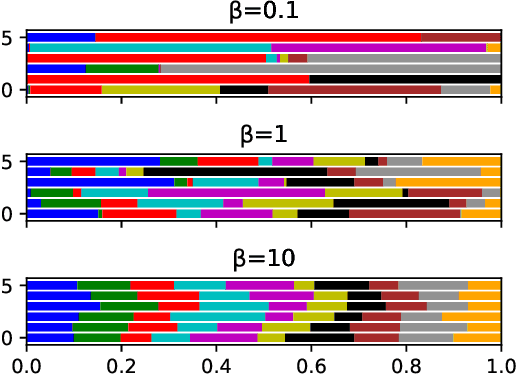
Federated learning (FL) is a collaborative machine learning framework that requires different clients (e.g., Internet of Things devices) to participate in the machine learning model training process by training and uploading their local models to an FL server in each global iteration. Upon receiving the local models from all the clients, the FL server generates a global model by aggregating the received local models. This traditional FL process may suffer from the straggler problem in heterogeneous client settings, where the FL server has to wait for slow clients to upload their local models in each global iteration, thus increasing the overall training time. One of the solutions is to set up a deadline and only the clients that can upload their local models before the deadline would be selected in the FL process. This solution may lead to a slow convergence rate and global model overfitting issues due to the limited client selection. In this paper, we propose the Latency awarE Semi-synchronous client Selection and mOdel aggregation for federated learNing (LESSON) method that allows all the clients to participate in the whole FL process but with different frequencies. That is, faster clients would be scheduled to upload their models more frequently than slow clients, thus resolving the straggler problem and accelerating the convergence speed, while avoiding model overfitting. Also, LESSON is capable of adjusting the tradeoff between the model accuracy and convergence rate by varying the deadline. Extensive simulations have been conducted to compare the performance of LESSON with the other two baseline methods, i.e., FedAvg and FedCS. The simulation results demonstrate that LESSON achieves faster convergence speed than FedAvg and FedCS, and higher model accuracy than FedCS.