 Add to Chrome
 Add to Firefox
 Add to Edge
NeSy-CSA: A Neuro-Symbolic Framework for Open-Ended Critical Scenario Attribution
Jul 04, 2026
Understanding why discovered scenarios become critical in scenario-based testing is essential for effectively leveraging them in decision-making systems. Reasoning about such criticality can be formulated as an attribution problem. However, across different decision-making tasks, the causes of criticality may involve diverse state variables, interaction patterns, and failure mechanisms, making attribution an inherently open-ended problem beyond predefined explanation spaces. Existing attribution methods still struggle to balance open-ended reasoning flexibility with the interpretability and traceability required for critical scenario reasoning. To address this limitation, we propose NeSy-CSA, a neuro-symbolic framework that transforms open-ended critical scenario attribution from unconstrained explanation generation into structured and traceable reasoning. NeSy-CSA narrows the attribution space by selecting relevant factors, makes the reasoning process traceable through a dependency-aware evidence graph, and executes symbolic reasoning procedures derived from atomic operations, coordinated with evidence-constrained neural inference to support flexible open-ended attribution. We further introduce a process-level and result-level assessment module to evaluate the structural validity of the attribution process and the behavioral effectiveness of the attribution results under controlled interventions. Experiments across four decision-making environments show that NeSy-CSA improves two intervention-based measures of attribution effectiveness by 18.32% and 13.67% over LLM-based baselines. These results demonstrate its potential to transform discovered critical scenarios into reusable knowledge for subsequent testing and safety analysis.

Illumination adaptive person reid based on teacher-student model and adversarial training
Feb 13, 2020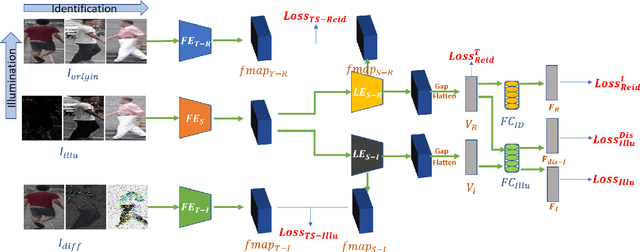
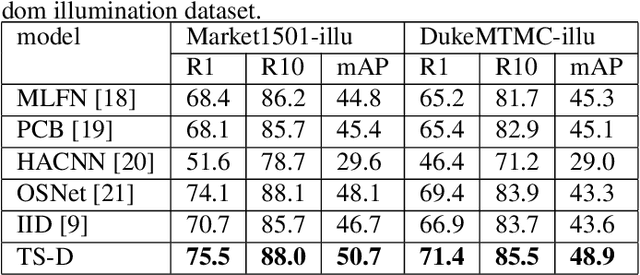

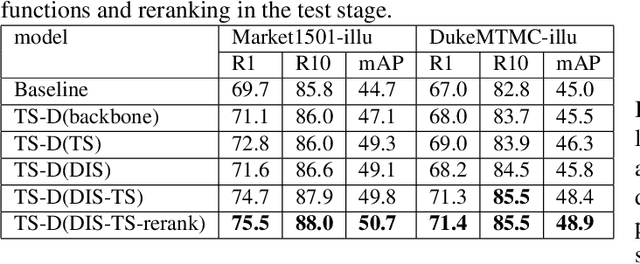
Most existing works in Person Re-identification (ReID) focus on settings where illumination either is kept the same or has very little fluctuation. However, the changes in the illumination degree may affect the robustness of a ReID algorithm significantly. To address this problem, we proposed a Two-Stream Network that can separate ReID features from lighting features to enhance ReID performance. Its innovations are threefold: (1) A discriminative entropy loss to ensure the ReID features contain no lighting information. (2) A ReID Teacher model trained by images under "neutral" lighting conditions to guide ReID classification. (3) An illumination Teacher model trained by the differences between the illumination-adjusted and original images to guide illumination classification. We construct two augmented datasets by synthetically changing a set of predefined lighting conditions in two of the most popular ReID benchmarks: Market1501 and DukeMTMC-ReID. Experiments demonstrate that our algorithm outperforms other state-of-the-art works and particularly potent in handling images under extremely low light.