 Add to Chrome
 Add to Firefox
 Add to Edge
RoboReact: Agentic Skill Distillation from Generated Egocentric Videos for Generalizable Whole-Body Manipulation
Aug 05, 2026
Humanoid robots have the potential to perform dexterous manipulation in human environments, yet acquiring diverse and generalizable skills remains costly due to expensive hardware data collection and labor-intensive annotation. Recent advances in video generative models provide a promising opportunity to synthesize rich manipulation experiences from visual observations, but transferring such imagined behaviors into executable whole-body humanoid skills remains largely unexplored. In this work, we present RoboReact, a framework that automatically synthesizes whole-body humanoid manipulation skills from a single egocentric RGB-D observation. RoboReact generates human manipulation videos, extracts geometry-preserving interaction keyframes through depth-aware 3D reconstruction, and retargets them to high-DoF humanoid platforms while preserving hand-object interaction geometry. To bridge the gap between imagined plans and physical execution, RoboReact performs online object-centric re-grounding and leverages a vision-language model-guided refinement loop to adapt skills under geometric mismatch and execution deviations. The refined skills are executed through a whole-body controller, enabling coordinated whole-body manipulation and dexterous interaction. Experiments on real humanoid robots demonstrate that RoboReact generalizes across diverse object configurations and robustly recovers from execution disturbances without requiring teleoperation or human demonstrations. These results highlight the potential of combining generative models, vision-language reasoning, and closed-loop control for scalable humanoid skill acquisition.

Mining Hidden Populations through Attributed Search
May 11, 2019
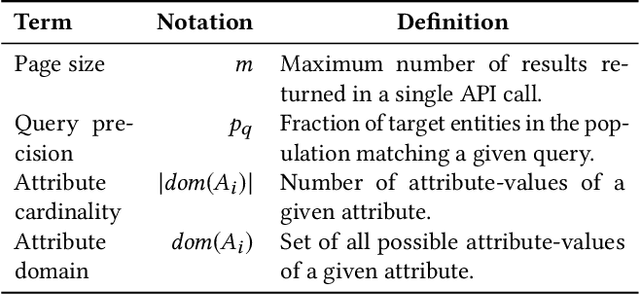
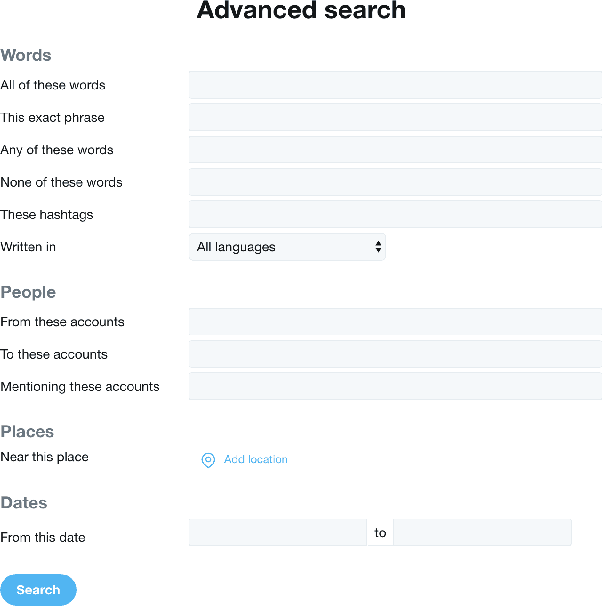
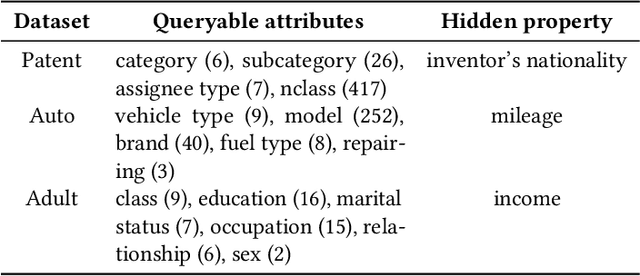
Researchers often query online social platforms through their application programming interfaces (API) to find target populations such as people with mental illness~\cite{De-Choudhury2017} and jazz musicians~\cite{heckathorn2001finding}. Entities of such target population satisfy a property that is typically identified using an oracle (human or a pre-trained classifier). When the property of the target entities is not directly queryable via the API, we refer to the property as `hidden' and the population as a hidden population. Finding individuals who belong to these populations on social networks is hard because they are non-queryable, and the sampler has to explore from a combinatorial query space within a finite budget limit. By exploiting the correlation between queryable attributes and the population of interest and by hierarchically ordering the query space, we propose a Decision tree-based Thompson sampler (\texttt{DT-TMP}) that efficiently discovers the right combination of attributes to query. Our proposed sampler outperforms the state-of-the-art samplers in online experiments, for example by 54\% on Twitter. When the number of matching entities to a query is known in offline experiments, \texttt{DT-TMP} performs exceedingly well by a factor of 0.9-1.5$\times$ over the baseline samplers. In the future, we wish to explore the option of finding hidden populations by formulating more complex queries.