 Add to Chrome
 Add to Firefox
 Add to Edge
CRAFT: Grounded Multi-Agent Coordination Under Partial Information
Mar 26, 2026
We introduce CRAFT, a multi-agent benchmark for evaluating pragmatic communication in large language models under strict partial information. In this setting, multiple agents with complementary but incomplete views must coordinate through natural language to construct a shared 3D structure that no single agent can fully observe. We formalize this problem as a multi-sender pragmatic reasoning task and provide a diagnostic framework that decomposes failures into spatial grounding, belief modeling and pragmatic communication errors, including a taxonomy of behavioral failure profiles in both frontier and open-weight models. Across a diverse set of models, including 8 open-weight and 7 frontier including reasoning models, we find that stronger reasoning ability does not reliably translate to better coordination: smaller open-weight models often match or outperform frontier systems, and improved individual communication does not guarantee successful collaboration. These results suggest that multi-agent coordination remains a fundamentally unsolved challenge for current language models. Our code can be found at https://github.com/csu-signal/CRAFT

TRACE: Real-Time Multimodal Common Ground Tracking in Situated Collaborative Dialogues
Mar 12, 2025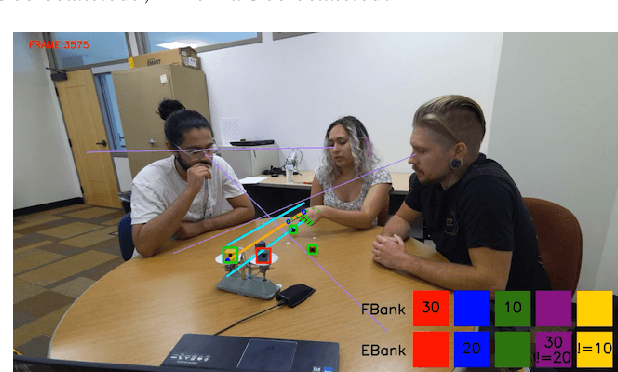
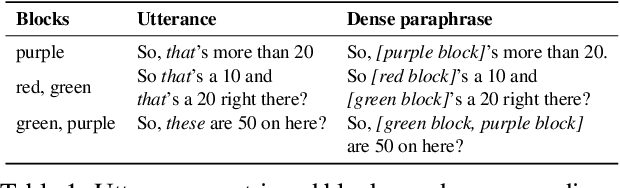
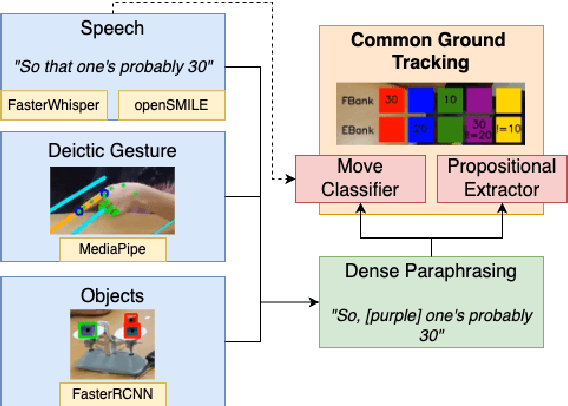
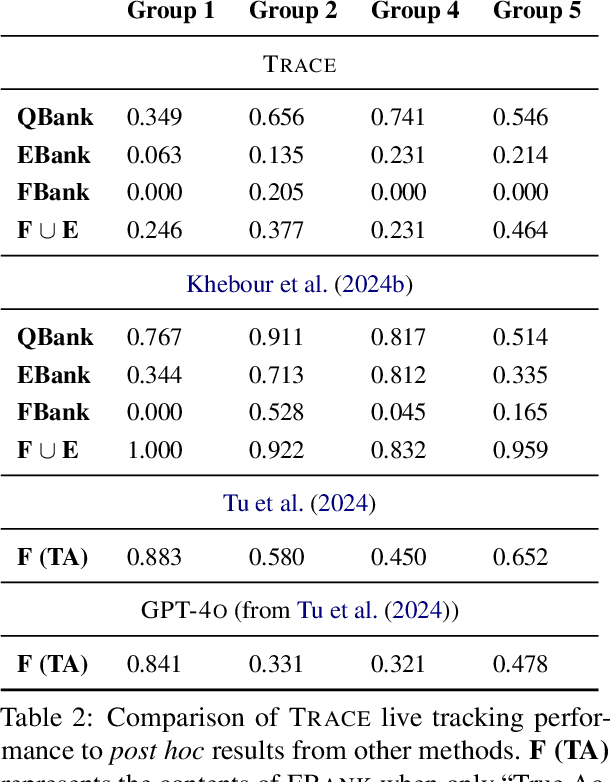
We present TRACE, a novel system for live *common ground* tracking in situated collaborative tasks. With a focus on fast, real-time performance, TRACE tracks the speech, actions, gestures, and visual attention of participants, uses these multimodal inputs to determine the set of task-relevant propositions that have been raised as the dialogue progresses, and tracks the group's epistemic position and beliefs toward them as the task unfolds. Amid increased interest in AI systems that can mediate collaborations, TRACE represents an important step forward for agents that can engage with multiparty, multimodal discourse.
Speech Is Not Enough: Interpreting Nonverbal Indicators of Common Knowledge and Engagement
Dec 08, 2024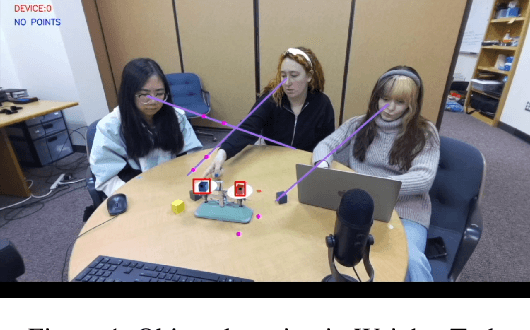
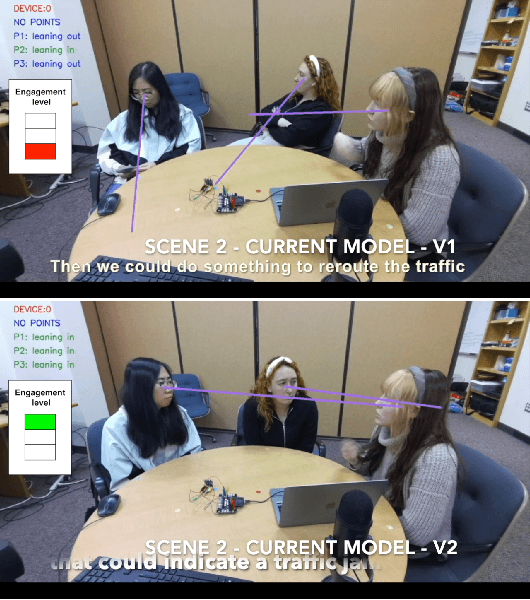
Our goal is to develop an AI Partner that can provide support for group problem solving and social dynamics. In multi-party working group environments, multimodal analytics is crucial for identifying non-verbal interactions of group members. In conjunction with their verbal participation, this creates an holistic understanding of collaboration and engagement that provides necessary context for the AI Partner. In this demo, we illustrate our present capabilities at detecting and tracking nonverbal behavior in student task-oriented interactions in the classroom, and the implications for tracking common ground and engagement.