 Add to Chrome
 Add to Firefox
 Add to Edge
MorphSNN: Adaptive Graph Diffusion and Structural Plasticity for Spiking Neural Networks
Mar 15, 2026
Spiking Neural Networks (SNNs) currently face a critical bottleneck: while individual neurons exhibit dynamic biological properties, their macro-scopic architectures remain confined within conventional connectivity patterns that are static and hierarchical. This discrepancy between neuron-level dynamics and network-level fixed connectivity eliminates critical brain-like lateral interactions, limiting adaptability in changing environments. To address this, we propose MorphSNN, a backbone framework inspired by biological non-synaptic diffusion and structural plasticity. Specifically, we introduce a Graph Diffusion (GD)mechanism to facilitate efficient undirected signal propagation, complementing the feedforward hierarchy. Furthermore, it incorporates a Spatio-Temporal Structural Plasticity (STSP) mechanism, endowing the network with the capability for instance-specific, dynamic topological reorganization, thereby overcoming the limitations of fixed topologies. Experiments demonstrate that MorphSNN achieves state-of-the-art accuracy on static and neuromorphic datasets; for instance, it reaches 83.35% accuracy on N-Caltech101 with only 5 timesteps. More importantly, its self-evolving topology functions as an intrinsic distribution fingerprint, enabling superior Out-of- Distribution (OOD) detection without auxiliary training. The code is available at anonymous.4open.science/r/MorphSNN-B0BC.

CogniSNN: Enabling Neuron-Expandability, Pathway-Reusability, and Dynamic-Configurability with Random Graph Architectures in Spiking Neural Networks
Dec 12, 2025Spiking neural networks (SNNs), regarded as the third generation of artificial neural networks, are expected to bridge the gap between artificial intelligence and computational neuroscience. However, most mainstream SNN research directly adopts the rigid, chain-like hierarchical architecture of traditional artificial neural networks (ANNs), ignoring key structural characteristics of the brain. Biological neurons are stochastically interconnected, forming complex neural pathways that exhibit Neuron-Expandability, Pathway-Reusability, and Dynamic-Configurability. In this paper, we introduce a new SNN paradigm, named Cognition-aware SNN (CogniSNN), by incorporating Random Graph Architecture (RGA). Furthermore, we address the issues of network degradation and dimensional mismatch in deep pathways by introducing an improved pure spiking residual mechanism alongside an adaptive pooling strategy. Then, we design a Key Pathway-based Learning without Forgetting (KP-LwF) approach, which selectively reuses critical neural pathways while retaining historical knowledge, enabling efficient multi-task transfer. Finally, we propose a Dynamic Growth Learning (DGL) algorithm that allows neurons and synapses to grow dynamically along the internal temporal dimension. Extensive experiments demonstrate that CogniSNN achieves performance comparable to, or even surpassing, current state-of-the-art SNNs on neuromorphic datasets and Tiny-ImageNet. The Pathway-Reusability enhances the network's continuous learning capability across different scenarios, while the dynamic growth algorithm improves robustness against interference and mitigates the fixed-timestep constraints during neuromorphic chip deployment. This work demonstrates the potential of SNNs with random graph structures in advancing brain-inspired intelligence and lays the foundation for their practical application on neuromorphic hardware.
CogniSNN: A First Exploration to Random Graph Architecture based Spiking Neural Networks with Enhanced Expandability and Neuroplasticity
May 09, 2025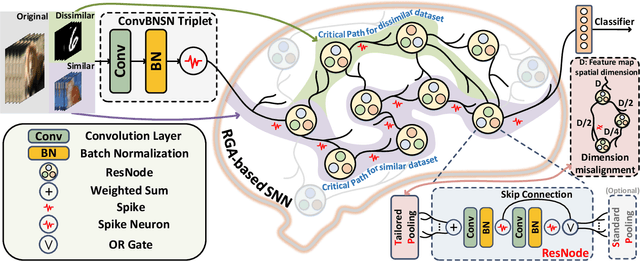
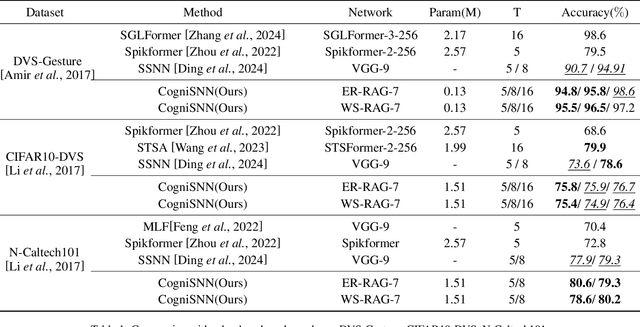
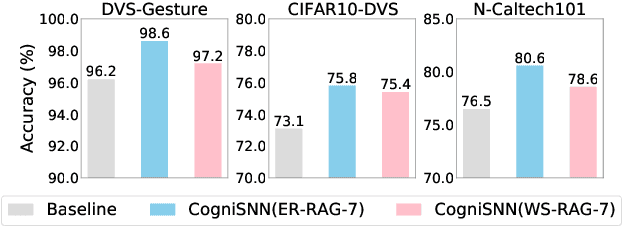
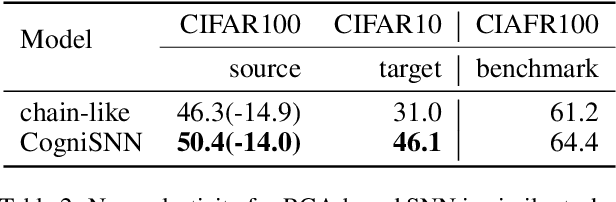
Despite advances in spiking neural networks (SNNs) in numerous tasks, their architectures remain highly similar to traditional artificial neural networks (ANNs), restricting their ability to mimic natural connections between biological neurons. This paper develops a new modeling paradigm for SNN with random graph architecture (RGA), termed Cognition-aware SNN (CogniSNN). Furthermore, we improve the expandability and neuroplasticity of CogniSNN by introducing a modified spiking residual neural node (ResNode) to counteract network degradation in deeper graph pathways, as well as a critical path-based algorithm that enables CogniSNN to perform continual learning on new tasks leveraging the features of the data and the RGA learned in the old task. Experiments show that CogniSNN with re-designed ResNode performs outstandingly in neuromorphic datasets with fewer parameters, achieving 95.5% precision in the DVS-Gesture dataset with only 5 timesteps. The critical path-based approach decreases 3% to 5% forgetting while maintaining expected performance in learning new tasks that are similar to or distinct from the old ones. This study showcases the potential of RGA-based SNN and paves a new path for biologically inspired networks based on graph theory.