 Add to Chrome
 Add to Firefox
 Add to Edge
Generative Model Proposal based Particle Filtering for Data Assimilation
Jul 01, 2026
Data assimilation models state dynamics conditioned on sequential observations, and has wide-ranging scientific applications. In the filtering setting, the goal is to model the posterior over the current state given all observations so far. Classical solutions typically make simplifying distributional or functional assumptions, e.g., linear-Gaussian systems, which can be inaccurate in many scenarios. In principle, particle filters (PFs) remove these assumptions, yet often collapse in high dimensions. Recent generative approaches learn conditional state transitions, but without principled Bayesian updates they do not recover the correct filtering posterior and can accumulate error over long horizons. In this work, we introduce Flow Proposal Particle Filters (FPPF), which learn a conditional generative model based proposal approximating the variance-minimizing optimal proposal for particle propagation. Conditioning on observations steers particles toward high-likelihood regions before weighting, reducing weight variance and delaying degeneracy. Since our proposal admits tractable likelihood evaluation, FPPF computes accurate importance weights and retains a Bayesian update step. We further extend FPPF to high-dimensional problems through localization strategies, adressing another standard PF failure mode. Extensive experiments on a variety of dynamical systems show that FPPF outperforms statistical baselines and other generative methods in non-linear, non-Gaussian, and high-dimensional regimes.

Towards Causal Representations of Climate Model Data
Dec 06, 2023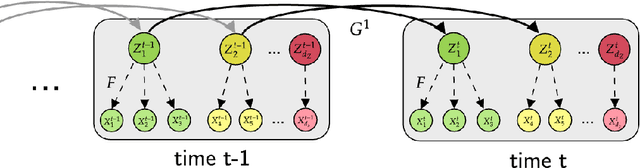

Climate models, such as Earth system models (ESMs), are crucial for simulating future climate change based on projected Shared Socioeconomic Pathways (SSP) greenhouse gas emissions scenarios. While ESMs are sophisticated and invaluable, machine learning-based emulators trained on existing simulation data can project additional climate scenarios much faster and are computationally efficient. However, they often lack generalizability and interpretability. This work delves into the potential of causal representation learning, specifically the \emph{Causal Discovery with Single-parent Decoding} (CDSD) method, which could render climate model emulation efficient \textit{and} interpretable. We evaluate CDSD on multiple climate datasets, focusing on emissions, temperature, and precipitation. Our findings shed light on the challenges, limitations, and promise of using CDSD as a stepping stone towards more interpretable and robust climate model emulation.
ClimateSet: A Large-Scale Climate Model Dataset for Machine Learning
Nov 07, 2023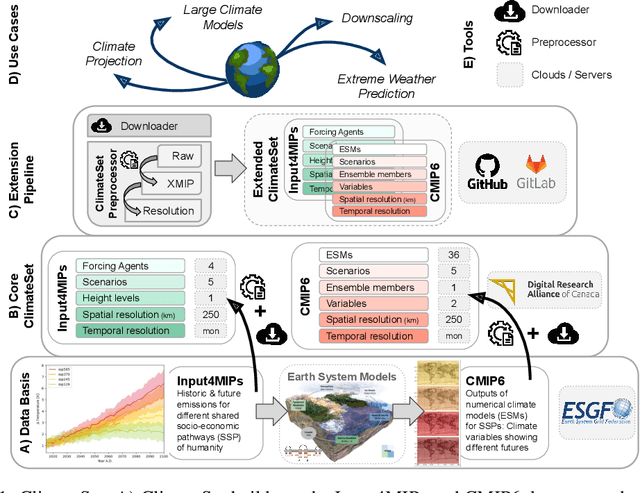
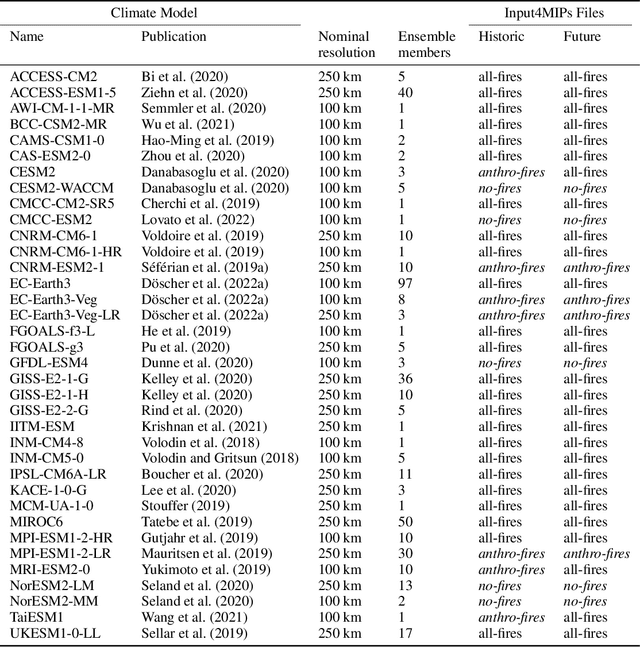
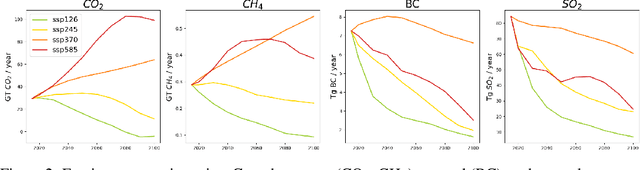
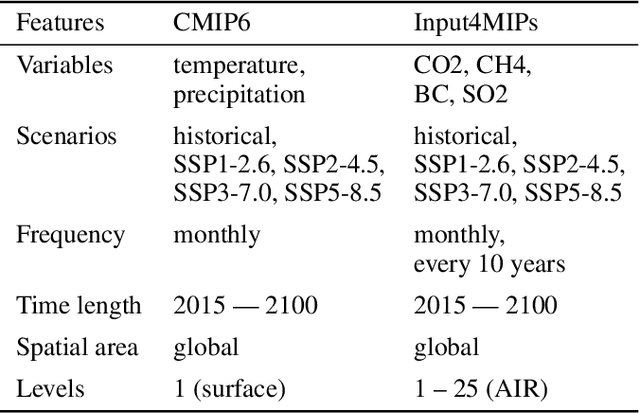
Climate models have been key for assessing the impact of climate change and simulating future climate scenarios. The machine learning (ML) community has taken an increased interest in supporting climate scientists' efforts on various tasks such as climate model emulation, downscaling, and prediction tasks. Many of those tasks have been addressed on datasets created with single climate models. However, both the climate science and ML communities have suggested that to address those tasks at scale, we need large, consistent, and ML-ready climate model datasets. Here, we introduce ClimateSet, a dataset containing the inputs and outputs of 36 climate models from the Input4MIPs and CMIP6 archives. In addition, we provide a modular dataset pipeline for retrieving and preprocessing additional climate models and scenarios. We showcase the potential of our dataset by using it as a benchmark for ML-based climate model emulation. We gain new insights about the performance and generalization capabilities of the different ML models by analyzing their performance across different climate models. Furthermore, the dataset can be used to train an ML emulator on several climate models instead of just one. Such a "super emulator" can quickly project new climate change scenarios, complementing existing scenarios already provided to policymakers. We believe ClimateSet will create the basis needed for the ML community to tackle climate-related tasks at scale.