 Add to Chrome
 Add to Firefox
 Add to Edge
Generative Model Proposal based Particle Filtering for Data Assimilation
Jul 01, 2026
Data assimilation models state dynamics conditioned on sequential observations, and has wide-ranging scientific applications. In the filtering setting, the goal is to model the posterior over the current state given all observations so far. Classical solutions typically make simplifying distributional or functional assumptions, e.g., linear-Gaussian systems, which can be inaccurate in many scenarios. In principle, particle filters (PFs) remove these assumptions, yet often collapse in high dimensions. Recent generative approaches learn conditional state transitions, but without principled Bayesian updates they do not recover the correct filtering posterior and can accumulate error over long horizons. In this work, we introduce Flow Proposal Particle Filters (FPPF), which learn a conditional generative model based proposal approximating the variance-minimizing optimal proposal for particle propagation. Conditioning on observations steers particles toward high-likelihood regions before weighting, reducing weight variance and delaying degeneracy. Since our proposal admits tractable likelihood evaluation, FPPF computes accurate importance weights and retains a Bayesian update step. We further extend FPPF to high-dimensional problems through localization strategies, adressing another standard PF failure mode. Extensive experiments on a variety of dynamical systems show that FPPF outperforms statistical baselines and other generative methods in non-linear, non-Gaussian, and high-dimensional regimes.

Hierarchical Testing of a Hybrid Machine Learning-Physics Global Atmosphere Model
Feb 11, 2026Machine learning (ML)-based models have demonstrated high skill and computational efficiency, often outperforming conventional physics-based models in weather and subseasonal predictions. While prior studies have assessed their fidelity in capturing synoptic-scale atmospheric dynamics, their performance across timescales and under out-of-distribution forcing, such as +3K or +4K uniform-warming forcings, and the sources of biases remain elusive, to establish the model reliability for Earth science. Here, we design three sets of experiments targeting synoptic-scale phenomena, interannual variability, and out-of-distribution uniform-warming forcings. We evaluate the Neural General Circulation Model (NeuralGCM), a hybrid model integrating a dynamical core with ML-based component, against observations and physics-based Earth system models (ESMs). At the synoptic scale, NeuralGCM captures the evolution and propagation of extratropical cyclones with performance comparable to ESMs. At the interannual scale, when forced by El Niño-Southern Oscillation sea surface temperature (SST) anomalies, NeuralGCM successfully reproduces associated teleconnection patterns but exhibits deficiencies in capturing nonlinear response. Under out-of-distribution uniform-warming forcings, NeuralGCM simulates similar responses in global-average temperature and precipitation and reproduces large-scale tropospheric circulation features similar to those in ESMs. Notable weaknesses include overestimating the tracks and spatial extent of extratropical cyclones, biases in the teleconnected wave train triggered by tropical SST anomalies, and differences in upper-level warming and stratospheric circulation responses to SST warming compared to physics-based ESMs. The causes of these weaknesses were explored.
Seasonal Prediction with Neural GCM and Simplified Boundary Forcings: Large-scale Atmospheric Variability and Tropical Cyclone Activity
Apr 30, 2025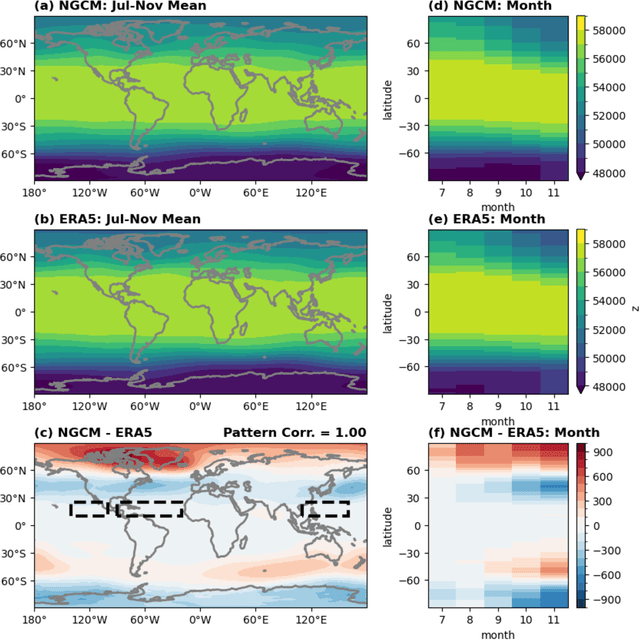
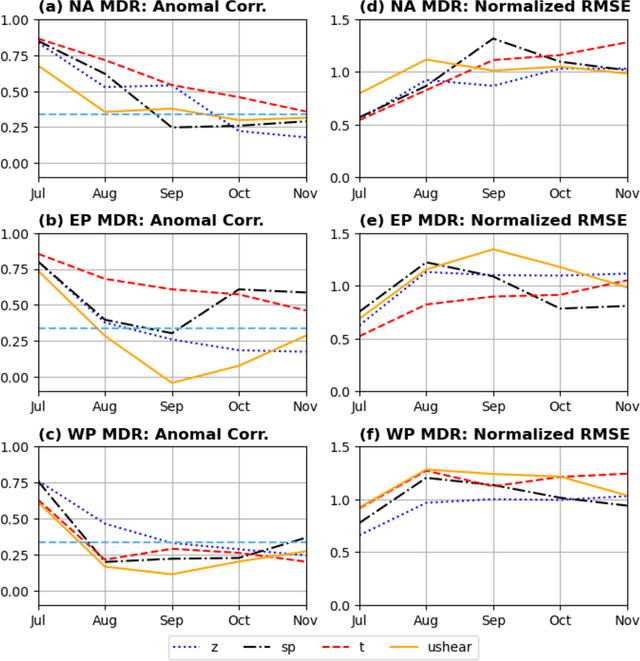

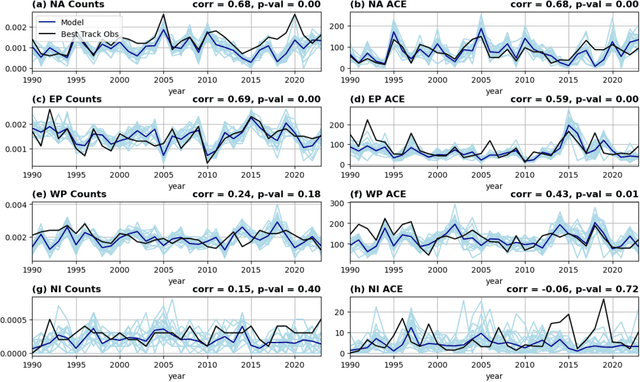
Machine learning (ML) models are successful with weather forecasting and have shown progress in climate simulations, yet leveraging them for useful climate predictions needs exploration. Here we show this feasibility using NeuralGCM, a hybrid ML-physics atmospheric model, for seasonal predictions of large-scale atmospheric variability and Northern Hemisphere tropical cyclone (TC) activity. Inspired by physical model studies, we simplify boundary conditions, assuming sea surface temperature (SST) and sea ice follow their climatological cycle but persist anomalies present at initialization. With such forcings, NeuralGCM simulates realistic atmospheric circulation and TC climatology patterns. Furthermore, this configuration yields useful seasonal predictions (July-November) for the tropical atmosphere and various TC activity metrics. Notably, the prediction skill for TC frequency in the North Atlantic and East Pacific basins is comparable to existing physical models. These findings highlight the promise of leveraging ML models with physical insights to model TC risks and deliver seamless weather-climate predictions.