 Add to Chrome
 Add to Firefox
 Add to Edge
RT-GS: Gaussian Splatting with Reflection and Transmittance Primitives
Apr 01, 2026
Gaussian Splatting is a powerful tool for reconstructing diffuse scenes, but it struggles to simultaneously model specular reflections and the appearance of objects behind semi-transparent surfaces. These specular reflections and transmittance are essential for realistic novel view synthesis, and existing methods do not properly incorporate the underlying physical processes to simulate them. To address this issue, we propose RT-GS, a unified framework that integrates a microfacet material model and ray tracing to jointly model specular reflection and transmittance in Gaussian Splatting. We accomplish this by using separate Gaussian primitives for reflections and transmittance, which allow modeling distant reflections and reconstructing objects behind transparent surfaces concurrently. We utilize a differentiable ray tracing framework to obtain the specular reflection and transmittance appearance. Our experiments demonstrate that our method successfully produces reflections and recovers objects behind transparent surfaces in complex environments, achieving significant qualitative improvements over prior methods where these specular light interactions are prominent.

A Unified Differentiable Boolean Operator with Fuzzy Logic
Jul 15, 2024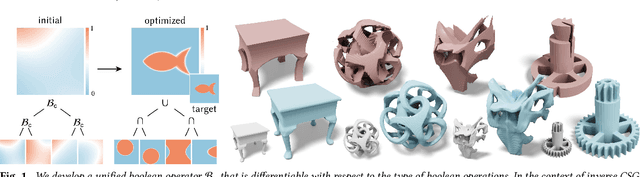
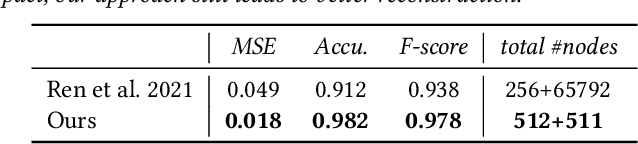

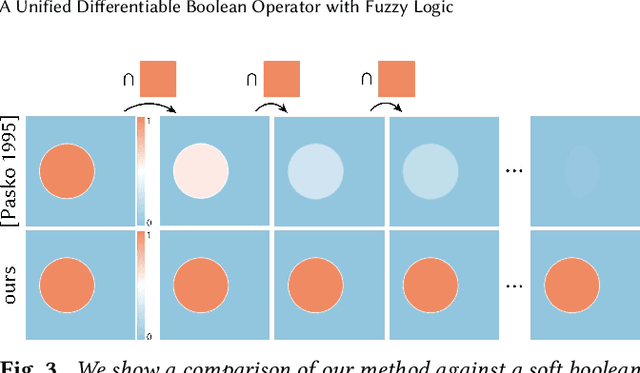
This paper presents a unified differentiable boolean operator for implicit solid shape modeling using Constructive Solid Geometry (CSG). Traditional CSG relies on min, max operators to perform boolean operations on implicit shapes. But because these boolean operators are discontinuous and discrete in the choice of operations, this makes optimization over the CSG representation challenging. Drawing inspiration from fuzzy logic, we present a unified boolean operator that outputs a continuous function and is differentiable with respect to operator types. This enables optimization of both the primitives and the boolean operations employed in CSG with continuous optimization techniques, such as gradient descent. We further demonstrate that such a continuous boolean operator allows modeling of both sharp mechanical objects and smooth organic shapes with the same framework. Our proposed boolean operator opens up new possibilities for future research toward fully continuous CSG optimization.