 Add to Chrome
 Add to Firefox
 Add to Edge
An Uncertainty Estimation Framework for Dose Accumulation in Adaptive Radiotherapy: Application to CBCT-Guided Radiotherapy for Cervical Cancer
Jun 09, 2026
Background and purpose: oART enables daily plan adaptation to interfraction anatomical variations, but cumulative dose estimation remains limited by DIR, segmentation, and anatomical uncertainties. We introduce IMPACT-DoseAcc, an uncertainty-aware dose accumulation framework, within IMPACT for semantic feature-driven image analysis. The framework is modality- and disease-agnostic and is applied to CBCT-guided oART for cervical cancer (LACC). Material and Methods: Nine LACC patients were retrospectively analyzed using daily CBCT-derived virtual CTs for dose recalculation. IMPACT-DoseAcc focuses on uncertainty from DIR, without modeling vCT-generation uncertainty. Two DIR uncertainty strategies were tested within IMPACT-Reg: a Bayesian segmentation-guided approach using one probabilistic model to quantify anatomical uncertainty, and an ensemble of segmentation models targeting structures to capture epistemic variability. Voxel-wise uncertainty maps were propagated through dose warping and accumulation to generate probabilistic dose-volume histograms. Ensemble uncertainty was quantified from voxel-wise standard deviation across deformation fields, and geometric error was assessed using surface distance between warped and validated contours. Anatomical-variability weighting refined aggregation. Results: Ensemble DIR uncertainty correlated with geometric error, with Pearson coefficients of 0.63 for CTVt and 0.66 for bladder. For CTVt, pDVHs achieved 96.3 +/- 3.9% coverage, showing calibration of propagated uncertainty. Weighting stabilized estimates across fractions and organs. Conclusions: IMPACT-DoseAcc propagates registration-driven uncertainty to cumulative dose metrics, improving interpretation of accumulated dose under anatomical variations. Its 3DSlicer integration supports reproducible, uncertainty-informed ART workflows.

Calibration and Uncertainty for multiRater Volume Assessment in multiorgan Segmentation (CURVAS) challenge results
May 13, 2025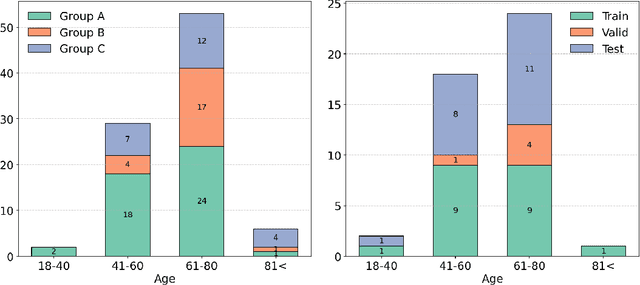
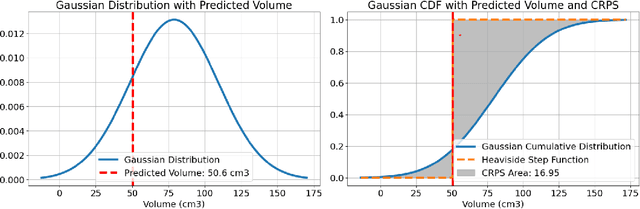
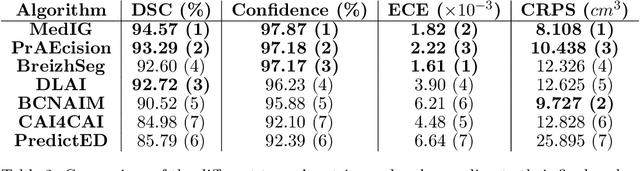
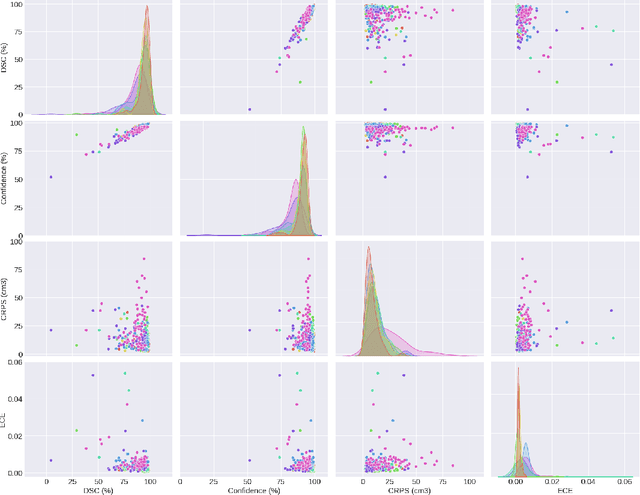
Deep learning (DL) has become the dominant approach for medical image segmentation, yet ensuring the reliability and clinical applicability of these models requires addressing key challenges such as annotation variability, calibration, and uncertainty estimation. This is why we created the Calibration and Uncertainty for multiRater Volume Assessment in multiorgan Segmentation (CURVAS), which highlights the critical role of multiple annotators in establishing a more comprehensive ground truth, emphasizing that segmentation is inherently subjective and that leveraging inter-annotator variability is essential for robust model evaluation. Seven teams participated in the challenge, submitting a variety of DL models evaluated using metrics such as Dice Similarity Coefficient (DSC), Expected Calibration Error (ECE), and Continuous Ranked Probability Score (CRPS). By incorporating consensus and dissensus ground truth, we assess how DL models handle uncertainty and whether their confidence estimates align with true segmentation performance. Our findings reinforce the importance of well-calibrated models, as better calibration is strongly correlated with the quality of the results. Furthermore, we demonstrate that segmentation models trained on diverse datasets and enriched with pre-trained knowledge exhibit greater robustness, particularly in cases deviating from standard anatomical structures. Notably, the best-performing models achieved high DSC and well-calibrated uncertainty estimates. This work underscores the need for multi-annotator ground truth, thorough calibration assessments, and uncertainty-aware evaluations to develop trustworthy and clinically reliable DL-based medical image segmentation models.