 Add to Chrome
 Add to Firefox
 Add to Edge
Identifying AI Web Scrapers Using Canary Tokens
May 13, 2026
From pre-training to query-time augmentation, web-scraped data helps to improve the quality and contextual relevancy of content generated by large language models (LLMs). However, large-scale web scraping to feed LLMs can affect site stability and raise legal, privacy, or ethics concerns. If website owners wish to limit LLM-related web scraping on their site, due to these or other concerns, they may turn to scraper access control mechanisms like the Robots Exclusion Protocol. To be most effective, such mechanisms require site owners to first identify the scrapers that they wish to restrict (e.g., via User-Agent strings). Existing mechanisms to identify LLM-related scrapers rely on voluntary disclosure by companies, one-off experiments by researchers, or crowd-sourced reports -- methods that are neither reliable nor scalable. This paper proposes a novel technique for accurately and automatically inferring LLM-related scrapers. We host dynamic websites that serve unique canary tokens to each visiting scraper, then prompt LLMs for information about our sites. If an LLM consistently generates outputs containing tokens unique to a scraper, it provides evidence of exposure to that scraper. Via experiments across 22 production LLM systems, we demonstrate that our approach can reliably identify which scrapers feed which LLM, including several that are not publicly known or disclosed by the companies. Our approach provides a promising avenue for unprivileged third parties to infer which scrapers serve data to which LLMs, potentially enabling better control over unwanted scraping.

Reflect: Transparent Principle-Guided Reasoning for Constitutional Alignment at Scale
Jan 26, 2026The constitutional framework of alignment aims to align large language models (LLMs) with value-laden principles written in natural language (such as to avoid using biased language). Prior work has focused on parameter fine-tuning techniques, such as reinforcement learning from human feedback (RLHF), to instill these principles. However, these approaches are computationally demanding, require careful engineering and tuning, and often require difficult-to-obtain human annotation data. We propose \textsc{reflect}, an inference-time framework for constitutional alignment that does not require any training or data, providing a plug-and-play approach for aligning an instruction-tuned model to a set of principles. \textsc{reflect} operates entirely in-context, combining a (i) constitution-conditioned base response with post-generation (ii) self-evaluation, (iii)(a) self-critique, and (iii)(b) final revision. \textsc{reflect}'s technique of explicit in-context reasoning over principles during post-generation outperforms standard few-shot prompting and provides transparent reasoning traces. Our results demonstrate that \textsc{reflect} significantly improves LLM conformance to diverse and complex principles, including principles quite distinct from those emphasized in the model's original parameter fine-tuning, without sacrificing factual reasoning. \textsc{reflect} is particularly effective at reducing the rate of rare but significant violations of principles, thereby improving safety and robustness in the tail end of the distribution of generations. Finally, we show that \textsc{reflect} naturally generates useful training data for traditional parameter fine-tuning techniques, allowing for efficient scaling and the reduction of inference-time computational overhead in long-term deployment scenarios.
"This really lets us see the entire world:" Designing a conversational telepresence robot for homebound older adults
May 23, 2024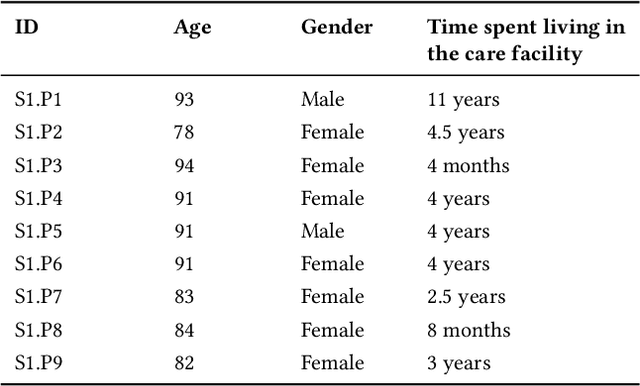

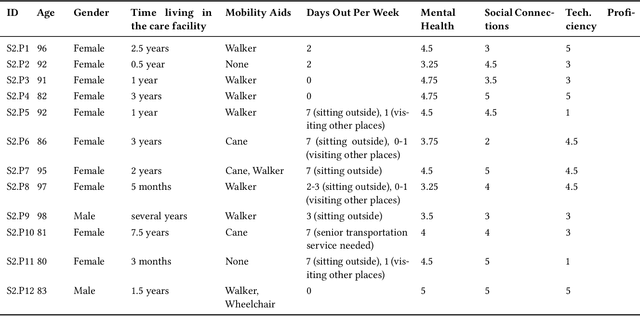
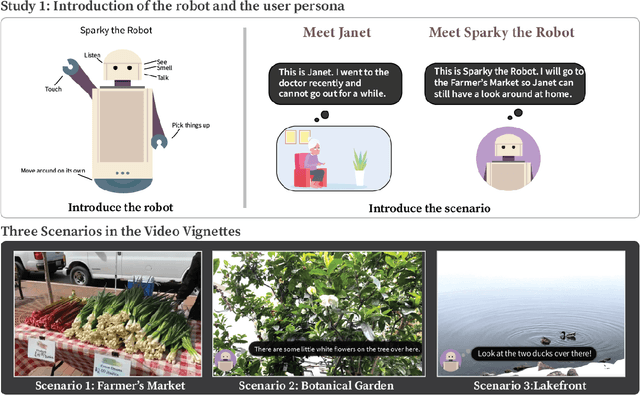
In this paper, we explore the design and use of conversational telepresence robots to help homebound older adults interact with the external world. An initial needfinding study (N=8) using video vignettes revealed older adults' experiential needs for robot-mediated remote experiences such as exploration, reminiscence and social participation. We then designed a prototype system to support these goals and conducted a technology probe study (N=11) to garner a deeper understanding of user preferences for remote experiences. The study revealed user interactive patterns in each desired experience, highlighting the need of robot guidance, social engagements with the robot and the remote bystanders. Our work identifies a novel design space where conversational telepresence robots can be used to foster meaningful interactions in the remote physical environment. We offer design insights into the robot's proactive role in providing guidance and using dialogue to create personalized, contextualized and meaningful experiences.