 Add to Chrome
 Add to Firefox
 Add to Edge
A Culturally-Aware Tool for Crowdworkers: Leveraging Chronemics to Support Diverse Work Styles
Jul 31, 2024

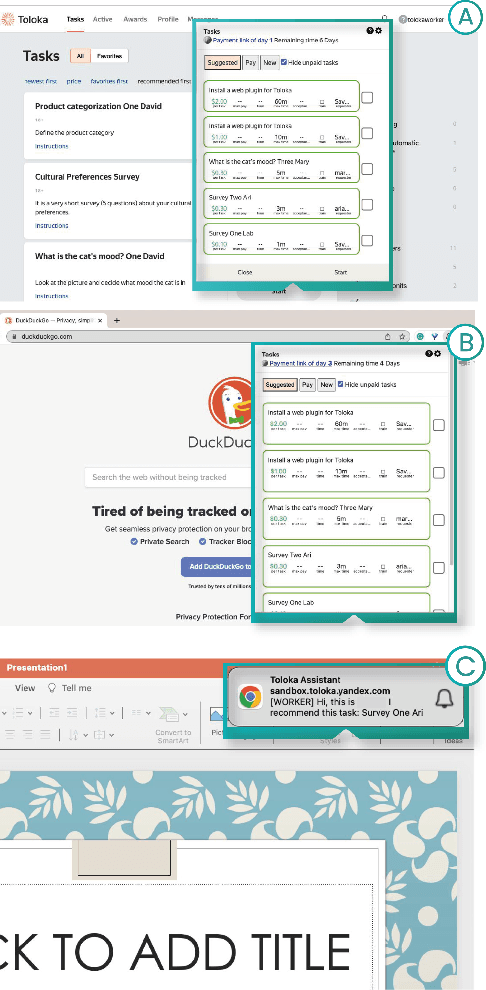

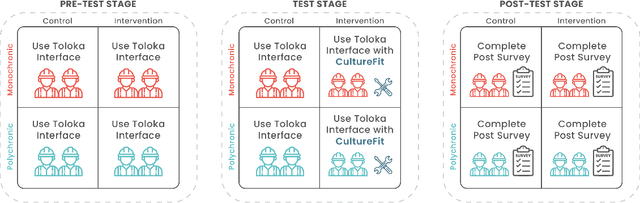
Crowdsourcing markets are expanding worldwide, but often feature standardized interfaces that ignore the cultural diversity of their workers, negatively impacting their well-being and productivity. To transform these workplace dynamics, this paper proposes creating culturally-aware workplace tools, specifically designed to adapt to the cultural dimensions of monochronic and polychronic work styles. We illustrate this approach with "CultureFit," a tool that we engineered based on extensive research in Chronemics and culture theories. To study and evaluate our tool in the real world, we conducted a field experiment with 55 workers from 24 different countries. Our field experiment revealed that CultureFit significantly improved the earnings of workers from cultural backgrounds often overlooked in design. Our study is among the pioneering efforts to examine culturally aware digital labor interventions. It also provides access to a dataset with over two million data points on culture and digital work, which can be leveraged for future research in this emerging field. The paper concludes by discussing the importance and future possibilities of incorporating cultural insights into the design of tools for digital labor.

Human-Centered Automation
May 24, 2024The rapid advancement of Generative Artificial Intelligence (AI), such as Large Language Models (LLMs) and Multimodal Large Language Models (MLLM), has the potential to revolutionize the way we work and interact with digital systems across various industries. However, the current state of software automation, such as Robotic Process Automation (RPA) frameworks, often requires domain expertise and lacks visibility and intuitive interfaces, making it challenging for users to fully leverage these technologies. This position paper argues for the emerging area of Human-Centered Automation (HCA), which prioritizes user needs and preferences in the design and development of automation systems. Drawing on empirical evidence from human-computer interaction research and case studies, we highlight the importance of considering user perspectives in automation and propose a framework for designing human-centric automation solutions. The paper discusses the limitations of existing automation approaches, the challenges in integrating AI and RPA, and the benefits of human-centered automation for productivity, innovation, and democratizing access to these technologies. We emphasize the importance of open-source solutions and provide examples of how HCA can empower individuals and organizations in the era of rapidly progressing AI, helping them remain competitive. The paper also explores pathways to achieve more advanced and context-aware automation solutions. We conclude with a call to action for researchers and practitioners to focus on developing automation technologies that adapt to user needs, provide intuitive interfaces, and leverage the capabilities of high-end AI to create a more accessible and user-friendly future of automation.
Conceptual Framework for Autonomous Cognitive Entities
Oct 03, 2023The rapid development and adoption of Generative AI (GAI) technology in the form of chatbots such as ChatGPT and Claude has greatly increased interest in agentic machines. This paper introduces the Autonomous Cognitive Entity (ACE) model, a novel framework for a cognitive architecture, enabling machines and software agents to operate more independently. Drawing inspiration from the OSI model, the ACE framework presents layers of abstraction to conceptualize artificial cognitive architectures. The model is designed to harness the capabilities of the latest generative AI technologies, including large language models (LLMs) and multimodal generative models (MMMs), to build autonomous, agentic systems. The ACE framework comprises six layers: the Aspirational Layer, Global Strategy, Agent Model, Executive Function, Cognitive Control, and Task Prosecution. Each layer plays a distinct role, ranging from setting the moral compass and strategic thinking to task selection and execution. The ACE framework also incorporates mechanisms for handling failures and adapting actions, thereby enhancing the robustness and flexibility of autonomous agents. This paper introduces the conceptual framework and proposes implementation strategies that have been tested and observed in industry. The goal of this paper is to formalize this framework so as to be more accessible.
Reputation Agent: Prompting Fair Reviews in Gig Markets
May 08, 2020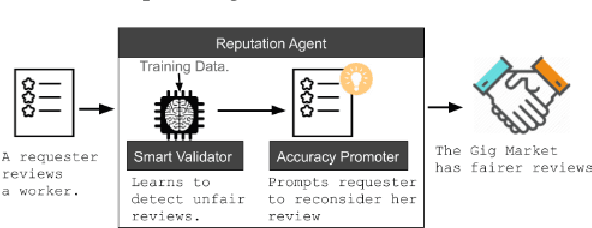
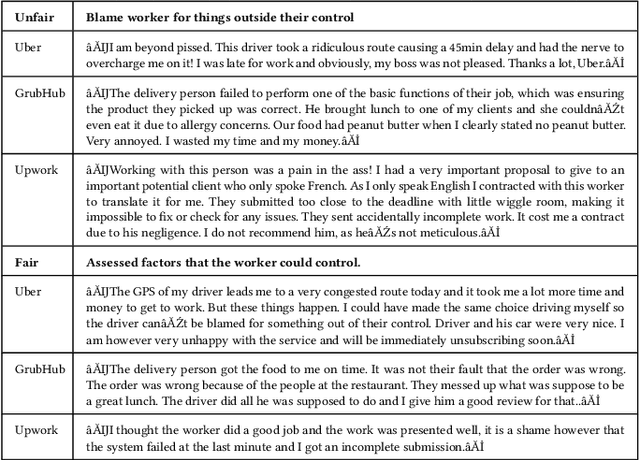
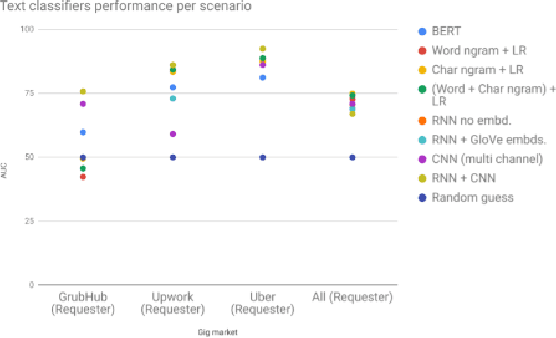
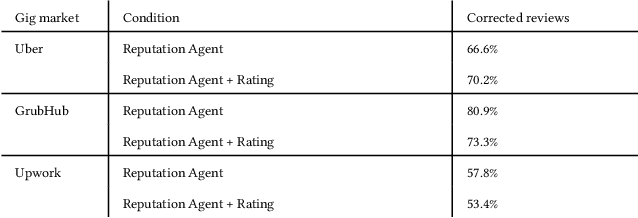
Our study presents a new tool, Reputation Agent, to promote fairer reviews from requesters (employers or customers) on gig markets. Unfair reviews, created when requesters consider factors outside of a worker's control, are known to plague gig workers and can result in lost job opportunities and even termination from the marketplace. Our tool leverages machine learning to implement an intelligent interface that: (1) uses deep learning to automatically detect when an individual has included unfair factors into her review (factors outside the worker's control per the policies of the market); and (2) prompts the individual to reconsider her review if she has incorporated unfair factors. To study the effectiveness of Reputation Agent, we conducted a controlled experiment over different gig markets. Our experiment illustrates that across markets, Reputation Agent, in contrast with traditional approaches, motivates requesters to review gig workers' performance more fairly. We discuss how tools that bring more transparency to employers about the policies of a gig market can help build empathy thus resulting in reasoned discussions around potential injustices towards workers generated by these interfaces. Our vision is that with tools that promote truth and transparency we can bring fairer treatment to gig workers.