 Add to Chrome
 Add to Firefox
 Add to Edge
Design Theater: A Benchmark for Generative UI
Jul 24, 2026
Generative UI tools promise to democratize UI design by turning natural language descriptions into complete interfaces. Alongside the interface, these tools generate user-facing design rationales that explain their layout, accessibility, and design choices. However, it remains unclear whether these stated rationales are actually reflected in the interfaces they produce. We call this disconnect ``Design Theater'': plausible and confident design rationales that have little relationship to the actual implementation. To study this phenomenon, we introduce a benchmark and three metrics for measuring Design Theater. The benchmark includes 24 UI generation tasks spanning structural, styling, and functional design requirements. Using this benchmark, we evaluate 120 interfaces created by five generative UI tools. On average, over 25\% of user-facing design rationales are not implemented in the generated interface, and the implementation failure increases to 34\% for functional requirements. Tools recognize roughly half of the UX principles embedded in prompts (mean = 0.54), with four of five tools implementing 6\% or fewer functional principles. We also measure interface similarity across tools and find convergence in visual appearance and layout organization, with greater variation in color choices. Overall, we contribute: 1) the concept of Design Theater; 2) a benchmark with metrics for assessing whether the stated reasoning of generative UI tools is reflected in their implementations; 3) and findings from a systematic evaluation of these tools. We discuss what these findings mean for the design and evaluation of generative UI tools.

How Formerly Incarcerated People Envision Technologies for Prison Parole
Jul 17, 2026AI-driven algorithms and automated tools are increasingly embedded in the correctional landscape, shaping parole eligibility,release decisions, and surveillance. These tools are also often framed as objective, inevitable solutions to inefficiency andbias. Yet, these computational systems are rarely designed with input from justice-impacted individuals, which means theymight fail to address the real needs of incarcerated people. To address this gap, we surveyed 31 formerly incarcerated peopleabout their parole experiences and their visions for technologies that could support parole preparation. Contrary to dominantassumptions, participants did not imagine computational tools as instruments to dismantle the prison system, but as resourcesfor navigating power: translating complex parole concepts into culturally familiar terms, documenting personal transformationin board-legible ways, and recognizing the often-invisible labor of families. We argue that these imaginaries point towardtechnologies designed for strategic agency, where tools help incarcerated individuals and their families build the capacity tonavigate existing power structures in pursuit of freedom. We conclude by reframing computational tools for parole awayfrom surveillance and toward human-centered systems that support people in navigating carceral power structures.
ThReadMed-QA: A Multi-Turn Medical Dialogue Benchmark from Real Patient Questions
Mar 11, 2026Medical question-answering benchmarks predominantly evaluate single-turn exchanges, failing to capture the iterative, clarification-seeking nature of real patient consultations. We introduce ThReadMed-QA, a benchmark of 2,437 fully-answered patient-physician conversation threads extracted from r/AskDocs, comprising 8,204 question-answer pairs across up to 9 turns. Unlike prior work relying on simulated dialogues, adversarial prompts, or exam-style questions, ThReadMed-QA captures authentic patient follow-up questions and verified physician responses, reflecting how patients naturally seek medical information online. We evaluate five state-of-the-art LLMs -- GPT-5, GPT-4o, Claude Haiku, Gemini 2.5 Flash, and Llama 3.3 70B -- on a stratified test split of 238 conversations (948 QA pairs) using a calibrated LLM-as-a-judge rubric grounded in physician ground truth. Even the strongest model, GPT-5, achieves only 41.2% fully-correct responses. All five models degrade significantly from turn 0 to turn 2 (p < 0.001), with wrong-answer rates roughly tripling by the third turn. We identify a fundamental tension between single-turn capability and multi-turn reliability: models with the strongest initial performance (GPT-5: 75.2; Claude Haiku: 72.3 out of 100) exhibit the steepest declines by turn 2 (dropping 16.2 and 25.0 points respectively), while weaker models plateau or marginally improve. We introduce two metrics to quantify multi-turn failure modes: Conversational Consistency Score (CCS) and Error Propagation Rate (EPR). CCS reveals that nearly one in three Claude Haiku conversations swings between a fully correct and a completely wrong response within the same thread. EPR shows that a single wrong turn raises the probability of a subsequent wrong turn by 1.9-6.1x across all models.
Data Enrichment Work and AI Labor in Latin America and the Caribbean
Jan 13, 2025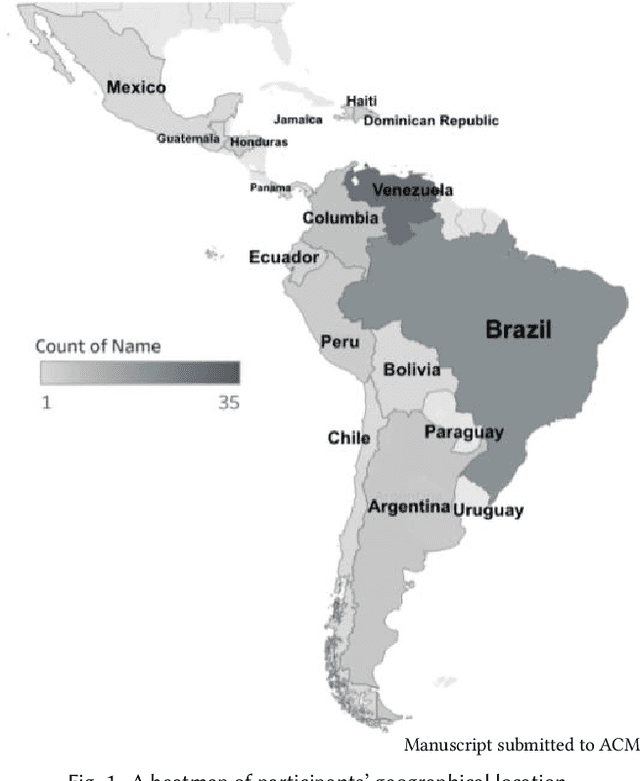
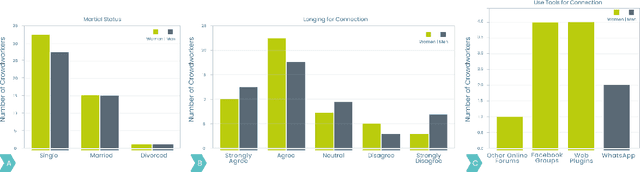
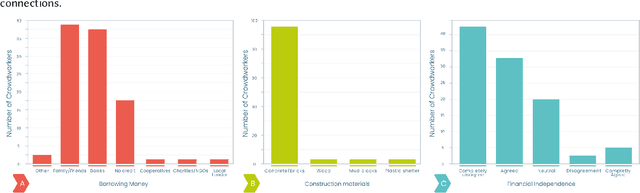
The global AI surge demands crowdworkers from diverse languages and cultures. They are pivotal in labeling data for enabling global AI systems. Despite global significance, research has primarily focused on understanding the perspectives and experiences of US and India crowdworkers, leaving a notable gap. To bridge this, we conducted a survey with 100 crowdworkers across 16 Latin American and Caribbean countries. We discovered that these workers exhibited pride and respect for their digital labor, with strong support and admiration from their families. Notably, crowd work was also seen as a stepping stone to financial and professional independence. Surprisingly, despite wanting more connection, these workers also felt isolated from peers and doubtful of others' labor quality. They resisted collaboration and gender-based tools, valuing gender-neutrality. Our work advances HCI understanding of Latin American and Caribbean crowdwork, offering insights for digital resistance tools for the region.
* 17 pages of content with 2 figures
A Culturally-Aware Tool for Crowdworkers: Leveraging Chronemics to Support Diverse Work Styles
Jul 31, 2024
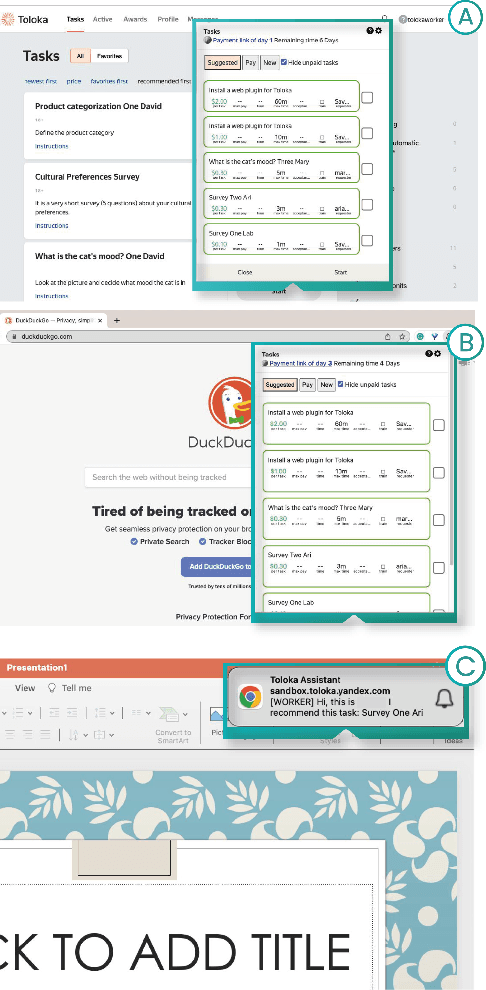

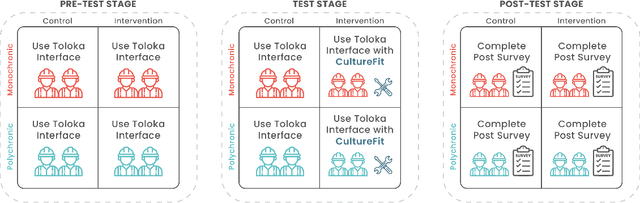
Crowdsourcing markets are expanding worldwide, but often feature standardized interfaces that ignore the cultural diversity of their workers, negatively impacting their well-being and productivity. To transform these workplace dynamics, this paper proposes creating culturally-aware workplace tools, specifically designed to adapt to the cultural dimensions of monochronic and polychronic work styles. We illustrate this approach with "CultureFit," a tool that we engineered based on extensive research in Chronemics and culture theories. To study and evaluate our tool in the real world, we conducted a field experiment with 55 workers from 24 different countries. Our field experiment revealed that CultureFit significantly improved the earnings of workers from cultural backgrounds often overlooked in design. Our study is among the pioneering efforts to examine culturally aware digital labor interventions. It also provides access to a dataset with over two million data points on culture and digital work, which can be leveraged for future research in this emerging field. The paper concludes by discussing the importance and future possibilities of incorporating cultural insights into the design of tools for digital labor.
Inclusive Portraits: Race-Aware Human-in-the-Loop Technology
Nov 06, 2023AI has revolutionized the processing of various services, including the automatic facial verification of people. Automated approaches have demonstrated their speed and efficiency in verifying a large volume of faces, but they can face challenges when processing content from certain communities, including communities of people of color. This challenge has prompted the adoption of "human-in-the-loop" (HITL) approaches, where human workers collaborate with the AI to minimize errors. However, most HITL approaches do not consider workers' individual characteristics and backgrounds. This paper proposes a new approach, called Inclusive Portraits (IP), that connects with social theories around race to design a racially-aware human-in-the-loop system. Our experiments have provided evidence that incorporating race into human-in-the-loop (HITL) systems for facial verification can significantly enhance performance, especially for services delivered to people of color. Our findings also highlight the importance of considering individual worker characteristics in the design of HITL systems, rather than treating workers as a homogenous group. Our research has significant design implications for developing AI-enhanced services that are more inclusive and equitable.
Datavoidant: An AI System for Addressing Political Data Voids on Social Media
Oct 24, 2022The limited information (data voids) on political topics relevant to underrepresented communities has facilitated the spread of disinformation. Independent journalists who combat disinformation in underrepresented communities have reported feeling overwhelmed because they lack the tools necessary to make sense of the information they monitor and address the data voids. In this paper, we present a system to identify and address political data voids within underrepresented communities. Armed with an interview study, indicating that the independent news media has the potential to address them, we designed an intelligent collaborative system, called Datavoidant. Datavoidant uses state-of-the-art machine learning models and introduces a novel design space to provide independent journalists with a collective understanding of data voids to facilitate generating content to cover the voids. We performed a user interface evaluation with independent news media journalists (N=22). These journalists reported that Datavoidant's features allowed them to more rapidly while easily having a sense of what was taking place in the information ecosystem to address the data voids. They also reported feeling more confident about the content they created and the unique perspectives they had proposed to cover the voids. We conclude by discussing how Datavoidant enables a new design space wherein individuals can collaborate to make sense of their information ecosystem and actively devise strategies to prevent disinformation.
Reputation Agent: Prompting Fair Reviews in Gig Markets
May 08, 2020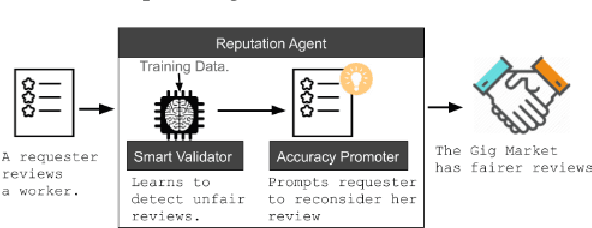
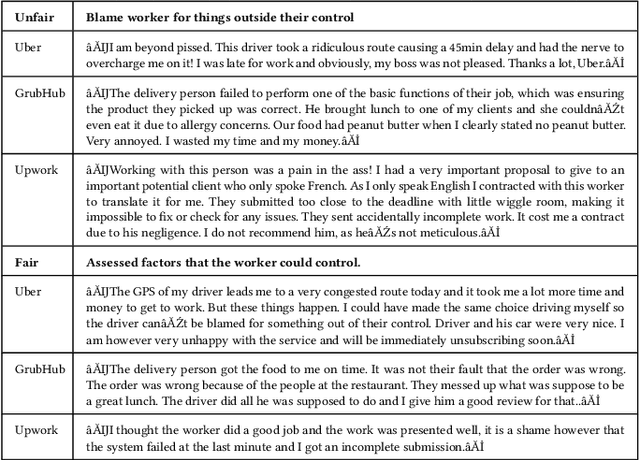
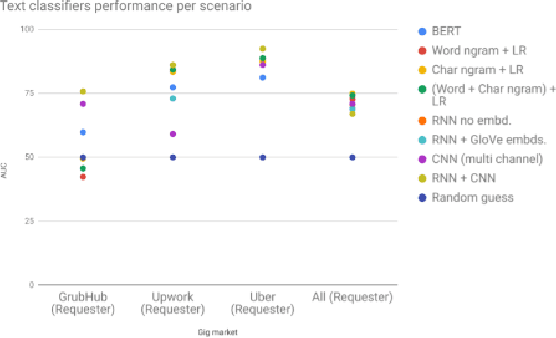
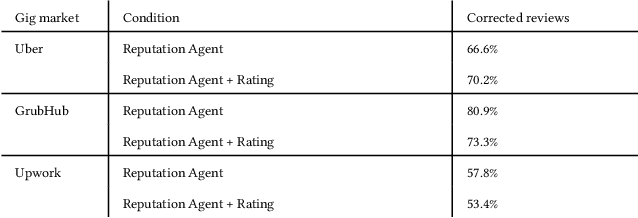
Our study presents a new tool, Reputation Agent, to promote fairer reviews from requesters (employers or customers) on gig markets. Unfair reviews, created when requesters consider factors outside of a worker's control, are known to plague gig workers and can result in lost job opportunities and even termination from the marketplace. Our tool leverages machine learning to implement an intelligent interface that: (1) uses deep learning to automatically detect when an individual has included unfair factors into her review (factors outside the worker's control per the policies of the market); and (2) prompts the individual to reconsider her review if she has incorporated unfair factors. To study the effectiveness of Reputation Agent, we conducted a controlled experiment over different gig markets. Our experiment illustrates that across markets, Reputation Agent, in contrast with traditional approaches, motivates requesters to review gig workers' performance more fairly. We discuss how tools that bring more transparency to employers about the policies of a gig market can help build empathy thus resulting in reasoned discussions around potential injustices towards workers generated by these interfaces. Our vision is that with tools that promote truth and transparency we can bring fairer treatment to gig workers.