 Add to Chrome
 Add to Firefox
 Add to Edge
A Culturally-Aware Tool for Crowdworkers: Leveraging Chronemics to Support Diverse Work Styles
Jul 31, 2024



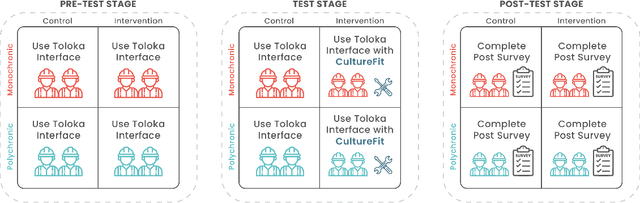
Crowdsourcing markets are expanding worldwide, but often feature standardized interfaces that ignore the cultural diversity of their workers, negatively impacting their well-being and productivity. To transform these workplace dynamics, this paper proposes creating culturally-aware workplace tools, specifically designed to adapt to the cultural dimensions of monochronic and polychronic work styles. We illustrate this approach with "CultureFit," a tool that we engineered based on extensive research in Chronemics and culture theories. To study and evaluate our tool in the real world, we conducted a field experiment with 55 workers from 24 different countries. Our field experiment revealed that CultureFit significantly improved the earnings of workers from cultural backgrounds often overlooked in design. Our study is among the pioneering efforts to examine culturally aware digital labor interventions. It also provides access to a dataset with over two million data points on culture and digital work, which can be leveraged for future research in this emerging field. The paper concludes by discussing the importance and future possibilities of incorporating cultural insights into the design of tools for digital labor.

Inclusive Portraits: Race-Aware Human-in-the-Loop Technology
Nov 06, 2023AI has revolutionized the processing of various services, including the automatic facial verification of people. Automated approaches have demonstrated their speed and efficiency in verifying a large volume of faces, but they can face challenges when processing content from certain communities, including communities of people of color. This challenge has prompted the adoption of "human-in-the-loop" (HITL) approaches, where human workers collaborate with the AI to minimize errors. However, most HITL approaches do not consider workers' individual characteristics and backgrounds. This paper proposes a new approach, called Inclusive Portraits (IP), that connects with social theories around race to design a racially-aware human-in-the-loop system. Our experiments have provided evidence that incorporating race into human-in-the-loop (HITL) systems for facial verification can significantly enhance performance, especially for services delivered to people of color. Our findings also highlight the importance of considering individual worker characteristics in the design of HITL systems, rather than treating workers as a homogenous group. Our research has significant design implications for developing AI-enhanced services that are more inclusive and equitable.