 Add to Chrome
 Add to Firefox
 Add to Edge
Automated Thematic Analysis for Clinical Qualitative Data: Iterative Codebook Refinement with Full Provenance
Mar 09, 2026
Thematic analysis (TA) is widely used in health research to extract patterns from patient interviews, yet manual TA faces challenges in scalability and reproducibility. LLM-based automation can help, but existing approaches produce codebooks with limited generalizability and lack analytic auditability. We present an automated TA framework combining iterative codebook refinement with full provenance tracking. Evaluated on five corpora spanning clinical interviews, social media, and public transcripts, the framework achieves the highest composite quality score on four of five datasets compared to six baselines. Iterative refinement yields statistically significant improvements on four datasets with large effect sizes, driven by gains in code reusability and distributional consistency while preserving descriptive quality. On two clinical corpora (pediatric cardiology), generated themes align with expert-annotated themes.

LLM-TA: An LLM-Enhanced Thematic Analysis Pipeline for Transcripts from Parents of Children with Congenital Heart Disease
Feb 03, 2025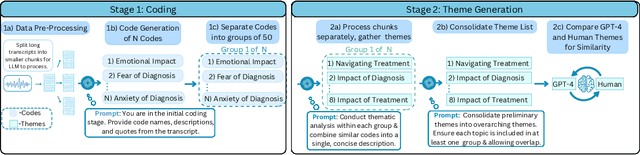
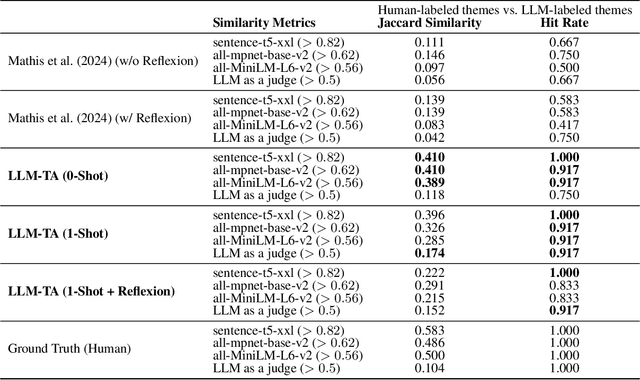
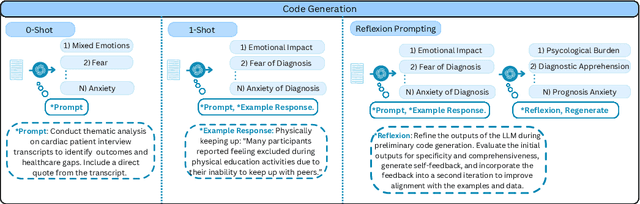

Thematic Analysis (TA) is a fundamental method in healthcare research for analyzing transcript data, but it is resource-intensive and difficult to scale for large, complex datasets. This study investigates the potential of large language models (LLMs) to augment the inductive TA process in high-stakes healthcare settings. Focusing on interview transcripts from parents of children with Anomalous Aortic Origin of a Coronary Artery (AAOCA), a rare congenital heart disease, we propose an LLM-Enhanced Thematic Analysis (LLM-TA) pipeline. Our pipeline integrates an affordable state-of-the-art LLM (GPT-4o mini), LangChain, and prompt engineering with chunking techniques to analyze nine detailed transcripts following the inductive TA framework. We evaluate the LLM-generated themes against human-generated results using thematic similarity metrics, LLM-assisted assessments, and expert reviews. Results demonstrate that our pipeline outperforms existing LLM-assisted TA methods significantly. While the pipeline alone has not yet reached human-level quality in inductive TA, it shows great potential to improve scalability, efficiency, and accuracy while reducing analyst workload when working collaboratively with domain experts. We provide practical recommendations for incorporating LLMs into high-stakes TA workflows and emphasize the importance of close collaboration with domain experts to address challenges related to real-world applicability and dataset complexity. https://github.com/jiaweixu98/LLM-TA