 Add to Chrome
 Add to Firefox
 Add to Edge
Parallel Sampling via Autospeculation
Nov 11, 2025
We present parallel algorithms to accelerate sampling via counting in two settings: any-order autoregressive models and denoising diffusion models. An any-order autoregressive model accesses a target distribution $μ$ on $[q]^n$ through an oracle that provides conditional marginals, while a denoising diffusion model accesses a target distribution $μ$ on $\mathbb{R}^n$ through an oracle that provides conditional means under Gaussian noise. Standard sequential sampling algorithms require $\widetilde{O}(n)$ time to produce a sample from $μ$ in either setting. We show that, by issuing oracle calls in parallel, the expected sampling time can be reduced to $\widetilde{O}(n^{1/2})$. This improves the previous $\widetilde{O}(n^{2/3})$ bound for any-order autoregressive models and yields the first parallel speedup for diffusion models in the high-accuracy regime, under the relatively mild assumption that the support of $μ$ is bounded. We introduce a novel technique to obtain our results: speculative rejection sampling. This technique leverages an auxiliary ``speculative'' distribution~$ν$ that approximates~$μ$ to accelerate sampling. Our technique is inspired by the well-studied ``speculative decoding'' techniques popular in large language models, but differs in key ways. Firstly, we use ``autospeculation,'' namely we build the speculation $ν$ out of the same oracle that defines~$μ$. In contrast, speculative decoding typically requires a separate, faster, but potentially less accurate ``draft'' model $ν$. Secondly, the key differentiating factor in our technique is that we make and accept speculations at a ``sequence'' level rather than at the level of single (or a few) steps. This last fact is key to unlocking our parallel runtime of $\widetilde{O}(n^{1/2})$.

Kevin: Multi-Turn RL for Generating CUDA Kernels
Jul 16, 2025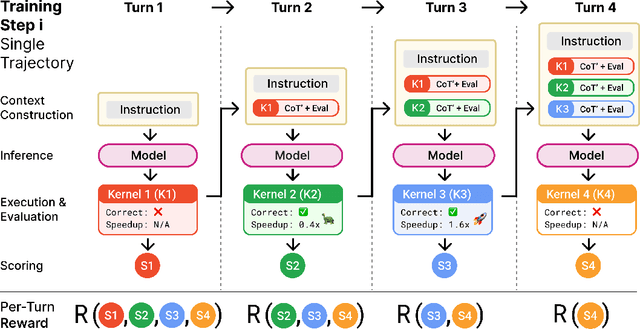
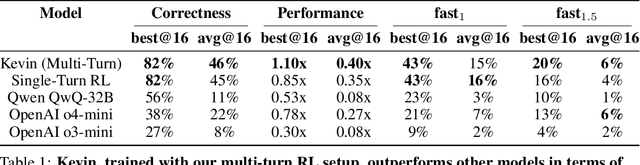
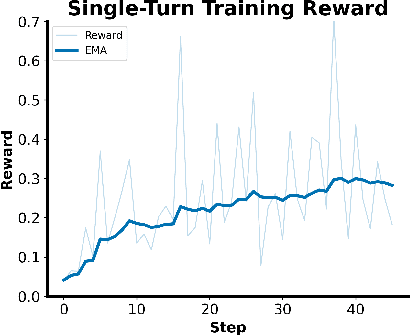
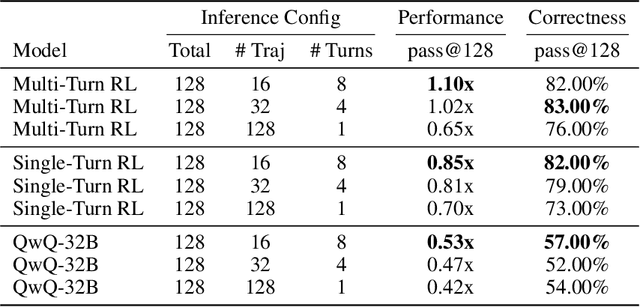
Writing GPU kernels is a challenging task and critical for AI systems' efficiency. It is also highly iterative: domain experts write code and improve performance through execution feedback. Moreover, it presents verifiable rewards like correctness and speedup, making it a natural environment to apply Reinforcement Learning (RL). To explicitly incorporate the iterative nature of this process into training, we develop a flexible multi-turn RL recipe that addresses unique challenges encountered in real-world settings, such as learning from long trajectories and effective reward attribution across turns. We present Kevin - K(ernel D)evin, the first model trained with multi-turn RL for CUDA kernel generation and optimization. In our evaluation setup, Kevin shows significant gains over its base model (QwQ-32B), improving correctness of generated kernels (in pure CUDA) from 56% to 82% and mean speedup from 0.53x to 1.10x of baseline (PyTorch Eager), and surpassing frontier models like o4-mini (0.78x). Finally, we study its behavior across test-time scaling axes: we found scaling serial refinement more beneficial than parallel sampling. In particular, when given more refinement turns, Kevin shows a higher rate of improvement.