 Add to Chrome
 Add to Firefox
 Add to Edge
Crayotter: Learning Long-Horizon Video Editing Agents via Group-Relative Preference Backpropagation
Aug 03, 2026
Long-horizon video editing agents receive final-product feedback only after many interdependent decisions. Yet editing quality is subjective, admits multiple valid solutions, and is not meaningfully calibrated across heterogeneous requests, making a global scalar objective both ambiguous and temporally uninformative. Our key observation is that fixing the request, materials, and production constraints converts this subjective objective into an ordinal comparison among directly comparable alternatives. We introduce Group-Relative Preference Backpropagation (GRPB), which transforms same-task rankings into zero-sum advantages and redistributes them as bounded credit over semantic editing segments. A lagged allocator and guarded transmission prevent current judgments or unreliable estimates from directly shaping the same rollout group. We manually construct a project-disjoint, horizon-stratified suite of realistic editing tasks for training and controlled evaluation. Across matched baselines, credit interventions, external benchmarking, and blinded human evaluation, GRPB improves both editing behavior and rendered products. The resulting 9B Crayotter model surpasses several proprietary systems on AgenticVBench, supporting task-local preference reduction as a practical approach to learning from subjective, delayed outcomes. Code and all supporting materials are publicly available at https://github.com/idwts/Crayotter.

Kevin: Multi-Turn RL for Generating CUDA Kernels
Jul 16, 2025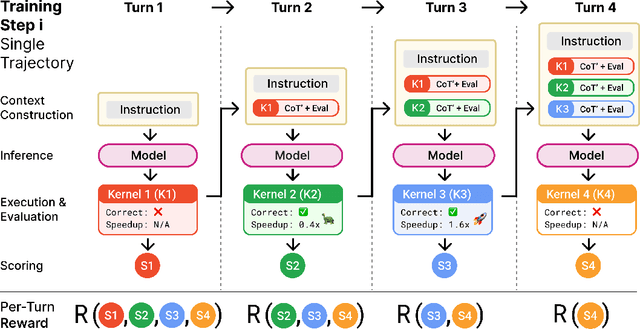
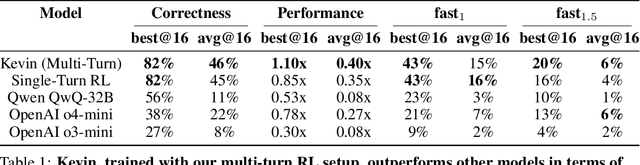
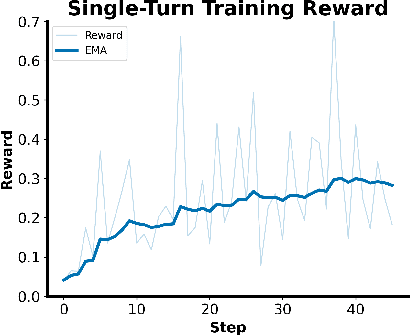
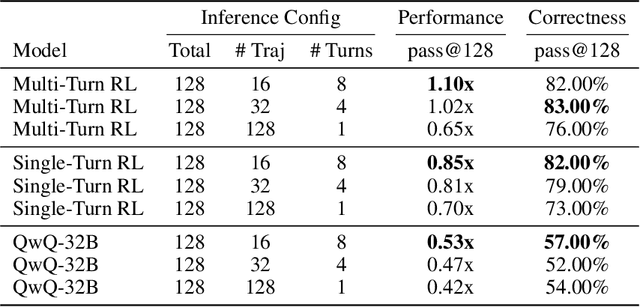
Writing GPU kernels is a challenging task and critical for AI systems' efficiency. It is also highly iterative: domain experts write code and improve performance through execution feedback. Moreover, it presents verifiable rewards like correctness and speedup, making it a natural environment to apply Reinforcement Learning (RL). To explicitly incorporate the iterative nature of this process into training, we develop a flexible multi-turn RL recipe that addresses unique challenges encountered in real-world settings, such as learning from long trajectories and effective reward attribution across turns. We present Kevin - K(ernel D)evin, the first model trained with multi-turn RL for CUDA kernel generation and optimization. In our evaluation setup, Kevin shows significant gains over its base model (QwQ-32B), improving correctness of generated kernels (in pure CUDA) from 56% to 82% and mean speedup from 0.53x to 1.10x of baseline (PyTorch Eager), and surpassing frontier models like o4-mini (0.78x). Finally, we study its behavior across test-time scaling axes: we found scaling serial refinement more beneficial than parallel sampling. In particular, when given more refinement turns, Kevin shows a higher rate of improvement.