 Add to Chrome
 Add to Firefox
 Add to Edge
QCalEval: Benchmarking Vision-Language Models for Quantum Calibration Plot Understanding
Apr 28, 2026
Quantum computing calibration depends on interpreting experimental data, and calibration plots provide the most universal human-readable representation for this task, yet no systematic evaluation exists of how well vision-language models (VLMs) interpret them. We introduce QCalEval, the first VLM benchmark for quantum calibration plots: 243 samples across 87 scenario types from 22 experiment families, spanning superconducting qubits and neutral atoms, evaluated on six question types in both zero-shot and in-context learning settings. The best general-purpose zero-shot model reaches a mean score of 72.3, and many open-weight models degrade under multi-image in-context learning, whereas frontier closed models improve substantially. A supervised fine-tuning ablation at the 9-billion-parameter scale shows that SFT improves zero-shot performance but cannot close the multimodal in-context learning gap. As a reference case study, we release NVIDIA Ising Calibration 1, an open-weight model based on Qwen3.5-35B-A3B that reaches 74.7 zero-shot average score.

Fully autonomous tuning of a spin qubit
Feb 06, 2024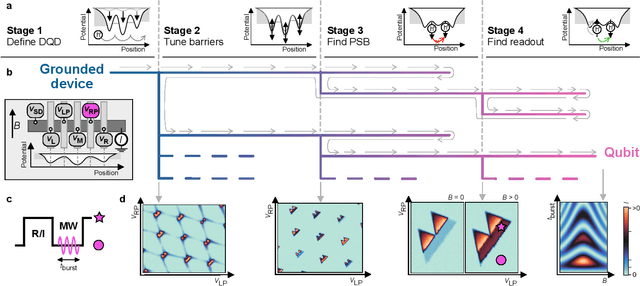
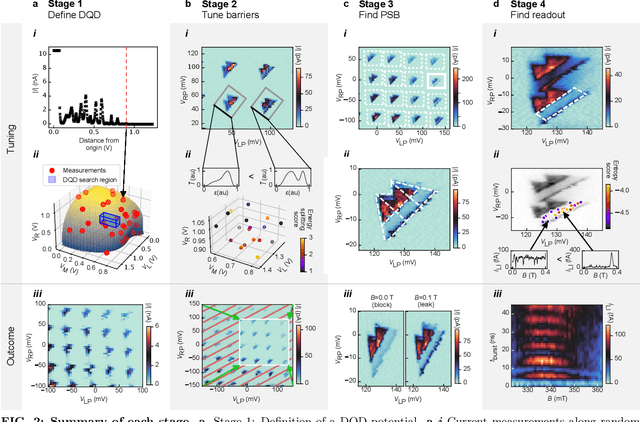
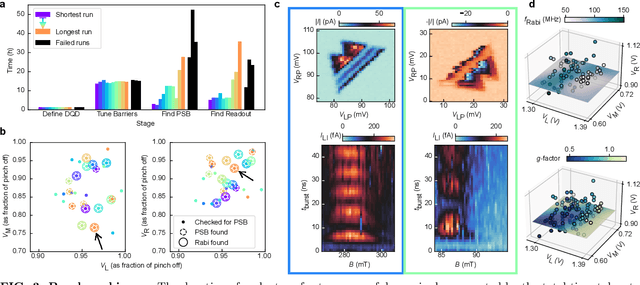
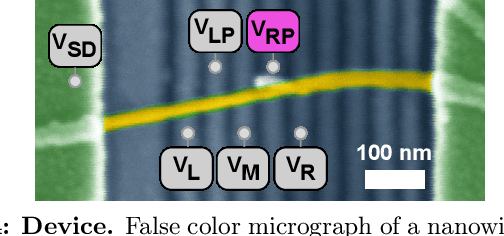
Spanning over two decades, the study of qubits in semiconductors for quantum computing has yielded significant breakthroughs. However, the development of large-scale semiconductor quantum circuits is still limited by challenges in efficiently tuning and operating these circuits. Identifying optimal operating conditions for these qubits is complex, involving the exploration of vast parameter spaces. This presents a real 'needle in the haystack' problem, which, until now, has resisted complete automation due to device variability and fabrication imperfections. In this study, we present the first fully autonomous tuning of a semiconductor qubit, from a grounded device to Rabi oscillations, a clear indication of successful qubit operation. We demonstrate this automation, achieved without human intervention, in a Ge/Si core/shell nanowire device. Our approach integrates deep learning, Bayesian optimization, and computer vision techniques. We expect this automation algorithm to apply to a wide range of semiconductor qubit devices, allowing for statistical studies of qubit quality metrics. As a demonstration of the potential of full automation, we characterise how the Rabi frequency and g-factor depend on barrier gate voltages for one of the qubits found by the algorithm. Twenty years after the initial demonstrations of spin qubit operation, this significant advancement is poised to finally catalyze the operation of large, previously unexplored quantum circuits.
Data Needs and Challenges of Quantum Dot Devices Automation: Workshop Report
Dec 21, 2023Gate-defined quantum dots are a promising candidate system to realize scalable, coupled qubit systems and serve as a fundamental building block for quantum computers. However, present-day quantum dot devices suffer from imperfections that must be accounted for, which hinders the characterization, tuning, and operation process. Moreover, with an increasing number of quantum dot qubits, the relevant parameter space grows sufficiently to make heuristic control infeasible. Thus, it is imperative that reliable and scalable autonomous tuning approaches are developed. In this report, we outline current challenges in automating quantum dot device tuning and operation with a particular focus on datasets, benchmarking, and standardization. We also present ideas put forward by the quantum dot community on how to overcome them.