 Add to Chrome
 Add to Firefox
 Add to Edge
PERCEPT-Net: A Perceptual Loss Driven Framework for Reducing MRI Artifact Tissue Confusion
Apr 12, 2026
Purpose: Existing deep learning-based MRI artifact correction models exhibit poor clinical generalization due to inherent artifact-tissue confusion, failing to discriminate artifacts from anatomical structures. To resolve this, we introduce PERCEPT-Net, a framework leveraging dedicated perceptual supervision for structure-preserving artifact suppression. Method: PERCEPT-Net utilizes a residual U-Net backbone integrated with a multi-scale recovery module and dual attention mechanisms to preserve anatomical context and salient features. The core mechanism, Motion Perceptual Loss (MPL), provides artifact-aware supervision by learning generalizable motion artifact representations. This logic directly guides the network to suppress artifacts while maintaining anatomical fidelity. Training utilized a hybrid dataset of real and simulated sequences, followed by prospective validation via objective metrics and expert radiologist assessments. Result: PERCEPT-Net outperformed state-of-the-art methods on clinical data. Ablation analysis established a direct causal link between MPL and performance; its omission caused a significant deterioration in structural consistency (p < 0.001) and tissue contrast (p < 0.001). Radiologist evaluations corroborated these objective metrics, scoring PERCEPT-Net significantly higher in global image quality (median 3 vs. 2, p < 0.001) and verifying the preservation of critical diagnostic structures. Conclusion: By integrating task-specific, artifact-aware perceptual learning, PERCEPT-Net suppresses motion artifacts in clinical MRI without compromising anatomical integrity. This framework improves clinical robustness and provides a verifiable mechanism to mitigate over-smoothing and structural degradation in medical image reconstruction.

Deep Learning Superresolution for 7T Knee MR Imaging: Impact on Image Quality and Diagnostic Performance
Jan 05, 2026Background: Deep learning superresolution (SR) may enhance musculoskeletal MR image quality, but its diagnostic value in knee imaging at 7T is unclear. Objectives: To compare image quality and diagnostic performance of SR, low-resolution (LR), and high-resolution (HR) 7T knee MRI. Methods: In this prospective study, 42 participants underwent 7T knee MRI with LR (0.8*0.8*2 mm3) and HR (0.4*0.4*2 mm3) sequences. SR images were generated from LR data using a Hybrid Attention Transformer model. Three radiologists assessed image quality, anatomic conspicuity, and detection of knee pathologies. Arthroscopy served as reference in 10 cases. Results: SR images showed higher overall quality than LR (median score 5 vs 4, P<.001) and lower noise than HR (5 vs 4, P<.001). Visibility of cartilage, menisci, and ligaments was superior in SR and HR compared to LR (P<.001). Detection rates and diagnostic performance (sensitivity, specificity, AUC) for intra-articular pathology were similar across image types (P>=.095). Conclusions: Deep learning superresolution improved subjective image quality in 7T knee MRI but did not increase diagnostic accuracy compared with standard LR imaging.
AutoLugano: A Deep Learning Framework for Fully Automated Lymphoma Segmentation and Lugano Staging on FDG-PET/CT
Dec 08, 2025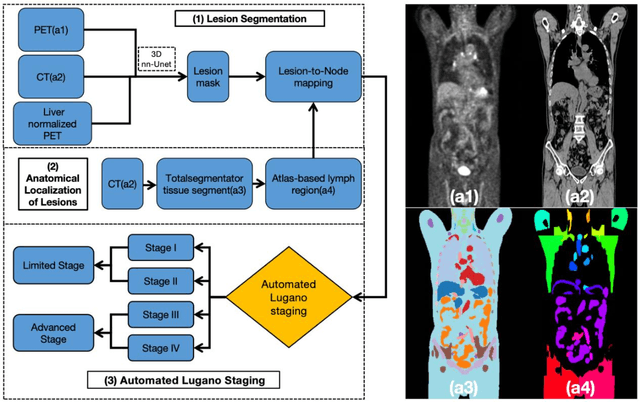
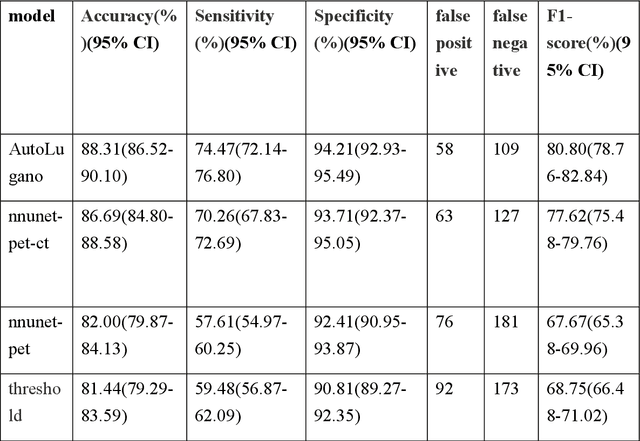
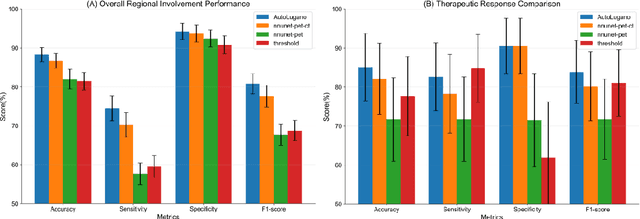
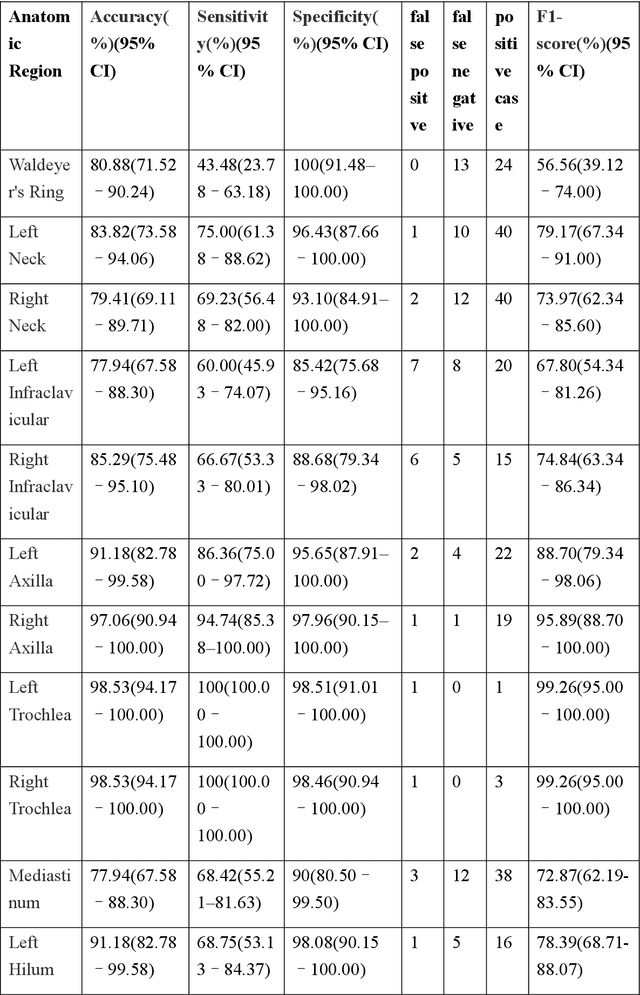
Purpose: To develop a fully automated deep learning system, AutoLugano, for end-to-end lymphoma classification by performing lesion segmentation, anatomical localization, and automated Lugano staging from baseline FDG-PET/CT scans. Methods: The AutoLugano system processes baseline FDG-PET/CT scans through three sequential modules:(1) Anatomy-Informed Lesion Segmentation, a 3D nnU-Net model, trained on multi-channel inputs, performs automated lesion detection (2) Atlas-based Anatomical Localization, which leverages the TotalSegmentator toolkit to map segmented lesions to 21 predefined lymph node regions using deterministic anatomical rules; and (3) Automated Lugano Staging, where the spatial distribution of involved regions is translated into Lugano stages and therapeutic groups (Limited vs. Advanced Stage).The system was trained on the public autoPET dataset (n=1,007) and externally validated on an independent cohort of 67 patients. Performance was assessed using accuracy, sensitivity, specificity, F1-scorefor regional involvement detection and staging agreement. Results: On the external validation set, the proposed model demonstrated robust performance, achieving an overall accuracy of 88.31%, sensitivity of 74.47%, Specificity of 94.21% and an F1-score of 80.80% for regional involvement detection,outperforming baseline models. Most notably, for the critical clinical task of therapeutic stratification (Limited vs. Advanced Stage), the system achieved a high accuracy of 85.07%, with a specificity of 90.48% and a sensitivity of 82.61%.Conclusion: AutoLugano represents the first fully automated, end-to-end pipeline that translates a single baseline FDG-PET/CT scan into a complete Lugano stage. This study demonstrates its strong potential to assist in initial staging, treatment stratification, and supporting clinical decision-making.