 Add to Chrome
 Add to Firefox
 Add to Edge
Probabilistic Tree Inference Enabled by FDSOI Ferroelectric FETs
Apr 06, 2026
Artificial intelligence applications in autonomous driving, medical diagnostics, and financial systems increasingly demand machine learning models that can provide robust uncertainty quantification, interpretability, and noise resilience. Bayesian decision trees (BDTs) are attractive for these tasks because they combine probabilistic reasoning, interpretable decision-making, and robustness to noise. However, existing hardware implementations of BDTs based on CPUs and GPUs are limited by memory bottlenecks and irregular processing patterns, while multi-platform solutions exploiting analog content-addressable memory (ACAM) and Gaussian random number generators (GRNGs) introduce integration complexity and energy overheads. Here we report a monolithic FDSOI-FeFET hardware platform that natively supports both ACAM and GRNG functionalities. The ferroelectric polarization of FeFETs enables compact, energy-efficient multi-bit storage for ACAM, and band-to-band tunneling in the gate-to-drain overlap region and subsequent hole storage in the floating body provides a high-quality entropy source for GRNG. System-level evaluations demonstrate that the proposed architecture provides robust uncertainty estimation, interpretability, and noise tolerance with high energy efficiency. Under both dataset noise and device variations, it achieves over 40% higher classification accuracy on MNIST compared to conventional decision trees. Moreover, it delivers more than two orders of magnitude speedup over CPU and GPU baselines and over four orders of magnitude improvement in energy efficiency, making it a scalable solution for deploying BDTs in resource-constrained and safety-critical environments.

A 65 nm Bayesian Neural Network Accelerator with 360 fJ/Sample In-Word GRNG for AI Uncertainty Estimation
Jan 08, 2025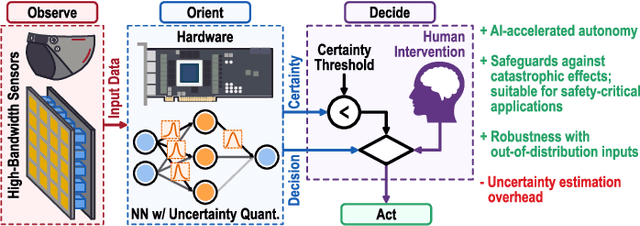
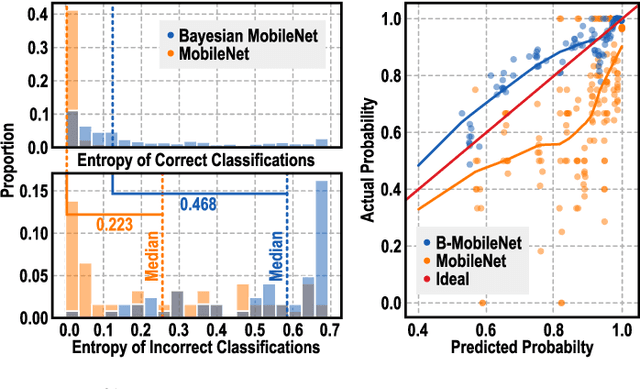
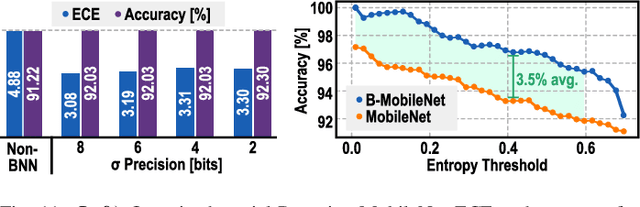
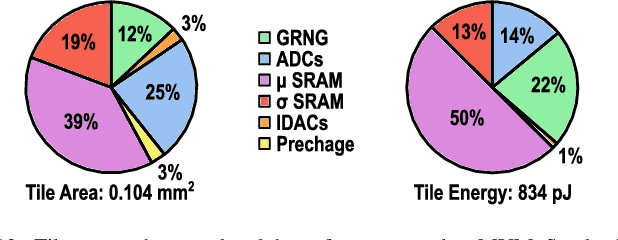
Uncertainty estimation is an indispensable capability for AI-enabled, safety-critical applications, e.g. autonomous vehicles or medical diagnosis. Bayesian neural networks (BNNs) use Bayesian statistics to provide both classification predictions and uncertainty estimation, but they suffer from high computational overhead associated with random number generation and repeated sample iterations. Furthermore, BNNs are not immediately amenable to acceleration through compute-in-memory architectures due to the frequent memory writes necessary after each RNG operation. To address these challenges, we present an ASIC that integrates 360 fJ/Sample Gaussian RNG directly into the SRAM memory words. This integration reduces RNG overhead and enables fully-parallel compute-in-memory operations for BNNs. The prototype chip achieves 5.12 GSa/s RNG throughput and 102 GOp/s neural network throughput while occupying 0.45 mm2, bringing AI uncertainty estimation to edge computation.