 Add to Chrome
 Add to Firefox
 Add to Edge
Probabilistic Tree Inference Enabled by FDSOI Ferroelectric FETs
Apr 06, 2026
Artificial intelligence applications in autonomous driving, medical diagnostics, and financial systems increasingly demand machine learning models that can provide robust uncertainty quantification, interpretability, and noise resilience. Bayesian decision trees (BDTs) are attractive for these tasks because they combine probabilistic reasoning, interpretable decision-making, and robustness to noise. However, existing hardware implementations of BDTs based on CPUs and GPUs are limited by memory bottlenecks and irregular processing patterns, while multi-platform solutions exploiting analog content-addressable memory (ACAM) and Gaussian random number generators (GRNGs) introduce integration complexity and energy overheads. Here we report a monolithic FDSOI-FeFET hardware platform that natively supports both ACAM and GRNG functionalities. The ferroelectric polarization of FeFETs enables compact, energy-efficient multi-bit storage for ACAM, and band-to-band tunneling in the gate-to-drain overlap region and subsequent hole storage in the floating body provides a high-quality entropy source for GRNG. System-level evaluations demonstrate that the proposed architecture provides robust uncertainty estimation, interpretability, and noise tolerance with high energy efficiency. Under both dataset noise and device variations, it achieves over 40% higher classification accuracy on MNIST compared to conventional decision trees. Moreover, it delivers more than two orders of magnitude speedup over CPU and GPU baselines and over four orders of magnitude improvement in energy efficiency, making it a scalable solution for deploying BDTs in resource-constrained and safety-critical environments.

Dendritic Computing with Multi-Gate Ferroelectric Field-Effect Transistors
May 02, 2025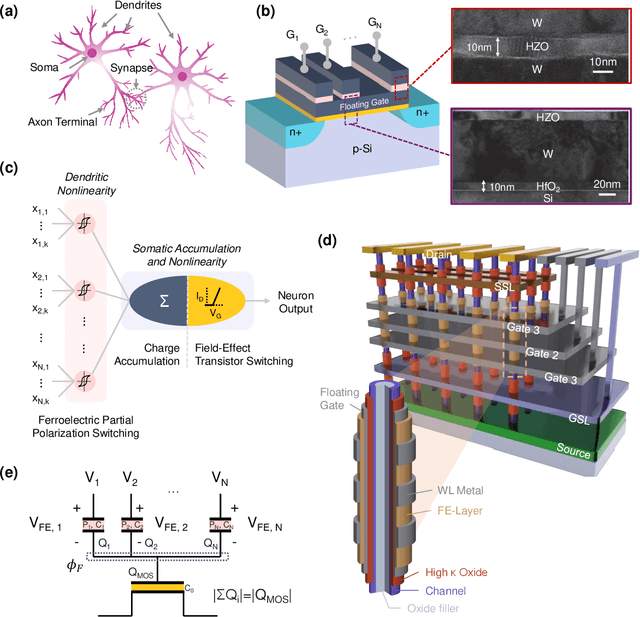
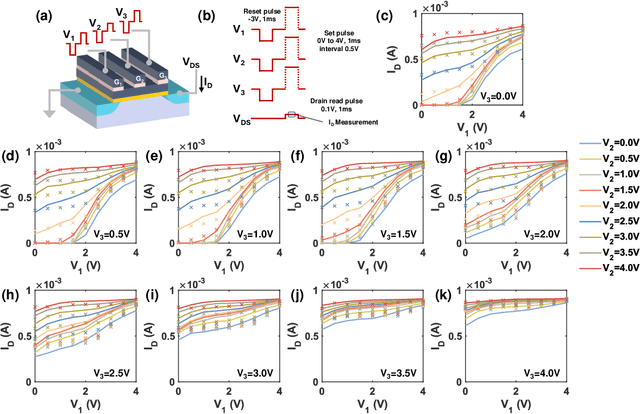
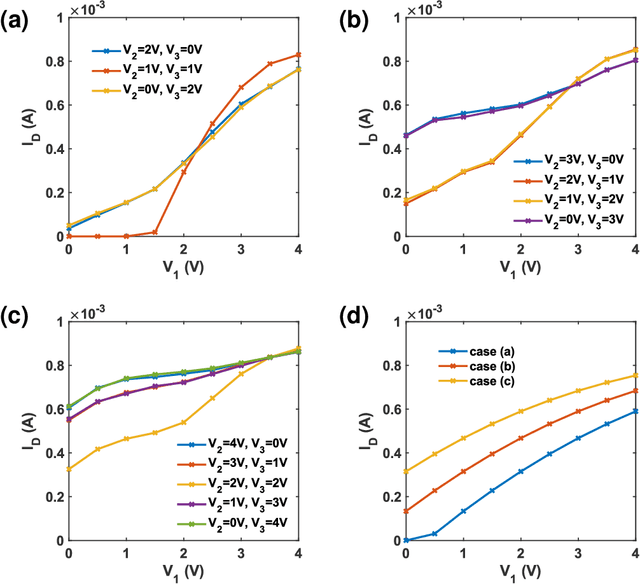
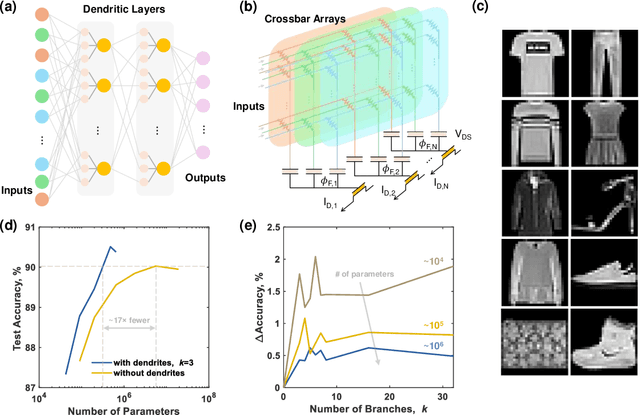
Although inspired by neuronal systems in the brain, artificial neural networks generally employ point-neurons, which offer far less computational complexity than their biological counterparts. Neurons have dendritic arbors that connect to different sets of synapses and offer local non-linear accumulation - playing a pivotal role in processing and learning. Inspired by this, we propose a novel neuron design based on a multi-gate ferroelectric field-effect transistor that mimics dendrites. It leverages ferroelectric nonlinearity for local computations within dendritic branches, while utilizing the transistor action to generate the final neuronal output. The branched architecture paves the way for utilizing smaller crossbar arrays in hardware integration, leading to greater efficiency. Using an experimentally calibrated device-circuit-algorithm co-simulation framework, we demonstrate that networks incorporating our dendritic neurons achieve superior performance in comparison to much larger networks without dendrites ($\sim$17$\times$ fewer trainable weight parameters). These findings suggest that dendritic hardware can significantly improve computational efficiency, and learning capacity of neuromorphic systems optimized for edge applications.