 Add to Chrome
 Add to Firefox
 Add to Edge
A Unified Memory Perspective for Probabilistic Trustworthy AI
Mar 26, 2026
Trustworthy artificial intelligence increasingly relies on probabilistic computation to achieve robustness, interpretability, security and privacy. In practical systems, such workloads interleave deterministic data access with repeated stochastic sampling across models, data paths and system functions, shifting performance bottlenecks from arithmetic units to memory systems that must deliver both data and randomness. Here we present a unified data-access perspective in which deterministic access is treated as a limiting case of stochastic sampling, enabling both modes to be analyzed within a common framework. This view reveals that increasing stochastic demand reduces effective data-access efficiency and can drive systems into entropy-limited operation. Based on this insight, we define memory-level evaluation criteria, including unified operation, distribution programmability, efficiency, robustness to hardware non-idealities and parallel compatibility. Using these criteria, we analyze limitations of conventional architectures and examine emerging probabilistic compute-in-memory approaches that integrate sampling with memory access, outlining pathways toward scalable hardware for trustworthy AI.

A 65 nm Bayesian Neural Network Accelerator with 360 fJ/Sample In-Word GRNG for AI Uncertainty Estimation
Jan 08, 2025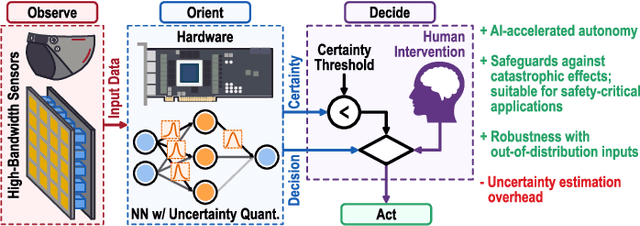
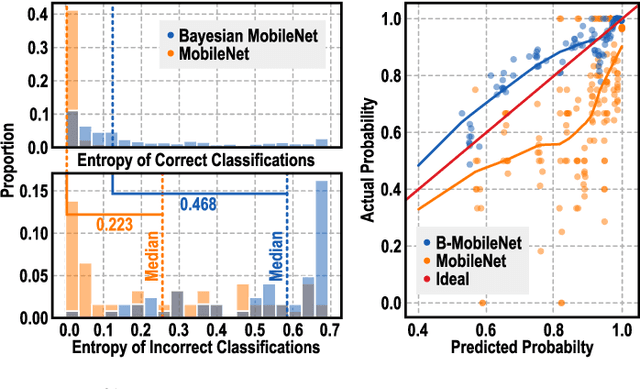
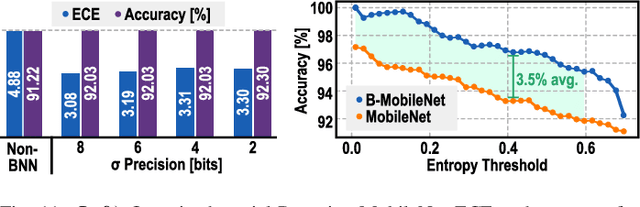
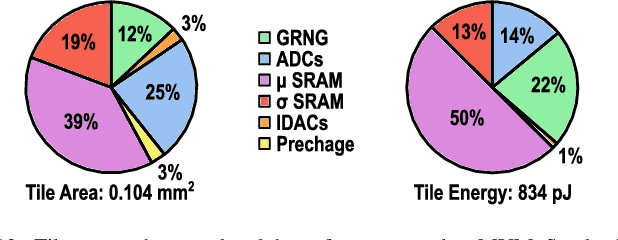
Uncertainty estimation is an indispensable capability for AI-enabled, safety-critical applications, e.g. autonomous vehicles or medical diagnosis. Bayesian neural networks (BNNs) use Bayesian statistics to provide both classification predictions and uncertainty estimation, but they suffer from high computational overhead associated with random number generation and repeated sample iterations. Furthermore, BNNs are not immediately amenable to acceleration through compute-in-memory architectures due to the frequent memory writes necessary after each RNG operation. To address these challenges, we present an ASIC that integrates 360 fJ/Sample Gaussian RNG directly into the SRAM memory words. This integration reduces RNG overhead and enables fully-parallel compute-in-memory operations for BNNs. The prototype chip achieves 5.12 GSa/s RNG throughput and 102 GOp/s neural network throughput while occupying 0.45 mm2, bringing AI uncertainty estimation to edge computation.