 Add to Chrome
 Add to Firefox
 Add to Edge
LycheeMemory V2: Efficient Long-Term Memory for LLM Agents via Semantic Segment-Level Consolidation
Aug 13, 2026
Long-horizon LLM agents must preserve information from past interactions to support future tasks. Existing memory systems typically rely on eager consolidation, invoking LLMs after each interaction to extract, summarize, or update memories. This design makes memory construction increasingly costly as conversations grow. Coarse summarization can reduce construction cost but risks discarding fine-grained contextual evidence, whereas larger retrieval contexts or multi-hop LLM reasoning shift the overhead to query time. We present LycheeMemory V2, an efficient long-term memory framework that replaces turn-level consolidation with semantic segment-level consolidation. Instead of consolidating every interaction, LycheeMemory batches multiple exchanges into segments and encodes each finalized segment into context-independent typed memory records. Segment-level batching lowers LLM encoding frequency, while semantic boundary detection helps preserve coherent event-level and temporal evidence compared with fixed-window batching. The resulting records are organized with lightweight structured indexes for query-planned evidence retrieval. Experiments using GPT-4.1-Mini show that LycheeMemory achieves state-of-the-art performance, reaching 89.22% on LoCoMo and 92.20% on LongMemEval-S. Compared with A-Mem, it reduces construction tokens by 86.0% on LoCoMo and 75.9% on LongMemEval-S without increasing query-time token usage. More broadly, our results suggest that the accuracy--cost trade-off of long-term agent memory depends not only on what information is retained, but also on the granularity at which it is consolidated.

LLM-Driven Multimodal Opinion Expression Identification
Jun 26, 2024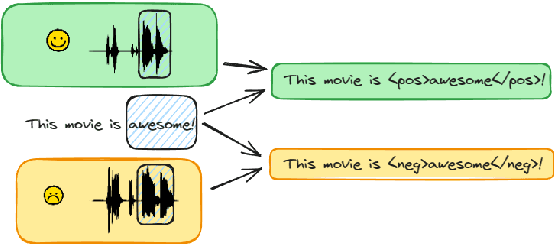
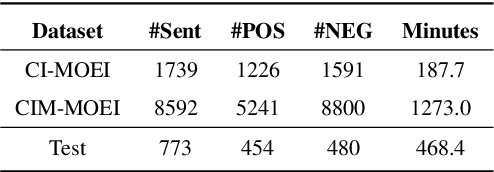
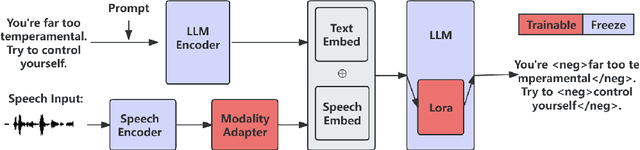
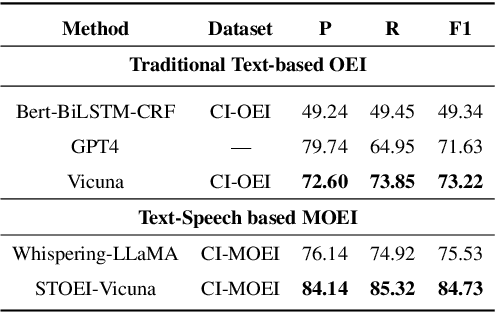
Opinion Expression Identification (OEI) is essential in NLP for applications ranging from voice assistants to depression diagnosis. This study extends OEI to encompass multimodal inputs, underlining the significance of auditory cues in delivering emotional subtleties beyond the capabilities of text. We introduce a novel multimodal OEI (MOEI) task, integrating text and speech to mirror real-world scenarios. Utilizing CMU MOSEI and IEMOCAP datasets, we construct the CI-MOEI dataset. Additionally, Text-to-Speech (TTS) technology is applied to the MPQA dataset to obtain the CIM-OEI dataset. We design a template for the OEI task to take full advantage of the generative power of large language models (LLMs). Advancing further, we propose an LLM-driven method STOEI, which combines speech and text modal to identify opinion expressions. Our experiments demonstrate that MOEI significantly improves the performance while our method outperforms existing methods by 9.20\% and obtains SOTA results.