 Add to Chrome
 Add to Firefox
 Add to Edge
Monroe: A Molecular Foundation Model for In-Context Probabilistic Inference
Aug 19, 2026
Bioassay activity prediction is often data-limited because drug-discovery datasets rely on time-consuming and expensive wet-lab experiments for data generation and evaluation. This challenge has inspired recent research into molecular foundation models (MFMs), which aim to encode general-purpose chemical knowledge into molecular representations that generalize well in data-constrained scenarios. This paper presents Monroe, a new MFM with several innovations over the existing state of the art: increased scale allowing pre-training on over 81 million molecules from the PM6 quantum chemistry dataset; improved graph representation of stereochemistry; improved training losses including conformer denoising and embedding decorrelation; improved multi-task learning; and the use of a prior-data-fitted model (TabPFN) for downstream in-context prediction. Our evaluations use a principled pairwise comparison framework that measures statistically significant performance differences. Across established Polaris benchmarks, Monroe matches or exceeds existing MFMs, while on activity cliff benchmarks, designed to assess utility for molecular discovery, it achieves significant improvements over prior methods. Finally, ablation and transfer experiments show that PFN-based downstream predictors also substantially improve two leading existing models, MiniMol and CheMeleon, yielding new state-of-the-art variants we call MiniMol_PFN and CheMeleon_PFN, suggesting that our downstream adaptation strategy generalizes beyond Monroe. Source code is at github.com/blazejba/monroe.

Reducing the Cost of Quantum Chemical Data By Backpropagating Through Density Functional Theory
Feb 06, 2024Density Functional Theory (DFT) accurately predicts the quantum chemical properties of molecules, but scales as $O(N_{\text{electrons}}^3)$. Sch\"utt et al. (2019) successfully approximate DFT 1000x faster with Neural Networks (NN). Arguably, the biggest problem one faces when scaling to larger molecules is the cost of DFT labels. For example, it took years to create the PCQ dataset (Nakata & Shimazaki, 2017) on which subsequent NNs are trained within a week. DFT labels molecules by minimizing energy $E(\cdot )$ as a "loss function." We bypass dataset creation by directly training NNs with $E(\cdot )$ as a loss function. For comparison, Sch\"utt et al. (2019) spent 626 hours creating a dataset on which they trained their NN for 160h, for a total of 786h; our method achieves comparable performance within 31h.
BESS: Balanced Entity Sampling and Sharing for Large-Scale Knowledge Graph Completion
Nov 22, 2022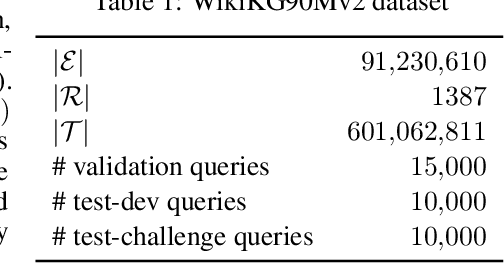
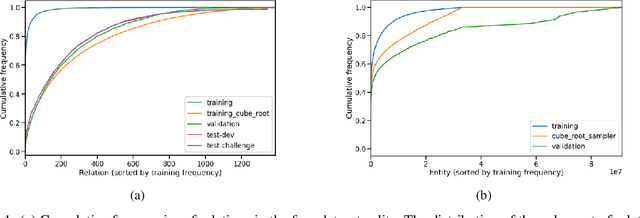

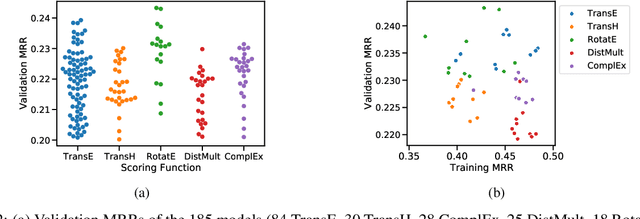
We present the award-winning submission to the WikiKG90Mv2 track of OGB-LSC@NeurIPS 2022. The task is link-prediction on the large-scale knowledge graph WikiKG90Mv2, consisting of 90M+ nodes and 600M+ edges. Our solution uses a diverse ensemble of $85$ Knowledge Graph Embedding models combining five different scoring functions (TransE, TransH, RotatE, DistMult, ComplEx) and two different loss functions (log-sigmoid, sampled softmax cross-entropy). Each individual model is trained in parallel on a Graphcore Bow Pod$_{16}$ using BESS (Balanced Entity Sampling and Sharing), a new distribution framework for KGE training and inference based on balanced collective communications between workers. Our final model achieves a validation MRR of 0.2922 and a test-challenge MRR of 0.2562, winning the first place in the competition. The code is publicly available at: https://github.com/graphcore/distributed-kge-poplar/tree/2022-ogb-submission.