 Add to Chrome
 Add to Firefox
 Add to Edge
CBCT-IQ: A Publicly Available Annotated Cone-Beam CT Dataset for Image Quality Assessment and Benchmarking
Jul 31, 2026
Medical image quality plays a critical role in diagnostic accuracy, especially in X-ray-based imaging modalities such as cone-beam computed tomography (CBCT), where image quality must be balanced against radiation dose. While expert visual evaluation remains the clinical standard for image quality evaluation, it is time-consuming, subjective and affected by inter-observer variability, emphasizing the need for reliable quantitative image quality assessment (IQA) methods. However, the development and validation of such IQA methods have been limited by the lack of publicly available CBCT datasets with expert image quality annotations. In this study, we provide the first open-access CBCT IQA dataset containing 1,764 annotated image slices acquired using systematic variations in image acquisition and reconstruction parameters. Three clinical experts graded the overall image quality and a predefined regions of interest (ROI) using a four-level scoring scheme. In addition, we benchmark 26 full reference- and no reference-based IQA measures against expert annotations and introduce an exploratory IQA measure-based ranking capable of distinguishing subtle image quality differences. This dataset introduced a standardized benchmark for future CBCT IQA research and provides a valuable resource for the development and validation of new IQA methods, enabling reproducible research and advancing CBCT IQA.

An Integrated Optimization and Deep Learning Pipeline for Predicting Live Birth Success in IVF Using Feature Optimization and Transformer-Based Models
Dec 27, 2024In vitro fertilization (IVF) is a widely utilized assisted reproductive technology, yet predicting its success remains challenging due to the multifaceted interplay of clinical, demographic, and procedural factors. This study develops a robust artificial intelligence (AI) pipeline aimed at predicting live birth outcomes in IVF treatments. The pipeline uses anonymized data from 2010 to 2018, obtained from the Human Fertilization and Embryology Authority (HFEA). We evaluated the prediction performance of live birth success as a binary outcome (success/failure) by integrating different feature selection methods, such as principal component analysis (PCA) and particle swarm optimization (PSO), with different traditional machine learning-based classifiers including random forest (RF) and decision tree, as well as deep learning-based classifiers including custom transformer-based model and a tab transformer model with an attention mechanism. Our research demonstrated that the best performance was achieved by combining PSO for feature selection with the TabTransformer-based deep learning model, yielding an accuracy of 99.50% and an AUC of 99.96%, highlighting its significant performance to predict live births. This study establishes a highly accurate AI pipeline for predicting live birth outcomes in IVF, demonstrating its potential to enhance personalized fertility treatments.
A Review on the Integration of Artificial Intelligence and Medical Imaging in IVF Ovarian Stimulation
Dec 27, 2024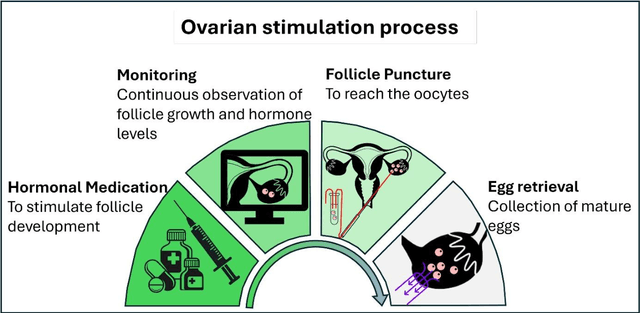
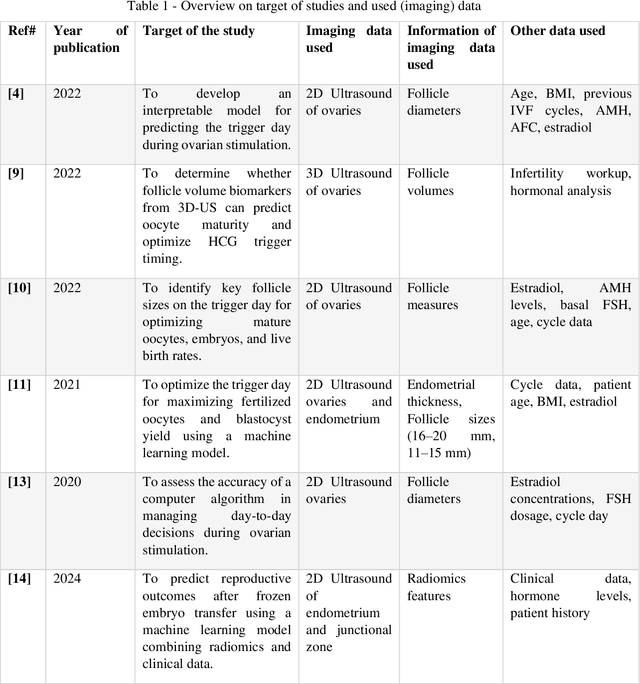
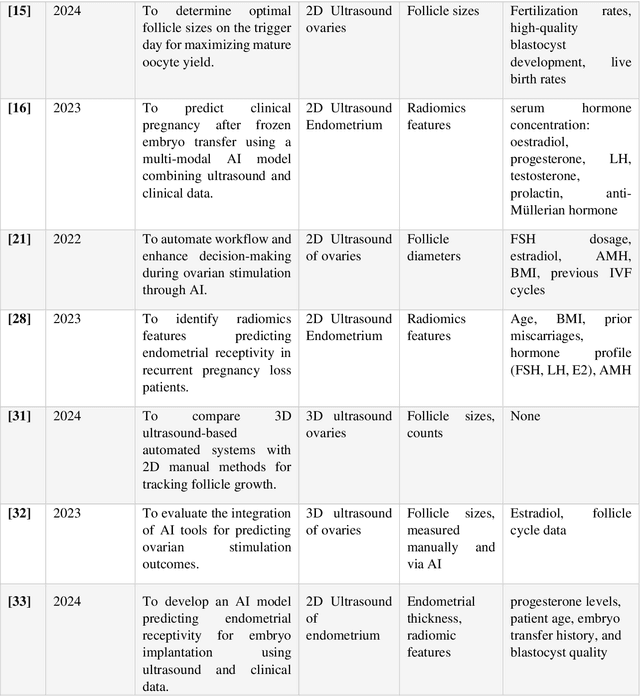
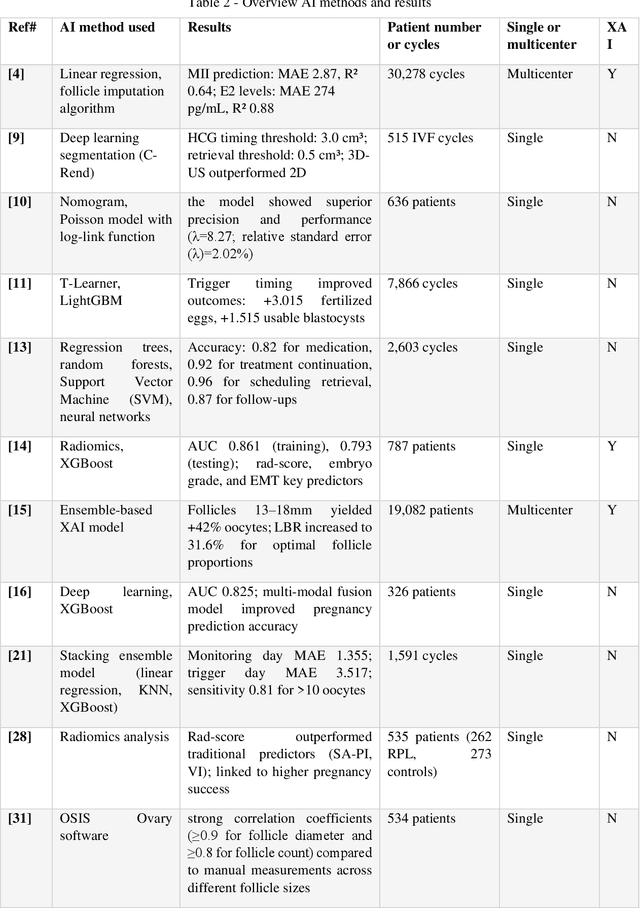
Artificial intelligence (AI) has emerged as a powerful tool to enhance decision-making and optimize treatment protocols in in vitro fertilization (IVF). In particular, AI shows significant promise in supporting decision-making during the ovarian stimulation phase of the IVF process. This review evaluates studies focused on the applications of AI combined with medical imaging in ovarian stimulation, examining methodologies, outcomes, and current limitations. Our analysis of 13 studies on this topic reveals that, reveal that while AI algorithms demonstrated notable potential in predicting optimal hormonal dosages, trigger timing, and oocyte retrieval outcomes, the medical imaging data utilized predominantly came from two-dimensional (2D) ultrasound which mainly involved basic quantifications, such as follicle size and number, with limited use of direct feature extraction or advanced image analysis techniques. This points to an underexplored opportunity where advanced image analysis approaches, such as deep learning, and more diverse imaging modalities, like three-dimensional (3D) ultrasound, could unlock deeper insights. Additionally, the lack of explainable AI (XAI) in most studies raises concerns about the transparency and traceability of AI-driven decisions - key factors for clinical adoption and trust. Furthermore, many studies relied on single-center designs and small datasets, which limit the generalizability of their findings. This review highlights the need for integrating advanced imaging analysis techniques with explainable AI methodologies, as well as the importance of leveraging multicenter collaborations and larger datasets. Addressing these gaps has the potential to enhance ovarian stimulation management, paving the way for efficient, personalized, and data-driven treatment pathways that improve IVF outcomes.