 Add to Chrome
 Add to Firefox
 Add to Edge
LLM Agents Are Latent Context Managers: Eliciting Self-Managed Context via a Proprioceptive Dashboard
Jun 29, 2026
Long-horizon tool agents are bottlenecked by how their context grows toward the limits of the context window. Recent systems make context management agent- or system-controlled, but they either learn a compression policy that discards evidence or manage context in a layer the agent never sees. We argue both leave a more basic gap unaddressed. Frontier language models are proprioceptively blind to their own context. From the prompt alone they cannot see how large, how old, or how used each block is, the signals a keep-or-drop decision needs. We hypothesize that competent context management is already latent in capable models, and that what is missing is not a learned policy but an interface exposing this state. We introduce VISTA (Visible Internal State for Tool Agents), a training-free, model-agnostic layer that represents working memory as typed, addressable blocks, surfaces a runtime dashboard of per-block token usage, recency, and access history, and archives blocks as recoverable full-fidelity payloads. On LOCA-Bench, BrowseComp-Plus, and GAIA, the same untrained interface transfers across million-, 100K-, and 10K-scale trajectories. On LOCA-Bench it improves four backbones and lifts Gemini-3-Flash from 22.7 to 50.7%. The lift grows with context pressure and transfers across backbones. Ablations further confirm that the dashboard matters beyond archive and recovery tools.

When Agent Automation Becomes Profitable: Quantifying and Insuring Autonomous AI Risk through Trace-Economic Underwriting
Jun 15, 2026AI agents can now take irreversible actions in operational systems, but agent-caused losses are still not clearly assigned, priced, or transferred. Providers often disclaim consequential damages, users are left with uncompensated losses, and default human review limits the efficiency gains of automation. We ask when autonomous AI deployment can become economically acceptable despite failure risk. Our answer is to quantify risk at the customer-task-trace episode level and transfer it through insurance. Automation is acceptable when its expected benefit exceeds the premium, control cost, and remaining risk. This requires a defined role with bounded permissions and comparable traces. We introduce trace-economic underwriting, which maps tool-use traces to customer exposure and claimable loss, then uses this representation for pricing, control, and risk transfer. It uses deterministic economic labels rather than an LLM judge. In our trace-to-loss testbed, trace-economic pricing reduces pricing MAE from $17.7K to $569 and removes regressive cross-subsidy. A 300-trace expert audit accepts 295 labels unchanged. On 1,000 real SWE-smith traces, trace-conditioned controls reduce CVaR95 by 72%. Theorem~1 gives a finite-sample scope condition. We release code, labels, and audit sheets.
From Multi-Agent to Single-Agent: When Is Skill Distillation Beneficial?
Apr 02, 2026Multi-agent systems (MAS) tackle complex tasks by distributing expertise, though this often comes at the cost of heavy coordination overhead, context fragmentation, and brittle phase ordering. Distilling a MAS into a single-agent skill can bypass these costs, but this conversion lacks a principled answer for when and what to distill. Instead, the empirical outcome is surprisingly inconsistent: skill lift ranges from a 28% improvement to a 2% degradation across metrics of the exact same task. In this work, we reveal that skill utility is governed not by the task, but by the evaluation metric. We introduce Metric Freedom ($F$), the first a priori predictor of skill utility. $F$ measures the topological rigidity of a metric's scoring landscape by quantifying how output diversity couples with score variance via a Mantel test. Guided by $F$, we propose a two-stage adaptive distillation framework. Stage 1 acts as a selective extraction mechanism, extracting tools and knowledge while discarding restrictive structures on "free" metrics to preserve exploration. Stage 2 targets computationally intensive iterative refinement exclusively toward "rigid" metrics ($F \lesssim 0.6$) to eliminate trajectory-local overfitting. Evaluating across 4 tasks, 11 datasets, and 6 metrics, $F$ strongly predicts skill utility ($ρ= -0.62$, $p < 0.05$). Strikingly, identical agent trajectories yield diametrically opposite skill lifts under rigid versus free metrics, demonstrating that skill utility is fundamentally a metric-level property. Driven by this signal, our adaptive agent matches or exceeds the original MAS while reducing cost up to 8$\times$ and latency by up to 15$\times$.
From Internal Diagnosis to External Auditing: A VLM-Driven Paradigm for Online Test-Time Backdoor Defense
Jan 27, 2026Deep Neural Networks remain inherently vulnerable to backdoor attacks. Traditional test-time defenses largely operate under the paradigm of internal diagnosis methods like model repairing or input robustness, yet these approaches are often fragile under advanced attacks as they remain entangled with the victim model's corrupted parameters. We propose a paradigm shift from Internal Diagnosis to External Semantic Auditing, arguing that effective defense requires decoupling safety from the victim model via an independent, semantically grounded auditor. To this end, we present a framework harnessing Universal Vision-Language Models (VLMs) as evolving semantic gatekeepers. We introduce PRISM (Prototype Refinement & Inspection via Statistical Monitoring), which overcomes the domain gap of general VLMs through two key mechanisms: a Hybrid VLM Teacher that dynamically refines visual prototypes online, and an Adaptive Router powered by statistical margin monitoring to calibrate gating thresholds in real-time. Extensive evaluation across 17 datasets and 11 attack types demonstrates that PRISM achieves state-of-the-art performance, suppressing Attack Success Rate to <1% on CIFAR-10 while improving clean accuracy, establishing a new standard for model-agnostic, externalized security.
Breaking the Stealth-Potency Trade-off in Clean-Image Backdoors with Generative Trigger Optimization
Nov 11, 2025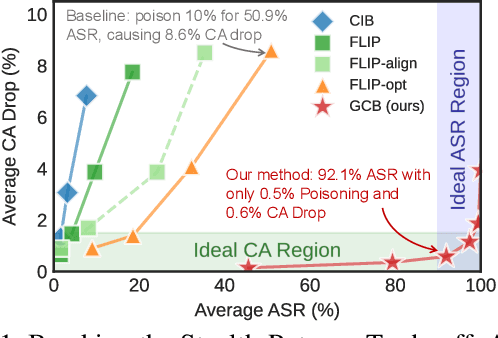
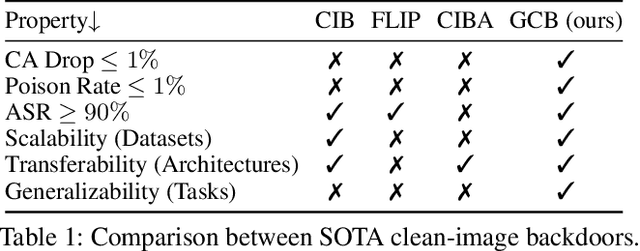
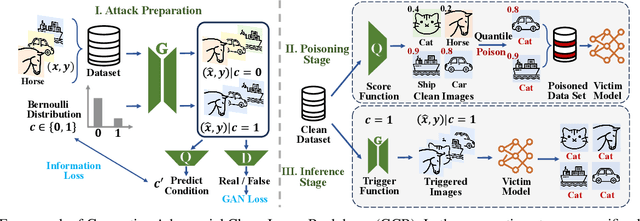
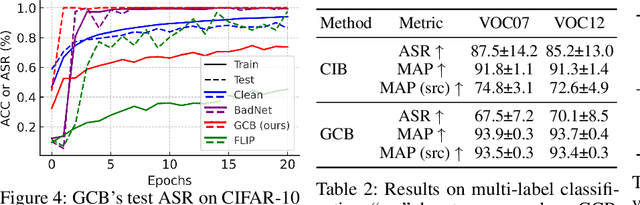
Clean-image backdoor attacks, which use only label manipulation in training datasets to compromise deep neural networks, pose a significant threat to security-critical applications. A critical flaw in existing methods is that the poison rate required for a successful attack induces a proportional, and thus noticeable, drop in Clean Accuracy (CA), undermining their stealthiness. This paper presents a new paradigm for clean-image attacks that minimizes this accuracy degradation by optimizing the trigger itself. We introduce Generative Clean-Image Backdoors (GCB), a framework that uses a conditional InfoGAN to identify naturally occurring image features that can serve as potent and stealthy triggers. By ensuring these triggers are easily separable from benign task-related features, GCB enables a victim model to learn the backdoor from an extremely small set of poisoned examples, resulting in a CA drop of less than 1%. Our experiments demonstrate GCB's remarkable versatility, successfully adapting to six datasets, five architectures, and four tasks, including the first demonstration of clean-image backdoors in regression and segmentation. GCB also exhibits resilience against most of the existing backdoor defenses.
One Surrogate to Fool Them All: Universal, Transferable, and Targeted Adversarial Attacks with CLIP
May 26, 2025Deep Neural Networks (DNNs) have achieved widespread success yet remain prone to adversarial attacks. Typically, such attacks either involve frequent queries to the target model or rely on surrogate models closely mirroring the target model -- often trained with subsets of the target model's training data -- to achieve high attack success rates through transferability. However, in realistic scenarios where training data is inaccessible and excessive queries can raise alarms, crafting adversarial examples becomes more challenging. In this paper, we present UnivIntruder, a novel attack framework that relies solely on a single, publicly available CLIP model and publicly available datasets. By using textual concepts, UnivIntruder generates universal, transferable, and targeted adversarial perturbations that mislead DNNs into misclassifying inputs into adversary-specified classes defined by textual concepts. Our extensive experiments show that our approach achieves an Attack Success Rate (ASR) of up to 85% on ImageNet and over 99% on CIFAR-10, significantly outperforming existing transfer-based methods. Additionally, we reveal real-world vulnerabilities, showing that even without querying target models, UnivIntruder compromises image search engines like Google and Baidu with ASR rates up to 84%, and vision language models like GPT-4 and Claude-3.5 with ASR rates up to 80%. These findings underscore the practicality of our attack in scenarios where traditional avenues are blocked, highlighting the need to reevaluate security paradigms in AI applications.