 Add to Chrome
 Add to Firefox
 Add to Edge
Long-Term Multi-Session 3D Reconstruction Under Substantial Appearance Change
Feb 24, 2026
Long-term environmental monitoring requires the ability to reconstruct and align 3D models across repeated site visits separated by months or years. However, existing Structure-from-Motion (SfM) pipelines implicitly assume near-simultaneous image capture and limited appearance change, and therefore fail when applied to long-term monitoring scenarios such as coral reef surveys, where substantial visual and structural change is common. In this paper, we show that the primary limitation of current approaches lies in their reliance on post-hoc alignment of independently reconstructed sessions, which is insufficient under large temporal appearance change. We address this limitation by enforcing cross-session correspondences directly within a joint SfM reconstruction. Our approach combines complementary handcrafted and learned visual features to robustly establish correspondences across large temporal gaps, enabling the reconstruction of a single coherent 3D model from imagery captured years apart, where standard independent and joint SfM pipelines break down. We evaluate our method on long-term coral reef datasets exhibiting significant real-world change, and demonstrate consistent joint reconstruction across sessions in cases where existing methods fail to produce coherent reconstructions. To ensure scalability to large datasets, we further restrict expensive learned feature matching to a small set of likely cross-session image pairs identified via visual place recognition, which reduces computational cost and improves alignment robustness.

Image-Based Relocalization and Alignment for Long-Term Monitoring of Dynamic Underwater Environments
Mar 06, 2025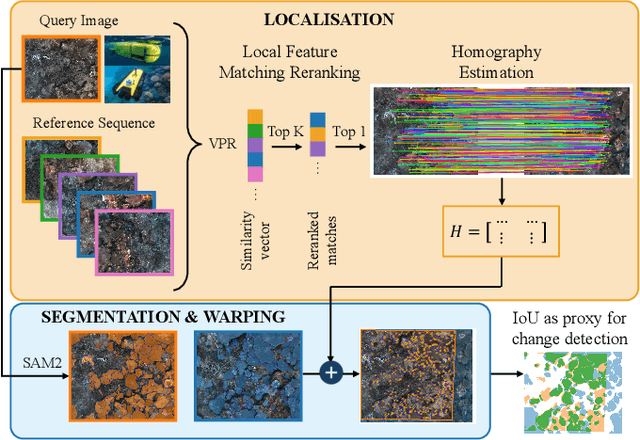

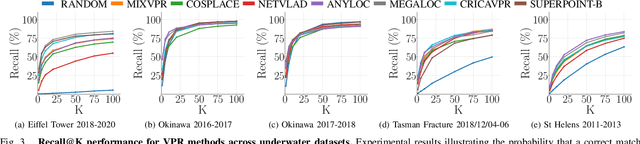
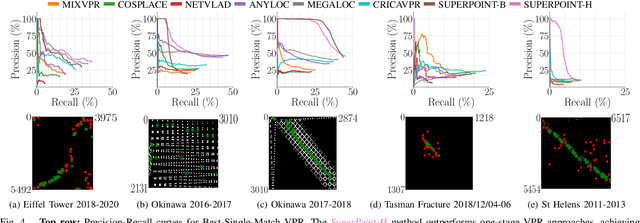
Effective monitoring of underwater ecosystems is crucial for tracking environmental changes, guiding conservation efforts, and ensuring long-term ecosystem health. However, automating underwater ecosystem management with robotic platforms remains challenging due to the complexities of underwater imagery, which pose significant difficulties for traditional visual localization methods. We propose an integrated pipeline that combines Visual Place Recognition (VPR), feature matching, and image segmentation on video-derived images. This method enables robust identification of revisited areas, estimation of rigid transformations, and downstream analysis of ecosystem changes. Furthermore, we introduce the SQUIDLE+ VPR Benchmark-the first large-scale underwater VPR benchmark designed to leverage an extensive collection of unstructured data from multiple robotic platforms, spanning time intervals from days to years. The dataset encompasses diverse trajectories, arbitrary overlap and diverse seafloor types captured under varying environmental conditions, including differences in depth, lighting, and turbidity. Our code is available at: https://github.com/bev-gorry/underloc