 Add to Chrome
 Add to Firefox
 Add to Edge
Hardware- and Vision-in-the-Loop Validation of Deep Monocular Pose Estimation for Autonomous Maritime UAV Flight
Jun 17, 2026
Autonomous UAV operations on ships require reliable vision-based relative pose estimation, yet at-sea validation is costly, weather-dependent, and risky. This paper presents a hardware-validated vision-in-the-loop framework that enables fully autonomous indoor flight while emulating photorealistic maritime environments. Rendered maritime views are processed onboard by a deep transformer-based monocular pose estimator. Delayed vision measurements are fused with high-rate IMU data using a delayed Kalman filter to provide consistent state estimates for geometric control. The system captures critical embedded effects, including perception latency, asynchronous updates, and computational constraints, that are absent in pure simulation. Autonomous takeoff, trajectory tracking, and landing experiments demonstrate stable closed-loop flight. The results establish a safe and hardware-realistic intermediate stage for developing maritime UAV autonomy prior to shipboard deployment.

Uncertainty Mitigation and Intent Inference: A Dual-Mode Human-Machine Joint Planning System
Mar 08, 2026Effective human-robot collaboration in open-world environments requires joint planning under uncertain conditions. However, existing approaches often treat humans as passive supervisors, preventing autonomous agents from becoming human-like teammates that can actively model teammate behaviors, reason about knowledge gaps, query, and elicit responses through communication to resolve uncertainties. To address these limitations, we propose a unified human-robot joint planning system designed to tackle dual sources of uncertainty: task-relevant knowledge gaps and latent human intent. Our system operates in two complementary modes. First, an uncertainty-mitigation joint planning module enables two-way conversations to resolve semantic ambiguity and object uncertainty. It utilizes an LLM-assisted active elicitation mechanism and a hypothesis-augmented A^* search, subsequently computing an optimal querying policy via dynamic programming to minimize interaction and verification costs. Second, a real-time intent-aware collaboration module maintains a probabilistic belief over the human's latent task intent via spatial and directional cues, enabling dynamic, coordination-aware task selection for agents without explicit communication. We validate the proposed system in both Gazebo simulations and real-world UAV deployments integrated with a Vision-Language Model (VLM)-based 3D semantic perception pipeline. Experimental results demonstrate that the system significantly cuts the interaction cost by 51.9% in uncertainty-mitigation planning and reduces the task execution time by 25.4% in intent-aware cooperation compared to the baselines.
Reasoning Knowledge-Gap in Drone Planning via LLM-based Active Elicitation
Mar 08, 2026Human-AI joint planning in Unmanned Aerial Vehicles (UAVs) typically relies on control handover when facing environmental uncertainties, which is often inefficient and cognitively demanding for non-expert operators. To address this, we propose a novel framework that shifts the collaboration paradigm from control takeover to active information elicitation. We introduce the Minimal Information Neuro-Symbolic Tree (MINT), a reasoning mechanism that explicitly structures knowledge gaps regarding obstacles and goals into a queryable format. By leveraging large language models, our system formulates optimal binary queries to resolve specific ambiguities with minimal human interaction. We demonstrate the efficacy of this approach through a comprehensive workflow integrating a vision-language model for perception, voice interfaces, and a low-level UAV control module in both high-fidelity NVIDIA Isaac simulations and real-world deployments. Experimental results show that our method achieves a significant improvement in the success rate for complex search-and-rescue tasks while significantly reducing the frequency of human interaction compared to exhaustive querying baselines.
Equivariant Reinforcement Learning Frameworks for Quadrotor Low-Level Control
Feb 27, 2025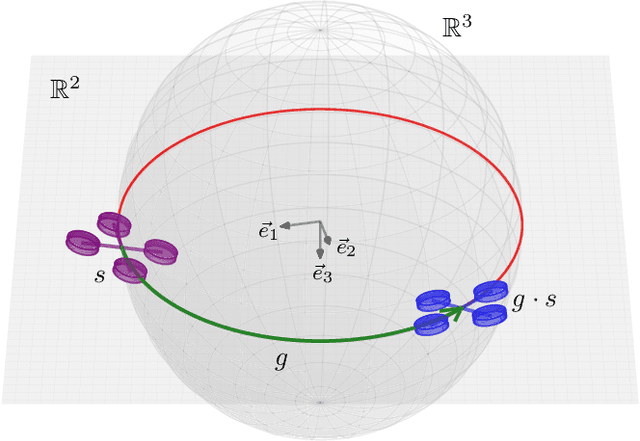
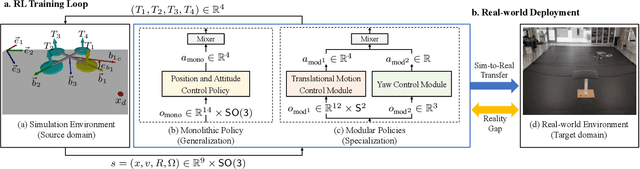
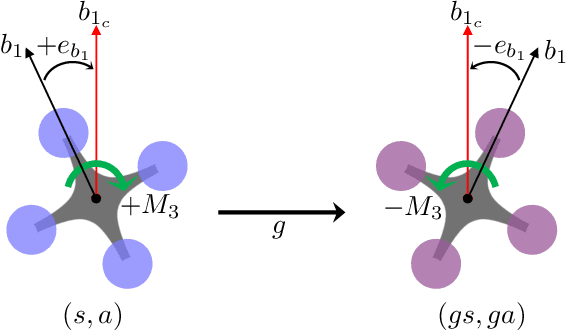
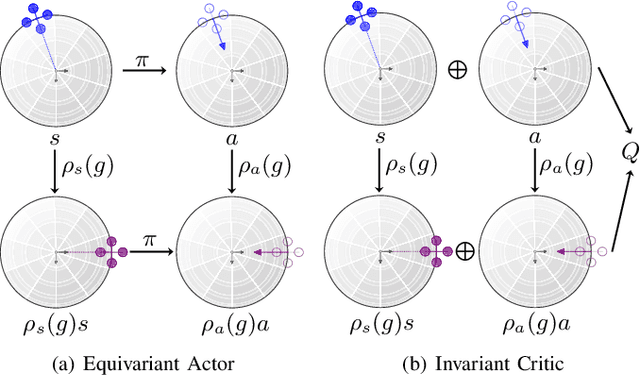
Improving sampling efficiency and generalization capability is critical for the successful data-driven control of quadrotor unmanned aerial vehicles (UAVs) that are inherently unstable. While various reinforcement learning (RL) approaches have been applied to autonomous quadrotor flight, they often require extensive training data, posing multiple challenges and safety risks in practice. To address these issues, we propose data-efficient, equivariant monolithic and modular RL frameworks for quadrotor low-level control. Specifically, by identifying the rotational and reflectional symmetries in quadrotor dynamics and encoding these symmetries into equivariant network models, we remove redundancies of learning in the state-action space. This approach enables the optimal control action learned in one configuration to automatically generalize into other configurations via symmetry, thereby enhancing data efficiency. Experimental results demonstrate that our equivariant approaches significantly outperform their non-equivariant counterparts in terms of learning efficiency and flight performance.
Vision-in-the-loop Simulation for Deep Monocular Pose Estimation of UAV in Ocean Environment
Feb 08, 2025This paper proposes a vision-in-the-loop simulation environment for deep monocular pose estimation of a UAV operating in an ocean environment. Recently, a deep neural network with a transformer architecture has been successfully trained to estimate the pose of a UAV relative to the flight deck of a research vessel, overcoming several limitations of GPS-based approaches. However, validating the deep pose estimation scheme in an actual ocean environment poses significant challenges due to the limited availability of research vessels and the associated operational costs. To address these issues, we present a photo-realistic 3D virtual environment leveraging recent advancements in Gaussian splatting, a novel technique that represents 3D scenes by modeling image pixels as Gaussian distributions in 3D space, creating a lightweight and high-quality visual model from multiple viewpoints. This approach enables the creation of a virtual environment integrating multiple real-world images collected in situ. The resulting simulation enables the indoor testing of flight maneuvers while verifying all aspects of flight software, hardware, and the deep monocular pose estimation scheme. This approach provides a cost-effective solution for testing and validating the autonomous flight of shipboard UAVs, specifically focusing on vision-based control and estimation algorithms.
Multi-Agent Reinforcement Learning for the Low-Level Control of a Quadrotor UAV
Nov 10, 2023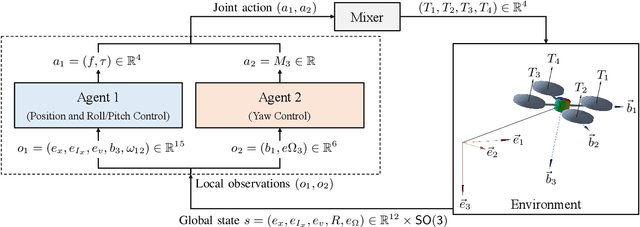
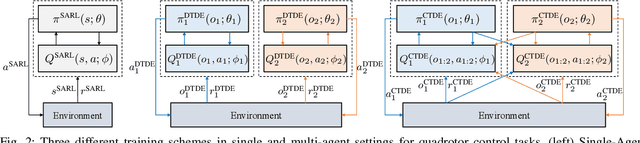
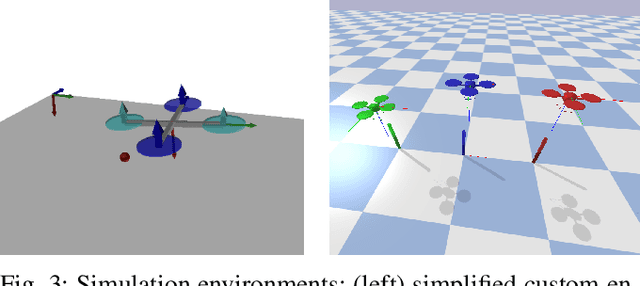
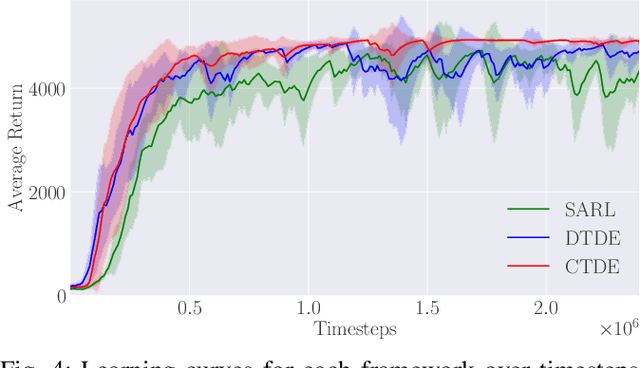
This paper presents multi-agent reinforcement learning frameworks for the low-level control of a quadrotor UAV. While single-agent reinforcement learning has been successfully applied to quadrotors, training a single monolithic network is often data-intensive and time-consuming. To address this, we decompose the quadrotor dynamics into the translational dynamics and the yawing dynamics, and assign a reinforcement learning agent to each part for efficient training and performance improvements. The proposed multi-agent framework for quadrotor low-level control that leverages the underlying structures of the quadrotor dynamics is a unique contribution. Further, we introduce regularization terms to mitigate steady-state errors and to avoid aggressive control inputs. Through benchmark studies with sim-to-sim transfer, it is illustrated that the proposed multi-agent reinforcement learning substantially improves the convergence rate of the training and the stability of the controlled dynamics.
Equivariant Reinforcement Learning for Quadrotor UAV
Jun 02, 2022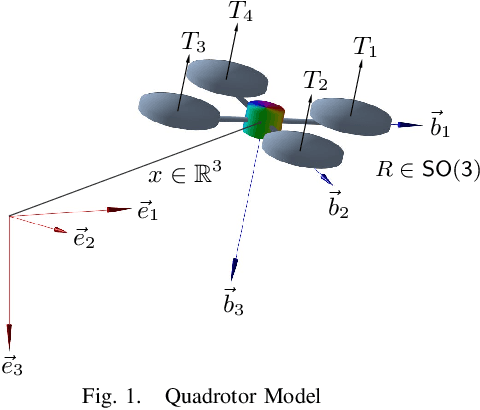
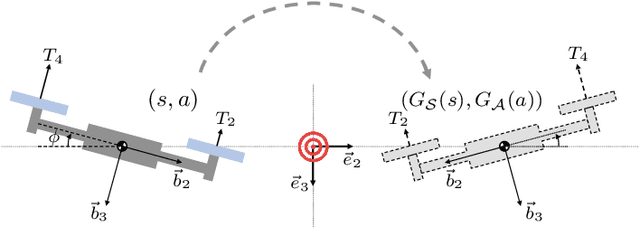
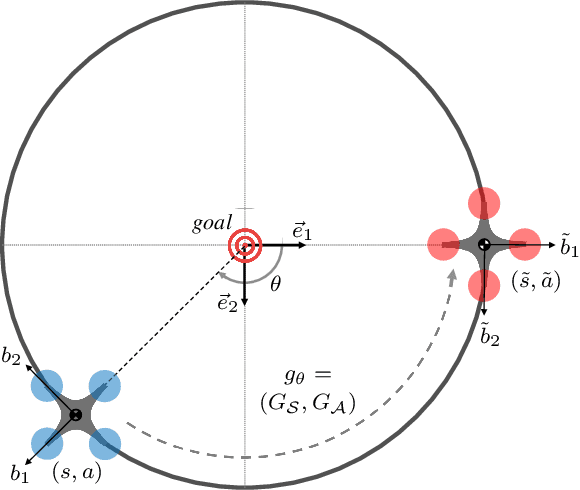
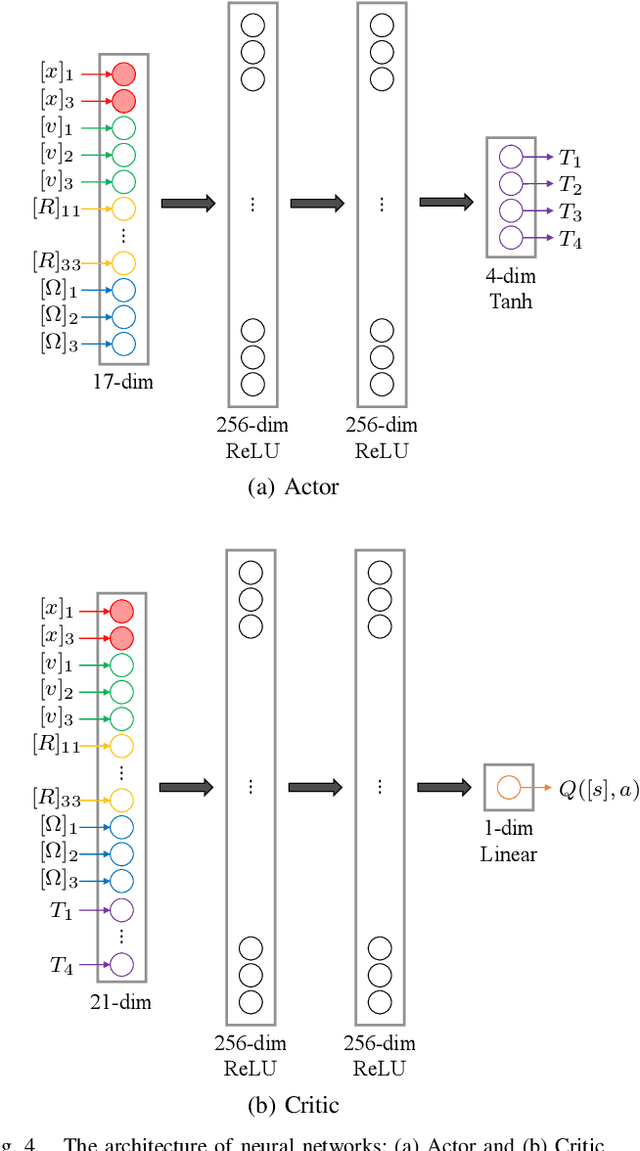
This paper presents an equivariant reinforcement learning framework for quadrotor unmanned aerial vehicles. Successful training of reinforcement learning often requires numerous interactions with the environments, which hinders its applicability especially when the available computational resources are limited, or when there is no reliable simulation model. We identified an equivariance property of the quadrotor dynamics such that the dimension of the state required in the training is reduced by one, thereby improving the sampling efficiency of reinforcement learning substantially. This is illustrated by numerical examples with popular reinforcement learning techniques of TD3 and SAC.