 Add to Chrome
 Add to Firefox
 Add to Edge
StereoMV2D: A Sparse Temporal Stereo-Enhanced Framework for Robust Multi-View 3D Object Detection
Dec 19, 2025
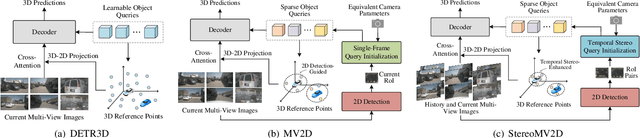
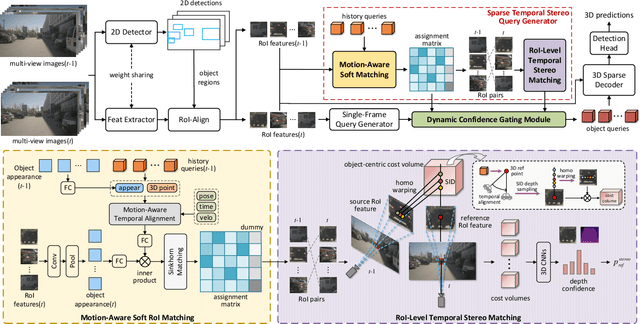
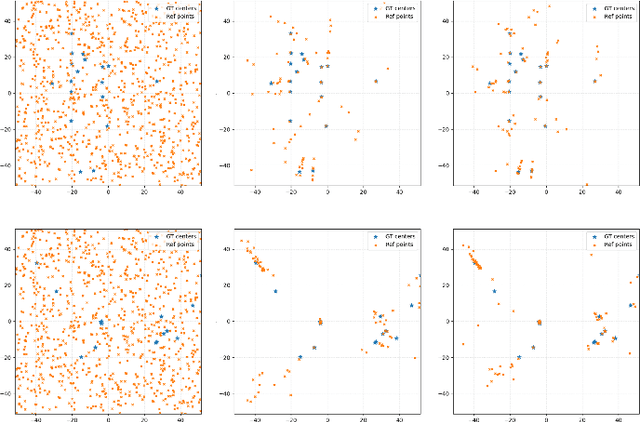
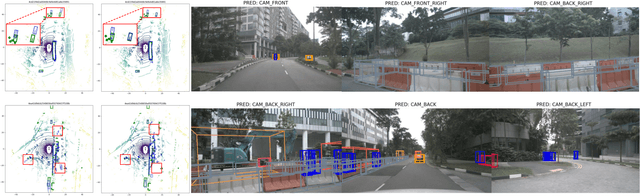
Multi-view 3D object detection is a fundamental task in autonomous driving perception, where achieving a balance between detection accuracy and computational efficiency remains crucial. Sparse query-based 3D detectors efficiently aggregate object-relevant features from multi-view images through a set of learnable queries, offering a concise and end-to-end detection paradigm. Building on this foundation, MV2D leverages 2D detection results to provide high-quality object priors for query initialization, enabling higher precision and recall. However, the inherent depth ambiguity in single-frame 2D detections still limits the accuracy of 3D query generation. To address this issue, we propose StereoMV2D, a unified framework that integrates temporal stereo modeling into the 2D detection-guided multi-view 3D detector. By exploiting cross-temporal disparities of the same object across adjacent frames, StereoMV2D enhances depth perception and refines the query priors, while performing all computations efficiently within 2D regions of interest (RoIs). Furthermore, a dynamic confidence gating mechanism adaptively evaluates the reliability of temporal stereo cues through learning statistical patterns derived from the inter-frame matching matrix together with appearance consistency, ensuring robust detection under object appearance and occlusion. Extensive experiments on the nuScenes and Argoverse 2 datasets demonstrate that StereoMV2D achieves superior detection performance without incurring significant computational overhead. Code will be available at https://github.com/Uddd821/StereoMV2D.

HV-BEV: Decoupling Horizontal and Vertical Feature Sampling for Multi-View 3D Object Detection
Dec 25, 2024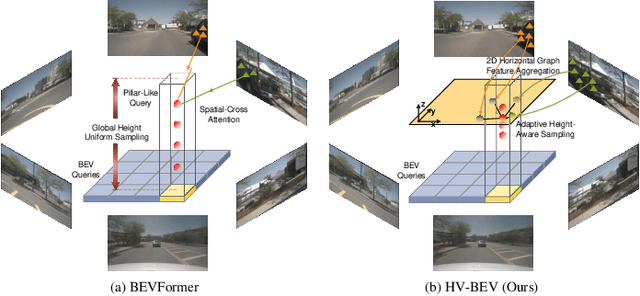
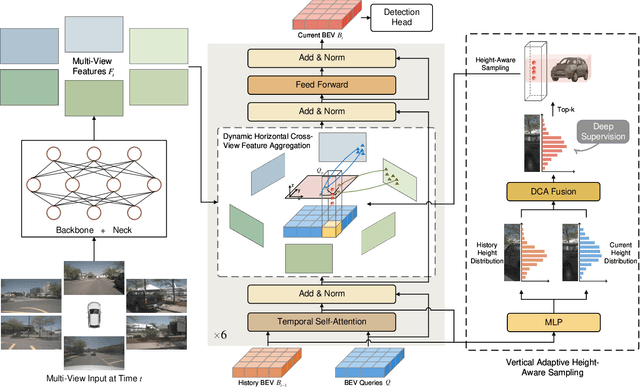
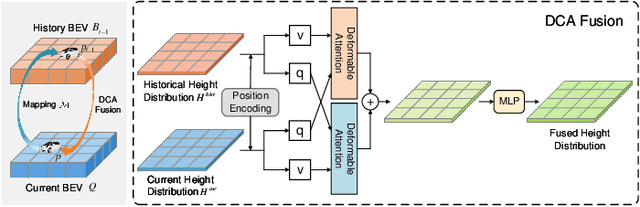
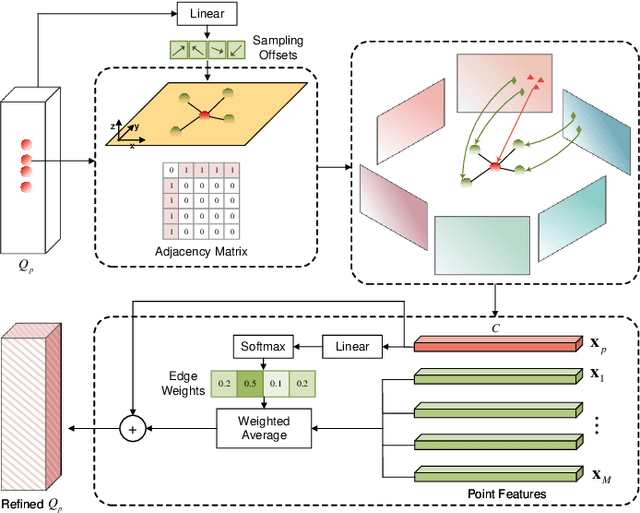
The application of vision-based multi-view environmental perception system has been increasingly recognized in autonomous driving technology, especially the BEV-based models. Current state-of-the-art solutions primarily encode image features from each camera view into the BEV space through explicit or implicit depth prediction. However, these methods often focus on improving the accuracy of projecting 2D features into corresponding depth regions, while overlooking the highly structured information of real-world objects and the varying height distributions of objects across different scenes. In this work, we propose HV-BEV, a novel approach that decouples feature sampling in the BEV grid queries paradigm into horizontal feature aggregation and vertical adaptive height-aware reference point sampling, aiming to improve both the aggregation of objects' complete information and generalization to diverse road environments. Specifically, we construct a learnable graph structure in the horizontal plane aligned with the ground for 3D reference points, reinforcing the association of the same instance across different BEV grids, especially when the instance spans multiple image views around the vehicle. Additionally, instead of relying on uniform sampling within a fixed height range, we introduce a height-aware module that incorporates historical information, enabling the reference points to adaptively focus on the varying heights at which objects appear in different scenes. Extensive experiments validate the effectiveness of our proposed method, demonstrating its superior performance over the baseline across the nuScenes dataset. Moreover, our best-performing model achieves a remarkable 50.5% mAP and 59.8% NDS on the nuScenes testing set.