 Add to Chrome
 Add to Firefox
 Add to Edge
Machine Learning on Heterogeneous, Edge, and Quantum Hardware for Particle Physics (ML-HEQUPP)
Feb 24, 2026
The next generation of particle physics experiments will face a new era of challenges in data acquisition, due to unprecedented data rates and volumes along with extreme environments and operational constraints. Harnessing this data for scientific discovery demands real-time inference and decision-making, intelligent data reduction, and efficient processing architectures beyond current capabilities. Crucial to the success of this experimental paradigm are several emerging technologies, such as artificial intelligence and machine learning (AI/ML) and silicon microelectronics, and the advent of quantum algorithms and processing. Their intersection includes areas of research such as low-power and low-latency devices for edge computing, heterogeneous accelerator systems, reconfigurable hardware, novel codesign and synthesis strategies, readout for cryogenic or high-radiation environments, and analog computing. This white paper presents a community-driven vision to identify and prioritize research and development opportunities in hardware-based ML systems and corresponding physics applications, contributing towards a successful transition to the new data frontier of fundamental science.

On-Sensor Data Filtering using Neuromorphic Computing for High Energy Physics Experiments
Jul 20, 2023


This work describes the investigation of neuromorphic computing-based spiking neural network (SNN) models used to filter data from sensor electronics in high energy physics experiments conducted at the High Luminosity Large Hadron Collider. We present our approach for developing a compact neuromorphic model that filters out the sensor data based on the particle's transverse momentum with the goal of reducing the amount of data being sent to the downstream electronics. The incoming charge waveforms are converted to streams of binary-valued events, which are then processed by the SNN. We present our insights on the various system design choices - from data encoding to optimal hyperparameters of the training algorithm - for an accurate and compact SNN optimized for hardware deployment. Our results show that an SNN trained with an evolutionary algorithm and an optimized set of hyperparameters obtains a signal efficiency of about 91% with nearly half as many parameters as a deep neural network.
Memory-Immersed Collaborative Digitization for Area-Efficient Compute-in-Memory Deep Learning
Jul 07, 2023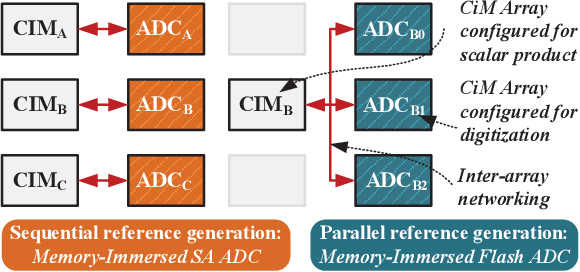
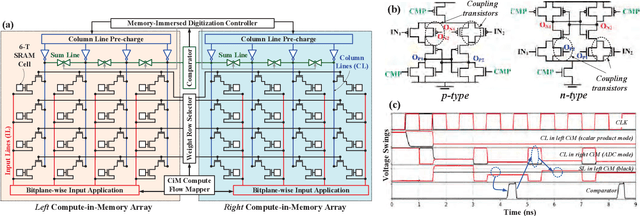
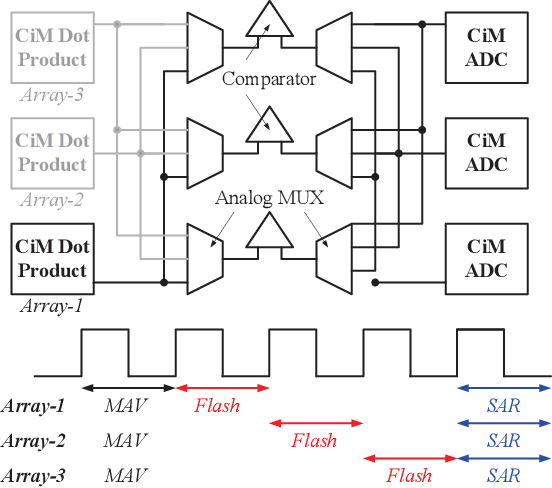
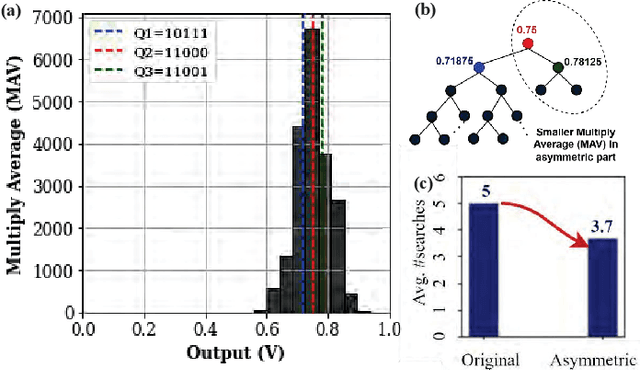
This work discusses memory-immersed collaborative digitization among compute-in-memory (CiM) arrays to minimize the area overheads of a conventional analog-to-digital converter (ADC) for deep learning inference. Thereby, using the proposed scheme, significantly more CiM arrays can be accommodated within limited footprint designs to improve parallelism and minimize external memory accesses. Under the digitization scheme, CiM arrays exploit their parasitic bit lines to form a within-memory capacitive digital-to-analog converter (DAC) that facilitates area-efficient successive approximation (SA) digitization. CiM arrays collaborate where a proximal array digitizes the analog-domain product-sums when an array computes the scalar product of input and weights. We discuss various networking configurations among CiM arrays where Flash, SA, and their hybrid digitization steps can be efficiently implemented using the proposed memory-immersed scheme. The results are demonstrated using a 65 nm CMOS test chip. Compared to a 40 nm-node 5-bit SAR ADC, our 65 nm design requires $\sim$25$\times$ less area and $\sim$1.4$\times$ less energy by leveraging in-memory computing structures. Compared to a 40 nm-node 5-bit Flash ADC, our design requires $\sim$51$\times$ less area and $\sim$13$\times$ less energy.