 Add to Chrome
 Add to Firefox
 Add to Edge
How is remifentanil dosed without dedicated indicator?
Dec 22, 2025
This study investigates the paradigm of intraoperative analgesic dosage using a data-driven approach based on retrospective clinical data. Remifentanil, an analgesic widely used during anesthesia, presents a dosing challenge due to the absence of an universally accepted indicator of analgesia. To examine how changes in patient state correlate with adjustments in remifentanil target concentration triggered by the practitioner, we analyzed data from two sources: VitalDB (Seoul, Korea) and PREDIMED (Grenoble, France). Results show that only features derived from arterial pressure are consistently associated with changes in remifentanil targets. This finding is robust across both datasets despite variations in specific thresholds. In particular, increases in remifentanil targets are associated with high or rising arterial pressure over short periods (1--2 minutes), whereas decreases are linked to low, stable, or declining arterial pressure over longer periods (5--7 minutes). By capturing anesthesiologists' dosing strategies we provide a foundation for the future development of closed-loop control algorithms. Beyond the specific example of remifentanil's change prediction, the proposed feature generation and associated sparse fitting approach can be applied to other domain where human decision can be viewed as sensors interpretation.

AI Agents for Computer Use: A Review of Instruction-based Computer Control, GUI Automation, and Operator Assistants
Jan 27, 2025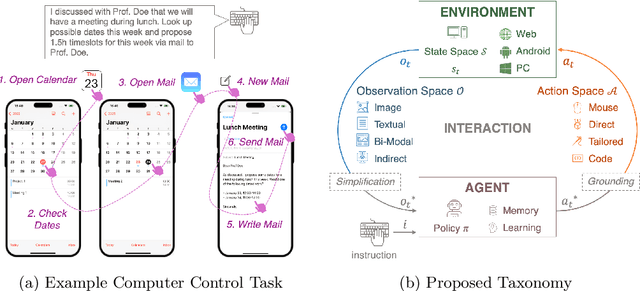
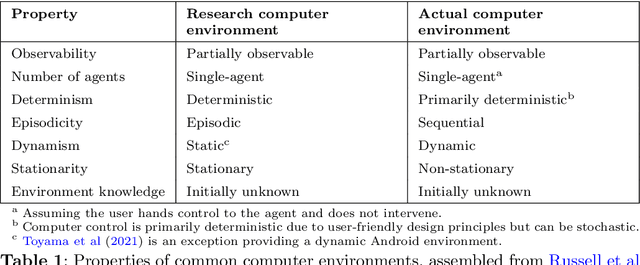
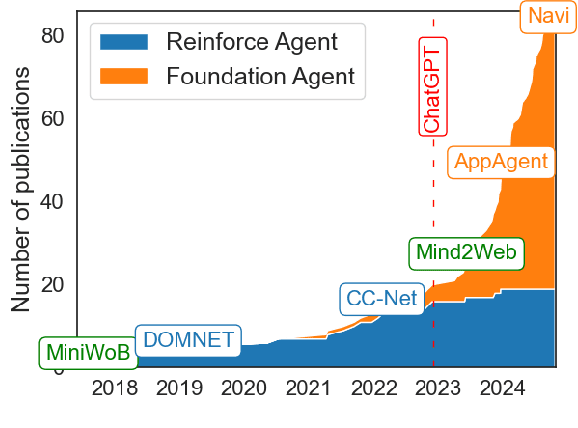
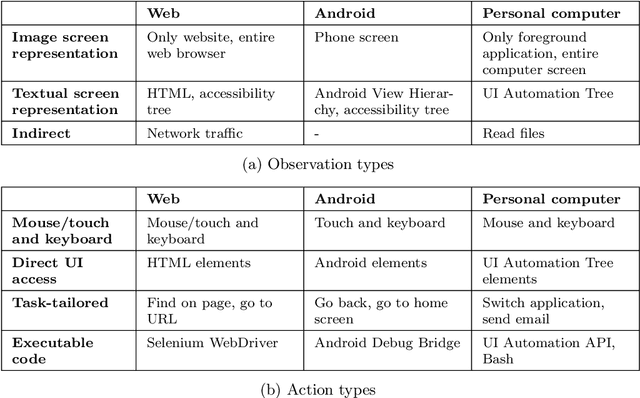
Instruction-based computer control agents (CCAs) execute complex action sequences on personal computers or mobile devices to fulfill tasks using the same graphical user interfaces as a human user would, provided instructions in natural language. This review offers a comprehensive overview of the emerging field of instruction-based computer control, examining available agents -- their taxonomy, development, and respective resources -- and emphasizing the shift from manually designed, specialized agents to leveraging foundation models such as large language models (LLMs) and vision-language models (VLMs). We formalize the problem and establish a taxonomy of the field to analyze agents from three perspectives: (a) the environment perspective, analyzing computer environments; (b) the interaction perspective, describing observations spaces (e.g., screenshots, HTML) and action spaces (e.g., mouse and keyboard actions, executable code); and (c) the agent perspective, focusing on the core principle of how an agent acts and learns to act. Our framework encompasses both specialized and foundation agents, facilitating their comparative analysis and revealing how prior solutions in specialized agents, such as an environment learning step, can guide the development of more capable foundation agents. Additionally, we review current CCA datasets and CCA evaluation methods and outline the challenges to deploying such agents in a productive setting. In total, we review and classify 86 CCAs and 33 related datasets. By highlighting trends, limitations, and future research directions, this work presents a comprehensive foundation to obtain a broad understanding of the field and push its future development.